Dallas does not do anything small.
The city that built AT&T, launched Capital One’s cloud-native banking empire, and witnessed the opening of NYSE Texas in 2025 is now shaping the future of American finance. In 2026, the DFW fintech ecosystem is not just growing. It is transforming.
Dallas fintech startups raised a record $1.6 billion in venture capital in 2025, with fintech accounting for 22% of all startup funding in the metro. That number is climbing in 2026.
However, here is what the funding headlines do not tell you.
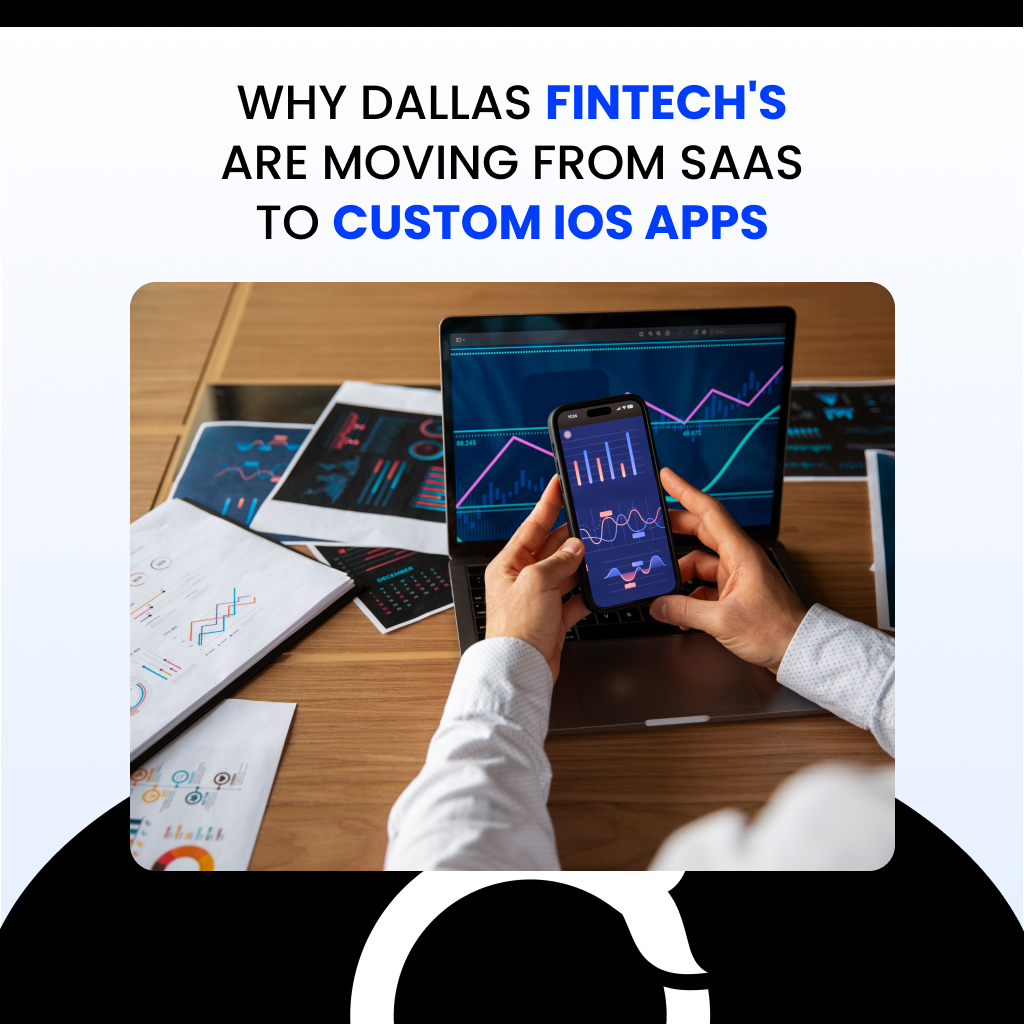
Behind the scenes, the smartest founders in the DFW fintech ecosystem are quietly making one very specific decision. They are walking away from SaaS tools. And they are moving to custom iOS app development in Dallas.
This is not a trendy pivot. It is a survival decision.
In this article, you will learn:
- Why the DFW fintech ecosystem has outgrown SaaS platforms
- The biggest SaaS limitations fintech startups are hitting in 2026
- What a custom iOS app gives you that off-the-shelf tools never will
- How to compare SaaS vs custom app fintech solutions side by side
- When to make the move from SaaS to native iOS, and how to start
The Dallas Fintech Boom Has Created a New Problem
Dallas is one of the most exciting fintech cities in the country right now.
Companies like Bestow, Gig Wage, Yendo, and Nada have all built serious businesses right here in the DFW metro. Nasdaq and NYSE both opened Texas offices. Capital Factory and TechFW are actively funding the next generation of Dallas fintech startups.
The talent is here. The capital is here. The market is here.
However, the tools that helped these companies get started are now holding them back.
How SaaS Became the Default, and Why That Is a Problem
When you are building a fintech MVP, SaaS feels like the obvious choice.
It is fast. It is cheap upfront. You can plug in a payment tool, a compliance dashboard, and a customer analytics platform within weeks.
However, according to a 2025 report by Uptech, SaaS and BaaS dependency is now one of thetop five challenges for fintech startups globally. Heavy reliance on third-party vendors limits your control, flexibility, and long-term growth.
In fact, there are now 7,570 fintech SaaS products globally in 2026. That means your SaaS stack is not a competitive advantage. It is a commodity.
Every one of your competitors is using the same tools.
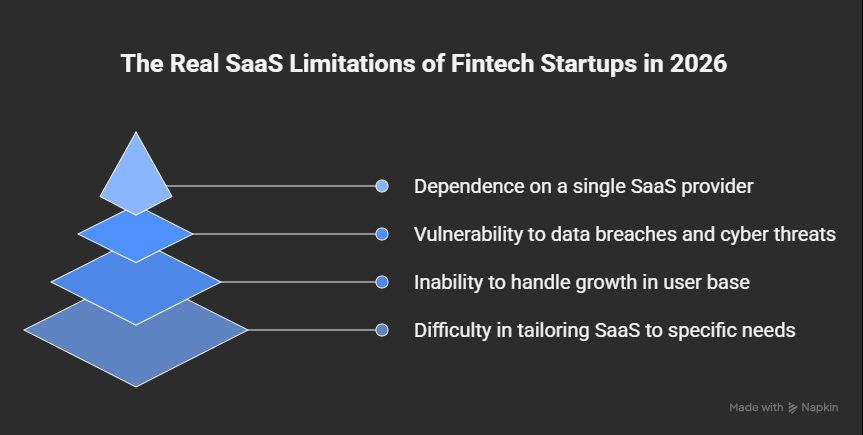
The Real SaaS Limitations Fintech Startups Are Hitting in 2026
Let us be direct about what is actually happening inside Dallas fintech companies right now.
The Customization Wall
Off-the-shelf fintech tools are built for everyone. That means they are optimized for no one.
More than 67% of firms believe off-the-shelf software is not customizable enough for their specific needs. When your product depends on a unique user experience, that 67% is not a statistic. It is your ceiling.
You cannot build a differentiated fintech brand on a platform your five closest competitors are also using.
The Scalability Cliff
SaaS tools work well at 500 users. They start breaking down at 50,000.
Most SaaS fintech platforms are not built to scale with your specific architecture. When you hit rapid growth, you hit rate limits, performance slowdowns, and integration failures.
Moreover, your monthly SaaS bill does not stay flat. A $250/month tool can become $2,000/month when you reach enterprise-level usage, according to software cost analysis from Mobibean.
Consequently, your margins shrink exactly when you need them to grow.
The Security Gap
This one matters most in fintech.
A Verizon Data Breach Report found that 43% of all cyberattacks target small businesses. Fintech startups are especially attractive targets because they handle sensitive financial data.
SaaS platforms give you their security. Not yours.
You are dependent on their SOC 2 reports, their encryption standards, and their patch schedules. If their security practices do not meet your compliance requirements, such as PCI DSS, SOC 2, or GDPR, you have no real option to fix it.
Custom iOS apps, on the other hand, let you build security from the ground up. You control where data lives, how it moves, and who can access it.
The Vendor Lock-In Trap
When you build on a SaaS platform, you are building on someone else’s foundation.
The day that vendor raises prices, changes its API, gets acquired, or shuts down, your entire product is at risk. This is vendor lock-in, and it is one of the most underestimated risks for Dallas fintech startups in 2026.
In contrast, a custom iOS app belongs to you. Your code. Your architecture. Your future.
SaaS vs Custom App Fintech: The Honest Side-by-Side Comparison
Here is a clear look at how these two approaches stack up for a growing fintech company:
| Factor | SaaS Platform | Custom iOS App |
| Upfront Cost | Low | Higher |
| Long-Term Cost | Scales up fast with users | Predictable and flat |
| Customization | Limited to vendor roadmap | Fully yours |
| Security Control | Vendor-dependent | Built to your specs |
| Scalability | Hits ceilings quickly | Built to scale with you |
| Compliance (PCI DSS, SOC 2) | Shared responsibility | Full ownership |
| Competitive Differentiation | Minimal (shared tools) | High (unique product) |
| Vendor Risk | High (lock-in) | None |
The crossover point where custom development becomes cheaper than SaaS typically happens between 18 and 36 months for core business applications, according to Mobibean’s 2026 software cost research.
If you plan to be in business for more than two years, the math already favors custom development.
What Custom iOS App Development Company in Dallas Actually Gives You
In 2026, more businesses are making this move than ever. Mobile app development company in Dallas are using the tools available for iOS development, which have matured, the costs have come down, and the expectations of mobile users have gone up. If you are still renting your digital product, it might be time to start owning it.
A Product Built Around Your Specific User
Custom iOS app development services are designed for one audience: yours.
71% of consumers expect personalized experiences from the companies they use. A generic SaaS interface cannot deliver that. A custom-built fintech mobile app in Dallas, built specifically around your user’s financial behavior, absolutely can.
Security You Actually Control
Choosing a mobile app development company is a bit tough. But it’s easy when you get the full security that you control. With a custom iOS app, your team decides the encryption standards, the authentication flow, and the compliance architecture.
You can implement biometric authentication, multi-factor authentication, KYC verification, and AES-256 encryption from day one. No waiting for your SaaS vendor to roll out a feature. No hoping their compliance covers yours.
This matters especially in the DFW fintech ecosystem, where financial regulations are becoming more rigorous in 2026.
Performance That Does Not Break Under Pressure
Native iOS apps built in Swift and SwiftUI are faster, smoother, and more stable than web-based SaaS tools running inside a browser.
When your users are processing real financial transactions, performance is not a nice-to-have. It is a trust signal.
Slow apps lose users. Crashed apps lose customers forever.
A Competitive Moat That SaaS Can Never Give You
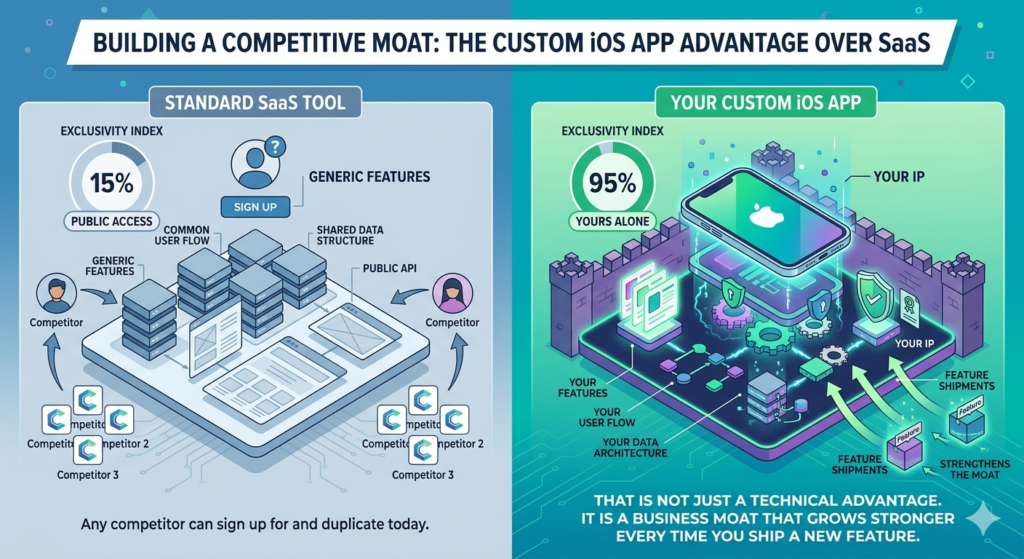
In contrast to a SaaS tool any competitor can sign up for today, a custom iOS app is yours alone.
Your features. Your user flow. Your data architecture. Your IP.
That is not just a technical advantage. It is a business moat that grows stronger every time you ship a new feature.
When Should a Dallas Fintech Startup Make the Move?
Not every company is ready to move from SaaS to native iOS on day one. However, there are clear signals that it is time.
You are ready to move to custom iOS app development in Dallas if:
- Your monthly SaaS bill is growing faster than your revenue
- Customers are complaining about the experience or performance
- You cannot build a feature your users need because the vendor does not support it
- You are hitting compliance requirements your SaaS tools cannot satisfy
- You have raised a funding round and are ready to invest in your own infrastructure
- Your biggest competitors are shipping native apps and you are not
If your SaaS stack is preventing you from moving quickly, that is the clearest signal of all.
How to Choose the Right iOS App Development Company in Dallas
The DFW metro has hundreds of development agencies. Finding the right one takes more than a Google search.
Look for Fintech-Specific Experience
Fintech app development in Dallas requires a team that understands more than Swift and Xcode.
You need developers who know PCI DSS compliance, secure API architecture, KYC flows, and real-time transaction processing. Generic app developers can build you a beautiful app that fails a compliance audit.
Ask for fintech case studies. Not just portfolio pieces. Real examples of apps handling real financial data.
Prioritize Security Credentials
A credible iOS app developer in Dallas working in fintech should be familiar with:
- SOC 2 Type II compliance frameworks
- PCI DSS data security standards
- Biometric authentication implementation
- End-to-end data encryption
If they cannot speak fluently about these topics in your first conversation, keep looking.
Demand Full IP Ownership
This is non-negotiable.
When the project is done, every line of code, every design file, and every API integration should belong to you. Not the agency. Not a third-party vendor. You.
Ask About Post-Launch Support
Shipping the app is not the finish line.
The right iOS app development company in Dallas will offer ongoing maintenance, OS update compatibility, performance monitoring, and feature development after launch. The best products are never finished. They are continuously improved.
The DFW Fintech Ecosystem Is Moving. Are You?
The Dallas fintech story is still being written.
In 2026, the founders winning in this market are the ones making deliberate infrastructure decisions. They are not just raising money and plugging in more SaaS tools. They are building products that belong to them, perform better, and create real competitive moats.
The move from SaaS to custom iOS is not a leap of faith. It is a logical step that follows naturally from what the data already tells us:
- SaaS costs scale against you
- SaaS security is never fully yours
- SaaS customization always hits a wall
- Custom iOS apps compound in value over time
Furthermore, in a fintech market as competitive and well-funded as Dallas, the companies with the best infrastructure will outlast the ones with the best SaaS stack.
To summarize, the question for your fintech company in 2026 is not whether to make the move. The question is whether you move now, while you still have time to build your moat, or later, when your competitors already have theirs.