Houston does not slow down. It is the fourth-largest city in the United States, home to over 2.3 million people, and one of the fastest-growing retail markets in the country. From the bustling streets of Midtown to the packed shopping corridors of The Woodlands, Houston retailers are hungry for growth.
But here is the problem. Most of them are running their online stores on platforms that were never built to scale.
Global e-commerce sales are expected to reach $6.8 trillion by 2028. The retailers who win will not just have good products. They will have fast, scalable, and user-friendly e-commerce web apps built to handle real demand.
If you are a Houston retailer and your online store crashes during a big sale, loads slowly on mobile, or frustrates customers at checkout, you are losing money every single day. This article is written for you.
Here is what you will learn in this article:
- Why Houston retailers need scalable e-commerce web apps right now
- What happens when your platform cannot handle traffic spikes
- What makes a truly scalable e-commerce web app
- Which platforms and technologies actually work
- How to choose the right e-commerce web app development service partner in Houston
The Houston Retail Boom Is Real, And It Is Moving Online
Houston’s retail scene is not just surviving. It is expanding.
A mobile app development company in Houston is moving rapidly in terms of technology. The city added over 40,000 new businesses between 2020 and 2024, according to the Houston Business Journal. More competition means customers have more choices. And those customers are increasingly shopping online first.
More than 60% of all e-commerce traffic now comes from mobile devices. If your Houston online store development does not prioritize mobile-first design, you are already behind your competitors.
The opportunity is massive. However, most retailers are leaving it on the table.
The Real Problem: Platforms That Cannot Keep Up
Here is a scenario you may recognize.
You run a flash sale. You promote it on Instagram and email. Hundreds of customers click simultaneously. And then your site crashes.
Orders are lost. Customers are frustrated. Your brand takes a hit.
This is not a rare situation. A 2023 Akamai study found that a 100-millisecond delay in page load time can reduce conversion rates by7%. For a store doing $50,000 a month, that is $3,500 in lost revenue from a single-second delay.
Why Do So Many E-Commerce Sites Break Under Pressure?
The answer is almost always the same.
They were built on rigid, template-based platforms that were never designed for scalability. They rely on shared hosting. They have no content delivery network. Their checkout is bloated with unnecessary code.
In short, they were built to launch, not to grow.
This is the core difference between a basic e-commerce website and a scalable e-commerce web app.
What Makes a Scalable E-commerce Web App Different
A scalable e-commerce platform is not just a website with more pages.
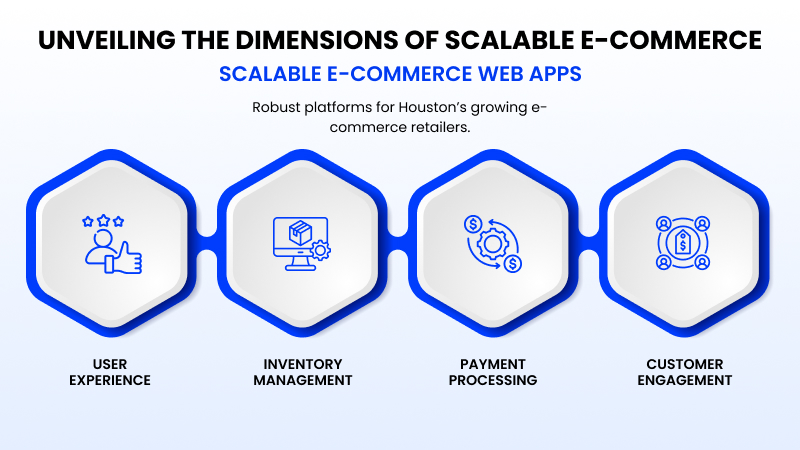
It is a full web app built with an architecture that grows with your business. Here is what separates scalable e-commerce web apps from basic online stores:
| Feature | Basic E-commerce Site | Scalable E-commerce Web App |
| Traffic handling | Crashes under spikes | Auto-scales with demand |
| Mobile experience | Responsive design | Mobile-first PWA |
| Speed | 3-5 second load times | Under 2 seconds |
| Checkout | Generic templates | Custom, optimized flow |
| Integration | Limited APIs | Full third-party integration |
| Architecture | Monolithic | Microservices or headless |
Headless Commerce Development
Headless commerce separates your frontend (what users see) from your backend (where data lives).
This means your Houston TX, ecommerce platform can deliver blazing-fast experiences on any device, without being limited by a template. Brands like Nike and Walmart use headless architecture for this exact reason.
Progressive Web App (PWA) E-commerce
A progressive web app works like a mobile app but loads directly in a browser. No download needed.
E-commerce PWA development is one of the fastest-growing approaches in retail tech because it delivers app-like speed and offline functionality. PWAs load up to 4x faster than traditional mobile sites, according to Google.
For Houston small business ecommerce, this is a game-changer. You get app performance without the cost of building a separate mobile app.
Microservices Architecture
Instead of one giant codebase, a microservices-based ecommerce web application development breaks your platform into smaller, independent services.
This means:
- One service handles payments
- One handles inventory
- One handles user accounts
If one part breaks, the rest keeps working. Furthermore, each service can scale independently during traffic spikes.
Which E-commerce Platform Is Right for You?
Not every Houston retailer needs a fully custom build. However, choosing the right foundation matters.
Here is a quick guide:
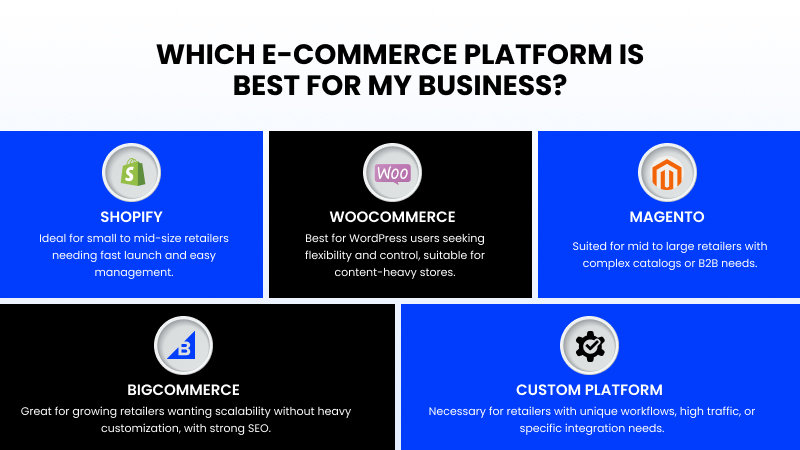
Shopify Development Services: It is best for small to mid-size retailers who want fast launch times and easy management. Shopify Plus handles high-volume stores well.
WooCommerce Development: It is best for retailers already on WordPress who want flexibility and control. Works well for content-heavy stores.
Magento Development Services: It is best for mid to large retailers with complex catalogs, B2B ecommerce development needs, or multi-vendor marketplace development requirements.
BigCommerce Development: It is best for growing retailers who want built-in scalability without heavy customization. Strong SEO tools out of the box.Custom Ecommerce Platform Development: It is best for retailers with unique workflows, very high traffic volumes, or specific integration needs that off-the-shelf platforms cannot meet.
In my opinion, most Houston retailers between $500K and $5M in annual revenue will benefit most from a well-configured Shopify Plus or a custom-built e-commerce web app, depending on how fast they plan to scale.
The Cost of Getting It Wrong: What Poor UX Is Costing You
Let us talk about user experience (UX) because this is where most retailers quietly bleed money.
70%of online shoppers abandon their cart because of a poor checkout experience, according to the Baymard Institute. That is not a marketing problem. That is a product problem.
If your e-commerce website design in Houston is not built around the customer journey, like every button, every page, every checkout step, you are paying for traffic that never converts.
What Good UX Actually Looks Like
Good UX in an e-commerce web app is not about beautiful design alone. It is about removing friction.
- Fast product search with filters
- One-page or two-step checkout
- Mobile-optimized product images
- Clear shipping timelines
- Easy returns process
- Guest checkout option
These are not nice-to-haves. They are conversion drivers.
How to Choose the Right E-commerce Web App Development Partner in Houston
Not all web development companies in Houston are built the same. Their web development services may differ from each other.
Here is what to look for when hiring a Houston e-commerce development company:
1. Proven E-commerce Experience: Ask for case studies. Look for results — not just pretty screenshots. Specifically, look for examples of handling traffic spikes, improving load speed, or increasing conversion rates.
2. Full-Stack Technical Capability: Your partner should handle frontend, backend, API integrations, and cloud infrastructure. Avoid agencies that outsource core development.
3. Mobile-First Thinking Any e-commerce solutions for Houston businesses in 2026 must be mobile-first by default. Ask how they approach mobile performance before anything else.
4. Local Market Understanding A Houston retail technology solutions partner who understands the local market, its demographics, its seasons, and its competition will build a better product than one who doesn’t.
5. Post-Launch Support Scaling is not a one-time event. You need a partner who will stay with you through traffic spikes, platform updates, and feature rollouts.
The Retailers Who Win Will Build to Scale
Here is the truth about e-commerce in Houston right now.
The market is growing. The competition is growing faster. And the customers have zero patience for slow, broken, or frustrating online experiences.
The retailers who invest in scalable e-commerce web apps today will own the market tomorrow. The ones who patch together cheap solutions will keep losing customers to brands with better digital experiences.
Indeed, this is not about technology for technology’s sake. It is about building a business that can actually handle success, without breaking when it arrives.
Whether you are a single-location boutique in Montrose or a multi-location chain shipping across Texas, the time to build your e-commerce web app the right way is now.
Your customers are online. Your competitors are online. Your growth depends on what you build next.
Conclusion
To summarize what we have covered:
- Houston’s retail market is booming and moving online fast
- Most e-commerce sites are not built to handle real traffic or real growth
- Scalable e-commerce web apps use headless architecture, PWA technology, and microservices
- Platform choice matters. Shopify, WooCommerce, Magento, BigCommerce, and custom builds each serve different needs.
- UX is not optional, poor checkout and slow speed cost you real money every day
- Choosing the right Houston e-commerce development company is the most important decision you will make
You have everything you need to make a smarter decision.