Mobile apps have become a core growth engine for modern businesses, powering services, customer engagement, and digital revenue.
In fact, the global mobile app market was valued at around above $235 billion in 2025 and is projected to grow rapidly in the coming years, showing how central apps have become to the digital economy.
Yet one question still comes up before any project begins: how much does mobile app development cost in 2026? The answer varies widely depending on app complexity, features, integrations, and development approach.
In this guide, we break down the real cost of mobile app development in 2026, key pricing factors, ways to choose a reliable mobile app development company, and practical insights to help you plan your budget wisely.
Key Factors That Influence Mobile App Development Costs
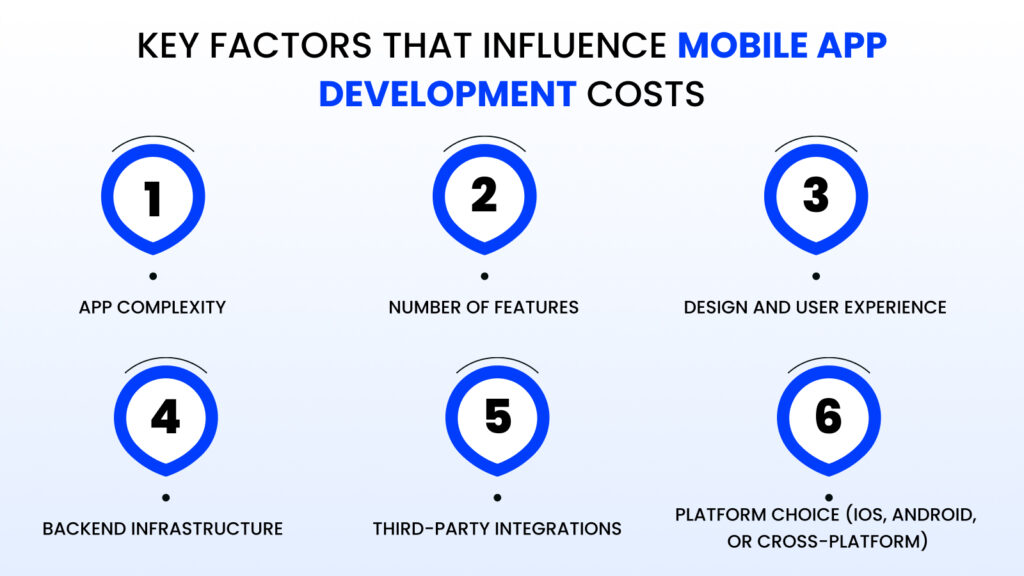
When I estimate the cost of a mobile app, I don’t start with a random number. I look at a few critical variables that shape the entire development scope.
In my experience, the final price of an app is rarely determined by a single factor. Instead, it’s the combination of complexity, features, architecture, and platform choices that drives the cost.
Below are the six factors that consistently influence mobile app development budgets.
1. App Complexity
The first thing I assess is the overall complexity of the app. A simple app with static content, basic login, and minimal backend logic costs far less than a platform that handles real-time data, AI features, or large user traffic.
For example, a basic informational app may take 300–500 development hours, while a complex platform such as a fintech or ride-sharing app can exceed 2,500–4,000 hours of development time.
This difference alone can push project costs from $20,000 to well over $300,000, depending on the scale.
2. Number of Features
Every feature added to an app increases development time. From my experience, businesses often underestimate how quickly feature lists grow.
Common features like:
- user authentication
- push notifications
- in-app messaging
- payment gateways
- analytics dashboards
Each requires design, development, testing, and security layers.
Industry research from Clutch suggests that over 60% of mobile app budgets increase due to feature expansion during development.
That’s why I always advise prioritizing essential features first and expanding later.
3. Design and User Experience
Design is no longer just about aesthetics. Today, UX directly influences user retention and revenue.
According to Forrester, a well-designed user experience can increase conversion rates by up to 400%. Because of that, companies are investing more in research-driven design.
When I work on app projects, UI/UX typically accounts for 10–20% of the total development cost, especially when it involves:
- custom animations
- advanced interaction flows
- accessibility design
- brand-specific visual systems
The more refined the user experience, the more design and testing hours are required.
4. Backend Infrastructure
Many businesses focus on the app interface but forget that the real engine sits behind it.
The backend handles:
- databases
- APIs
- authentication systems
- cloud infrastructure
- data processing
If the app needs real-time data syncing, large user volumes, or AI-based features, the backend architecture becomes more complex.
In large-scale apps, backend development can account for 30–40% of the total development effort, especially when cloud platforms such as AWS or Google Cloud are involved.
5. Third-Party Integrations
Modern apps rarely operate in isolation. They often connect with external services such as:
- payment processors
- CRM systems
- analytics platforms
- messaging APIs
- location services
Each integration requires configuration, security testing, and maintenance.
For instance, integrating a secure payment gateway like Stripe or PayPal may add $8,000–$25,000 to the development budget depending on compliance requirements.
6. Platform Choice (iOS, Android, or Cross-Platform)
Another major cost driver is the platform strategy.
Developing separate native apps for iOS and Android typically increases costs because each platform requires independent development and testing.
According to GoodFirms, cross-platform frameworks such as Flutter or React Native reduce duplication and can cut development costs by 25–40%.
However, the right choice depends on performance needs, scalability, and product goals.
Cost Impact Overview
| Factor | Cost Impact | Why It Matters |
| App Complexity | Very High | Determines development hours and architecture |
| Number of Features | High | Each feature requires design, development, and testing |
| Design & UX | Medium–High | Advanced UI and interaction design increase development time |
| Backend Infrastructure | High | Supports data, performance, and scalability |
| Third-Party Integrations | Medium | External services require setup, security, and maintenance |
| Platform Choice | High | Native apps cost more than cross-platform solutions |
These factors rarely work in isolation. When I evaluate an app project, I look at how these variables interact. A feature-heavy app with advanced UX, real-time backend systems, and dual-platform support will naturally demand a much larger budget than a focused MVP with limited functionality.
Mobile App Development Cost by App Type
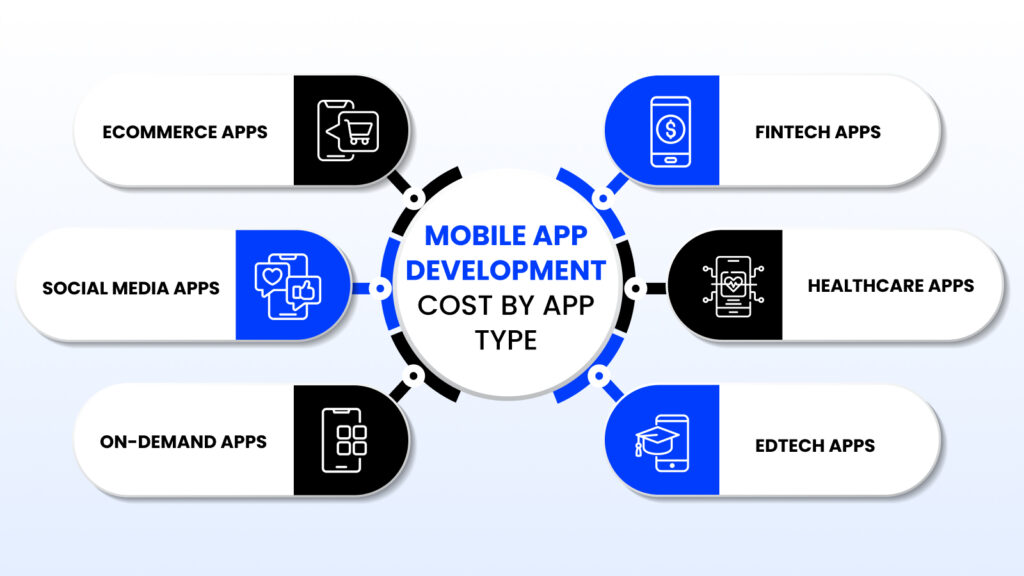
When I calculate app budgets, the type of app is one of the first things I analyze. Different industries have very different requirements in terms of complexity, security, integrations, and compliance.
Here’s a practical breakdown based on real-world projects I’ve worked on and verified industry data.
1. eCommerce Apps
eCommerce apps require product catalogs, payment systems, inventory management, and sometimes loyalty programs. Depending on the size of the catalog and integration needs, costs typically range from $60,000 to $250,000.
Larger platforms with custom features and multi-store support push toward the higher end.
2. Social Media Apps
Social media apps are feature-heavy, requiring real-time chat, notifications, content feeds, and often AI-powered recommendations.
I’ve found these apps generally cost $80,000 to $300,000, with costs rising sharply if video streaming or advanced algorithms are included.
3. On-Demand Apps
Apps like ride-hailing or delivery platforms need GPS tracking, payment integrations, and real-time updates.
They are technically complex and require robust backend systems, typically costing $100,000 to $350,000.
4. Fintech Apps
Fintech apps demand the highest level of security, compliance (like PCI DSS), and often real-time transaction processing.
For a fully compliant, secure app, costs usually fall between $120,000 and $400,000.
5. Healthcare Apps
Healthcare apps require HIPAA compliance, secure patient data handling, and often integrations with medical devices or EHRs.
Development costs usually range from $100,000 to $350,000, depending on feature complexity.
6. EdTech Apps
Education apps can vary from simple learning platforms to interactive gamified apps.
Costs typically start around $70,000 for a basic version and can go up to $250,000 for advanced platforms with AI-driven learning or multi-user collaboration features.
Mobile App Cost by Type in 2026
| App Type | Estimated Cost | Key Cost Drivers |
| eCommerce Apps | $60k – $250k | Product catalog, payments, inventory, multi-store |
| Social Media Apps | $80k – $300k | Real-time chat, content feeds, AI recommendations |
| On-Demand Apps | $100k – $350k | GPS, live updates, payment integration |
| Fintech Apps | $120k – $400k | Security, compliance, transaction processing |
| Healthcare Apps | $100k – $350k | HIPAA compliance, secure data, device/EHR integration |
| EdTech Apps | $70k – $250k | Interactive learning, AI features, collaboration tools |
This table gives a clear picture of what to expect by app type, and it helps businesses budget realistically before diving into development.

Mobile App Development Cost Breakdown by Development Stage
When I plan a mobile app project, I always break down costs by development stage. This approach not only makes budgeting transparent but also helps teams identify where most resources will go.
From my experience, certain stages, especially development and backend work, consume the largest portion of the budget, while others like planning and deployment are smaller but still critical.
Understanding this distribution is key to avoiding unexpected overruns.
1. Product Discovery & Planning
This stage sets the foundation. I work closely with stakeholders to define app goals, user personas, features, and technology choices.
While it might seem minor, skipping thorough planning often leads to scope creep and higher costs later. Typically, planning accounts for 5–10% of the total budget.
2. UI/UX Design
Good design drives usability and retention. I include wireframes, prototypes, interactive designs, and user testing. Depending on complexity, design can take 10–15% of the budget, especially for apps requiring advanced animations or branded experiences.
3. Frontend Development
This is where the app interface comes alive. Frontend developers implement the UI and integrate it with backend APIs. For most apps, frontend development consumes 20–25% of the total cost, varying with platform and interactivity requirements.
4. Backend Development
The backend powers your app, handling data storage, authentication, business logic, and cloud integrations. I’ve seen backend work take 20–30% of the total budget in standard apps, and even more for complex systems like fintech or on-demand platforms.
5. API Integrations
Connecting third-party services, like payments, analytics, messaging, or social logins, requires careful implementation and testing. Integration typically takes 5–10% of the budget, depending on the number of services and complexity.
6. Testing & QA
Quality assurance ensures the app works across devices and meets security standards. I allocate 15–20% of the budget here, because skipping testing leads to costly post-launch fixes.
7. Deployment
Finally, deployment involves app store submissions, server setup, and launch monitoring. Though smaller in scope, it’s essential for a smooth release, typically taking 5–10% of the budget.
Development Stage Cost Distribution in 2026
| Stage | Cost Share | Notes |
| Product Discovery & Planning | 5–10% | Define scope, features, and strategy |
| UI/UX Design | 10–15% | Wireframes, prototypes, visual design |
| Frontend Development | 20–25% | App interface, interactivity, platform-specific code |
| Backend Development | 20–30% | Data, servers, cloud, business logic |
| API Integrations | 5–10% | Payment gateways, analytics, messaging services |
| Testing & QA | 15–20% | Functional, device, security, performance testing |
| Deployment | 5–10% | App stores, servers, launch monitoring |
Breaking costs this way helps me, and clients, see where investments matter most and avoid surprises during development.
It also provides a clear structure for project management and resource allocation.
Mobile App Development Cost by Region in 2026
When I estimate mobile app budgets, geography plays a major role. Development costs vary dramatically depending on where the team is located, their expertise, and local economic factors.
Choosing the right region can reduce costs without compromising quality, but it requires careful evaluation of skills, communication, and time zones.
Regional Developer Rates
Here’s a practical overview of hourly rates I’ve observed across different regions in 2026:
| Region | Hourly Rate | Notes |
| US / Canada | $100 – $200 | Top-tier expertise, strong security/compliance, high costs |
| Western Europe | $80 – $150 | High-quality developers, strong design/UX standards |
| Eastern Europe | $40 – $80 | Skilled developers at mid-range cost, strong in backend/frontend |
| South Asia | $20 – $50 | Cost-efficient, large talent pool, requires careful project management |
| Latin America | $30 – $70 | Good English proficiency, nearshore option for US clients |
Why Companies Outsource Development
Outsourcing is strategic. Companies often outsource to:
- Access specialized expertise: Certain regions have developers skilled in AI, fintech, or blockchain.
- Reduce costs: Lower hourly rates can save 30–60% compared to US/Western Europe teams.
- Scale faster: Outsourcing allows quick expansion without long-term hiring commitments.
- Focus on core business: Teams can focus on product strategy and marketing while development runs offshore.
I’ve managed projects where combining onsite product managers with offshore developers delivered high-quality apps at a fraction of the cost.
Region selection can significantly influence the final budget, but success comes from choosing the right team and communication strategy.
Cost of Key Mobile App Features in 2026
When I work with clients on app budgeting, one of the most common questions is: “How much will each feature cost?” Breaking down costs at the feature level gives clarity, helps prioritize functionality, and prevents surprises during development.
Some features are simple to implement, while others, especially those involving real-time data or AI, can drive the budget up significantly.
Here’s a breakdown based on real-world projects I’ve managed:
1. User Authentication
User login and registration is essential for most apps. Features like email/password, social logins, and multi-factor authentication cost between $3,000 and $10,000, depending on security requirements and complexity.
2. In-App Chat
Messaging systems are a staple for social, on-demand, or community apps. Integrating real-time chat with notifications, emojis, and media sharing typically ranges from $8,000 to $25,000.
3. Payment Integration
Apps handling transactions require secure payment gateways, encryption, and compliance with standards like PCI DSS. Costs vary between $10,000 and $30,000, depending on the number of payment options and region-specific requirements.
4. GPS Tracking
Apps like ride-hailing, delivery, or fitness platforms need location tracking and mapping. Implementation costs are usually $5,000 to $20,000, depending on accuracy, route optimization, and integration with maps APIs.
5. Push Notifications
Sending alerts and updates to users is critical for engagement. Push notification setup, segmentation, and analytics typically costs $3,000 to $8,000.
6. AI Recommendation Engine
Personalization drives engagement in modern apps. AI-based recommendation engines, like product suggestions in eCommerce or content feeds in media apps, can cost $20,000 to $80,000, depending on data complexity, algorithm sophistication, and integration.
Feature-Level Cost Overview
| Feature | Estimated Cost | Key Considerations |
| User Authentication | $3k – $10k | Security, multi-factor login, social login |
| In-App Chat | $8k – $25k | Real-time messaging, media sharing, notifications |
| Payment Integration | $10k – $30k | Security, compliance, multiple gateways |
| GPS Tracking | $5k – $20k | Accuracy, route optimization, maps integration |
| Push Notifications | $3k – $8k | Segmentation, scheduling, analytics |
| AI Recommendation Engine | $20k – $80k | Data complexity, algorithm design, backend support |
By understanding these feature-level costs, I help clients prioritize development, decide what to launch in an MVP, and plan for phased enhancements without overspending.
Hidden Costs Most Businesses Ignore
When I talk to businesses about mobile app budgets, I often see a focus on development costs while ongoing expenses are overlooked. These “hidden costs” can quietly add up, and ignoring them can lead to major surprises after launch. From my experience, planning for these recurring costs upfront is essential for long-term success.
1. App Maintenance
Maintenance ensures the app remains functional, bug-free, and compatible with new OS versions. I typically see annual costs of 15–20% of the initial development budget.
For example, a $100,000 app might require $15,000–$20,000 per year to maintain.
2. Server Infrastructure
Apps with user accounts, real-time data, or media storage require servers and cloud services. Costs vary based on usage, but for mid-sized apps, I usually budget $5,000–$25,000 per year, scaling with traffic and data storage needs.
3. App Store Fees
Publishing apps isn’t free. Both Apple App Store and Google Play charge annual or one-time fees:
- Apple: $99/year
- Google: $25 one-time
If your app uses subscriptions, platforms also take a 15–30% transaction cut, which should be factored into financial planning.
4. Security Updates
Cybersecurity is non-negotiable, especially for fintech, healthcare, or enterprise apps. Regular updates, patching, and audits can cost $3,000–$10,000 per year, depending on app sensitivity.
5. Feature Updates
User expectations evolve, and apps require continuous improvement. Adding new features, improving UX, or integrating APIs can add $10,000–$50,000 annually, depending on complexity and scope.
Hidden Costs: Annual Estimates
| Hidden Cost | Yearly Estimate | Notes |
| App Maintenance | 15–20% of dev cost | Bug fixes, OS updates, minor improvements |
| Server Infrastructure | $5k – $25k | Hosting, cloud services, scaling |
| App Store Fees | $25 – $99 + commission | Store listing, subscription fees |
| Security Updates | $3k – $10k | Patching, audits, compliance |
| Feature Updates | $10k – $50k | Adding new features, UX enhancements |
Factoring these hidden costs early helps me guide clients toward realistic budgets and ensures the app stays competitive, secure, and scalable well beyond launch.
How to Reduce Mobile App Development Costs Without Compromising Quality
Over the years, I’ve worked with dozens of businesses trying to balance cost with quality. The truth is, cutting corners rarely works, like smart budgeting is about making strategic choices rather than skimping on development. Here are the approaches I’ve found most effective for reducing costs while still building a high-quality app.
1. Build an MVP First
Instead of developing a fully-featured app upfront, I recommend starting with a Minimum Viable Product (MVP). This allows you to validate the idea, test with real users, and focus only on the features that drive value.
An MVP can cut initial development costs by 40–50% while minimizing risk.
2. Use Cross-Platform Development
Leveraging frameworks like Flutter or React Native allows a single codebase to run on both iOS and Android. From multiple projects
This approach typically reduces development time and costs by 25–40% without sacrificing performance for standard app features.
3. Prioritize Core Features
I always work with clients to identify must-have vs nice-to-have features. By focusing on core functionality first, you avoid unnecessary development hours and can add additional features incrementally based on user feedback.
4. Use Pre-Built APIs
Instead of building everything from scratch, integrating pre-built APIs for payments, analytics, messaging, or authentication can save significant time.
API integration reduce development effort by 20–30%, and it also ensures reliability since these services are already tested and maintained.
5. Work with Experienced Development Teams
Finally, experience matters. Working with teams who have a proven track record avoids costly mistakes, reduces rework, and accelerates delivery.
I’ve consistently found that skilled developers may have higher hourly rates but save more money overall due to efficiency and quality output.
Why Software Orca Is the Best Fit for Mobile App Development
The right mobile app development partner can make or break an app project. Software Orca stands out for several reasons:
- They deliver apps across eCommerce, Fintech, Healthcare, and EdTech, handling complex backends, AI integrations, and compliance with ease.
- From planning and design to development and maintenance, they cover every stage for a seamless workflow.
- Experts in native (iOS/Android) and cross-platform (Flutter/React Native) apps to balance cost and performance.
- Designs that boost engagement and retention.
- Clear milestones, no hidden costs, predictable budgets.
With Software Orca, businesses get high-quality, scalable apps without surprises.
Wrapping it Up
Mobile app development in 2026 is a significant investment, but with the right planning, feature prioritization, and development partner, it doesn’t have to break the bank.
Understanding costs by app type, features, development stage, and region helps you budget realistically and make informed decisions.
Whether you’re building an MVP or a complex enterprise app, focusing on core functionality, UX, and scalability ensures your app delivers real value while staying on budget.

FAQs
How much does it cost to build an app in 2026?
The cost depends on app complexity, features, platform, and region. A simple app can range from $15,000–$50,000, a medium complexity app from $50,000–$120,000, and complex apps, including enterprise-grade solutions, can exceed $350,000. Choosing the right features and development approach is key to staying within budget.
How long does it take to develop a mobile app?
Development timelines vary with complexity. A basic app can take 2–3 months, a medium-complexity app 4–6 months, and complex apps 6–12+ months. Proper planning, MVP-first approaches, and experienced developers can help reduce delays.
What is the cheapest way to build an app?
The most cost-efficient approach is to start with an MVP, focus on core features, and use cross-platform development frameworks like Flutter or React Native. Leveraging pre-built APIs and experienced offshore developers can also significantly reduce costs without sacrificing quality.
Is cross-platform development cheaper than native?
Yes. Cross-platform apps share a single codebase for iOS and Android, which can reduce development costs by 25–40%. Native apps are more expensive but deliver higher performance and platform-specific features, making them ideal for complex or high-traffic apps.
How much does it cost to maintain an app annually?
Annual maintenance typically costs 15–20% of the initial development budget. This includes bug fixes, OS updates, server costs, security patches, and feature updates. Skipping maintenance can lead to higher long-term costs and poor user experience.