Choose a developer based on technical depth, scalability planning, and real project experience. Shortlist a few options, validate their work, and focus on how they approach architecture and long-term growth.
The right developer is not the cheapest, but the one who can build a product that scales and performs reliably over time.
Dallas has rapidly emerged as a serious tech hub, with hundreds of mobile app development companies competing for business. But here’s where most companies get it wrong: app failure rarely happens during coding. It happens during vendor selection.
In fact, studies show that nearly 70% of app projects fail due to early-stage decisions like misaligned expectations and poor planning .
The cost of getting this wrong is significant. A typical mobile app can range from $40,000 to $400,000+ depending on complexity, and poor developer choices often lead to rework, delays, and long-term scalability issues that inflate that investment even further.
This guide breaks down how to evaluate, compare, and hire the right mobile app developer in Dallas using real technical, architectural, and business criteria, so you don’t just build an app, you build one that actually scales.
What Does a Mobile App Developer in Dallas Actually Do?
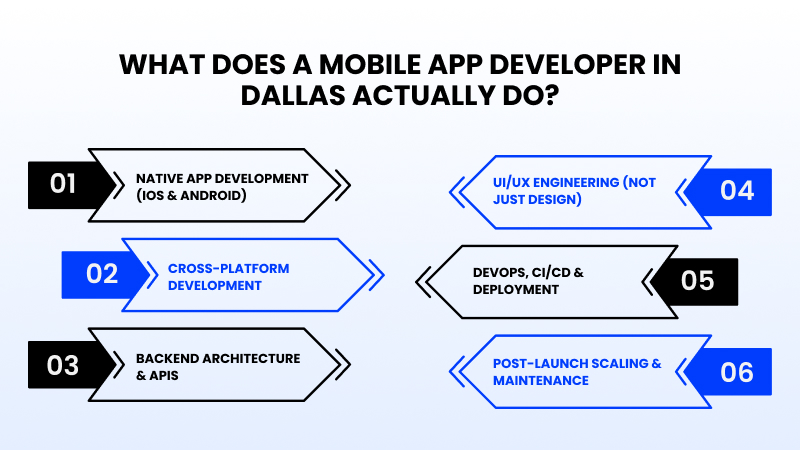
A mobile app developer designs, builds, and scales a complete digital product. The difference between an average app and a high-performing one lies in how well each layer is engineered.
Here’s what competent mobile app developers in Dallas is responsible for:
1. Native App Development (iOS & Android):
Building high-performance apps using Swift (iOS) and Kotlin (Android) to ensure speed, security, and full access to device capabilities
2. Cross-Platform Development:
Using frameworks like Flutter and React Native to deliver a single codebase experience across platforms, like reducing development time by up to 30–40%
3. Backend Architecture & APIs:
Designing scalable systems using Node.js, .NET, Firebase, AWS. This ensures your app can handle user growth, data processing, and integrations without breaking
4. UI/UX Engineering (Not Just Design):
Structuring user journeys, optimizing flows, and reducing friction, because even a 1-second delay in load time can reduce conversions by 7%.
5. DevOps, CI/CD & Deployment:
Automating builds, testing, and releases to ensure faster updates, fewer bugs, and consistent performance across environments
6. Post-Launch Scaling & Maintenance:
Monitoring performance, fixing issues, and optimizing infrastructure, because 80% of app lifecycle costs occur after launch.
Mini Insight
A developer who only focuses on building features will deliver an app that works. A developer who focuses on architecture, scalability, and performance will deliver an app that grows.
Why Dallas Is a Strategic Location for Mobile App Development
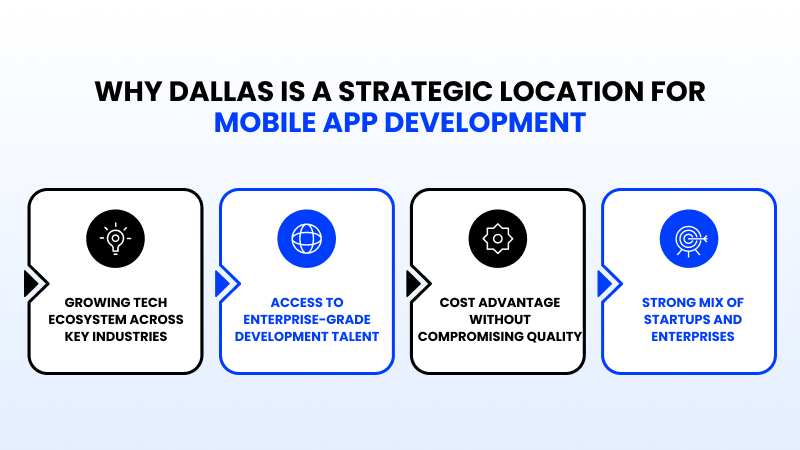
Dallas has quietly positioned itself as one of the most practical cities in the U.S. for building and scaling digital products. It combines enterprise-level talent with cost efficiency. This is a balance that’s hard to find in traditional tech hubs.
Here’s why businesses are actively choosing Dallas for mobile app development:
1. Growing Tech Ecosystem Across Key Industries:
Dallas is home to strong sectors like FinTech, Healthcare, and Logistics, all of which demand complex, scalable applications. The Dallas-Fort Worth metro area ranks among the top U.S. regions for tech job growth and workforce size, with over 300,000 tech workers.
2. Access to Enterprise-Grade Development Talent:
With major companies and startups co-existing, Dallas offers developers experienced in building high-scale, production-ready systems.
3. Cost Advantage Without Compromising Quality:
Hiring developers in Dallas is significantly more cost-effective than in Silicon Valley. On average, tech salaries in Texas are about 10–15% lower than California, while the cost of living is nearly 30% lower. This creates a real cost advantage for businesses.
4. Strong Mix of Startups and Enterprises:
Dallas supports both fast-moving startups and large enterprises, meaning development teams here are used to working on everything from MVP launches to enterprise-grade systems
Decision Insight
Dallas is ideal for companies that want enterprise-grade mobile app development without paying Silicon Valley-level costs. This makes it a strategic choice for both startups and scaling businesses.
7 Critical Factors to Evaluate Before Hiring a Mobile App Developer in Dallas
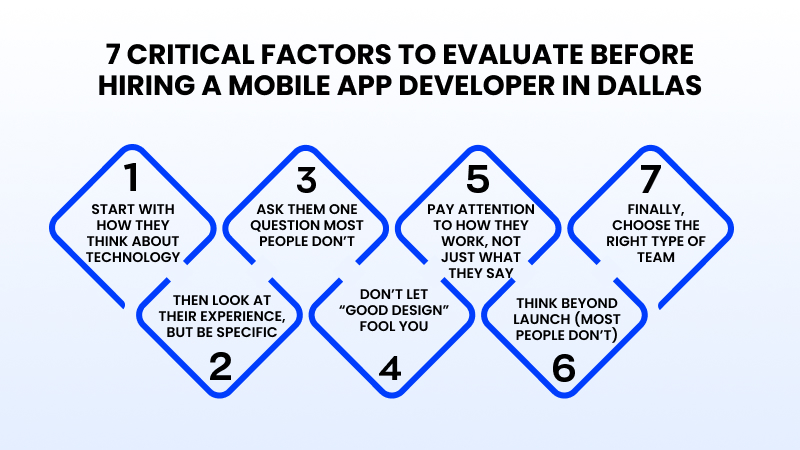
If you’ve never hired a mobile app developer before, it’s easy to focus on the wrong things , like price, portfolio, or how polished their sales pitch sounds.
But, here’s how I’d actually evaluate a developer if I were in your position:
1. Start With How They Think About Technology
Don’t get impressed by terms like “latest tech stack”. Ask them simple questions:
- What language will you use for iOS? Why that one?
- How are you building Android, and why?
- If it’s cross-platform, when does it make sense and when does it not?
Good developers won’t just name tools like Flutter or React Native. They’ll explain when they use them and when they avoid them.
That’s the difference between someone who codes, and someone who makes decisions.
Because poor tech decisions early on? They quietly increase your costs over time. Sometimes by 50–60% due to rework and inefficiencies.
2. Then Look at Their Experience, But Be Specific
A lot of teams will say “we’ve worked with startups” or “we’ve done fintech.”
That’s not enough.
If you’re building in healthcare, ask them how they handled compliance.
If it’s fintech, ask how they secured transactions.
If it’s logistics, ask how they managed real-time data.
You’re not testing their portfolio. You’re testing whether they’ve solved your kind of problems before.
Because if they haven’t, you’re paying for their learning curve.
3. Ask Them One Question Most People Don’t
“What happens when my app grows?”
Not at launch. Not at 1,000 users. At 100,000. At scale.
Watch how they answer.
If they talk about structure, architecture, load handling; good sign.
If they jump back to features; they’re not thinking long-term.
This is where most projects go wrong. Apps don’t usually crash at launch. They break when they start working. And fixing that later? That’s where teams end up spending 40–50% extra effort on rework.
4. Don’t Let “Good Design” Fool You
Nice screens are easy to sell. But what actually matters is:
- Can users move through the app without thinking too much?
- Where do they drop off?
- What’s confusing?
- What’s slowing them down?
A strong team will talk about flows, behavior, and decisions, not just colors and layouts. Because design is about whether people stay or leave. And better UX alone can improve conversion significantly.
5. Pay Attention to How They Work, Not Just What They Say
This part gets ignored way too often.
Ask them:
“How will I see progress?” If the answer is vague. That’s a problem.
You should know:
- What happens each week
- What gets delivered
- How feedback is handled
Good teams don’t disappear for months. They show progress consistently.
6. Think Beyond Launch (Most People Don’t)
Here’s something most businesses realize too late:
The app is not the finish line. It’s the starting point. After launch, you’ll need:
- Updates
- Fixes
- Performance improvements
- Scaling support
And this is actually the bigger one. A large portion of app costs happen after launch. So ask yourself: Will this team still be useful to me 6 months from now?
7. Finally, Choose the Right Type of Team
This is about how you hire.
- Freelancers can work for small tasks, but risky for serious products.
- Agencies bring structure, but often come with higher costs and less flexibility.
- Staff augmentation sits in the middle, giving you skilled developers without losing control.
If you’re planning to grow, flexibility matters more than anything.
What is the Cost of Hiring a Mobile App Developer in Dallas
The honest answer: it depends on who you hire and how you hire them. But there are clear market ranges you can expect in Dallas. Freelancers typically cost $25 – $75/hour, mid-level agencies cost $75 – $150/hour, enterprise agencies cost $150 – $250/hour, and staff augmentation: $40 – $120/hour.
Mobile App Developer Cost in Dallas
| Hiring Model | Hourly Rate (Dallas) | When It Works Best | What to Watch Out For |
| Freelancers | $25 – $75/hour | Small features, quick fixes, early MVPs | Inconsistency, limited ownership |
| Mid-Level Agencies | $75 – $150/hour | Startups building their first scalable product | Process varies by team quality |
| Enterprise Agencies | $150 – $250/hour | Large systems, compliance-heavy applications | High cost, slower execution |
| Staff Augmentation | $40 – $120/hour | Scaling teams, long-term development | Requires internal oversight |
Estimated App Development Cost by Project Type
| Project Type | Estimated Cost Range | What You Get |
| MVP (Basic App) | $25K – $60K | Core features, basic UI, limited scalability |
| Mid-Scale App | $60K – $150K | Custom features, integrations, better UX |
| Enterprise App | $150K – $500K+ | High scalability, complex backend, advanced security |
Quick Cost Reality Check
| Factor | Impact on Cost |
| Complex features (AI, real-time, payments) | ↑ High |
| Strong backend & integrations | ↑ High |
| Scalable architecture | ↑ Medium–High |
| Basic UI vs advanced UX | ↑ Medium |
| Cheap developer choice | ↓ Short-term, ↑ Long-term |
Common Mistakes Businesses Make When Hiring Developers in Dallas
Dallas has become one of the fastest-growing tech hubs in the U.S., which means you have more options than ever when hiring a mobile app developer. That sounds like an advantage. In reality, it makes hiring harder because many vendors look similar on the surface.
From experience, the mistakes businesses make are rarely obvious. They feel like reasonable decisions at the time, until the project starts moving.
1. Choosing Based on Price Only
Price is the easiest thing to compare, so it often becomes the deciding factor.
The issue is that two quotes can look similar on paper but be completely different in depth. One team may include proper planning, testing, and scalable structure. Another may focus only on getting the app built.
Clutch data shows most app projects fall in the $10K to $49K range, which explains why pricing alone does not tell you much about quality
Source:Clutch Pricing Research
What matters more is what sits behind the quote, like team structure, process, and long-term thinking.
2. Ignoring Backend Architecture
Most buyers focus on what they can see. Design, screens, flows. But the real stability of your app comes from how it is built underneath. If backend decisions are weak, you will start noticing it when:
- the app slows down with more users
- integrations become unreliable
- new features take longer to implement
These issues do not show up early. They appear when your product starts growing, which makes them harder and more expensive to fix.
3. Not Validating Real Case Studies
A strong portfolio is expected. It is not proof. You need to understand what the team actually did in those projects. Clutch hosts 350,000+ verified company reviews, which reflects how much modern buyers rely on real validation before choosing a mobile app development company.
When reviewing case studies, go deeper:
- What was their role
- What problems did they solve
- Is the product still live
Good teams explain decisions. Average teams show visuals.
4. Hiring Without Technical Vetting
This is where many non-technical teams struggle. Without some level of technical discussion, hiring decisions are based on how well something is explained, not how well it is built.
Even a short conversation can reveal:
- how the team approaches architecture
- how they handle complexity
- how they think about future changes
If everything sounds simple and perfect, it usually means the depth is missing.
5. No Scalability Planning
Most apps work well in the beginning. The real pressure comes when usage grows, features expand, and the system becomes more complex.
According to CompTIA, U.S. tech employment is expected to reach 9.8 million in 2026, which reflects how quickly digital products and user expectations are growing. If scalability is not planned early, growth creates friction instead of momentum.
How to Vet a Mobile App Developer (Step-by-Step Process)
Once you have a few options, the goal is not to pick the most impressive one. It is to reduce risk before you commit. A simple, structured vetting process saves time, money, and rework later.
Here is how I would approach it:
Step 1: Shortlist 3–5 Vendors
Do not evaluate 10 or 15 companies. You will only create noise. Pick 3 to 5 serious contenders based on:
- relevant experience
- clear communication
- initial understanding of your product
The goal here is focus, not volume.
Step 2: Review Real Case Studies (Not Just Visuals)
Skip design shots and polished presentations.
Look for:
- live apps
- real product functionality
- complexity similar to your idea
Ask simple but direct questions:
- What exactly did you build here?
- What challenges came up?
- What would you improve if you rebuilt it today?
A strong team will go beyond visuals and explain decisions.
Step 3: Conduct a Technical Discussion (Not Just a Sales Call)
Most companies will guide you through a sales conversation. That is expected. You need a second conversation that focuses only on how the product will be built. You are listening for:
- clarity in explanation
- structured thinking
- awareness of trade-offs
If everything sounds too easy or overly simplified, it usually means the depth is missing.
Step 4: Ask for Their Architecture Approach
This is where you separate teams that build for launch from teams that build for growth.
Ask them:
- How will this system scale?
- How do you handle future feature expansion?
- How do you avoid technical debt?
A good developer should be able to explain this without overcomplicating it. If they jump straight to features instead of structure, they are not thinking long-term.
Step 5: Start With a Small Paid Pilot
Before committing to a full project, start small. This could be:
- a discovery phase
- a prototype
- a limited feature build
It allows you to evaluate:
- communication
- delivery speed
- problem-solving ability
According to IBM, even enterprise teams use pilot phases to reduce risk before full rollout. This step gives you real working experience with the team instead of relying only on conversations.
What This Process Does
It does not guarantee the perfect choice. But it filters out:
- weak technical thinking
- surface-level experience
- teams that sound good but cannot execute
And that is usually enough to make a confident decision.
Best Engagement Model for Hiring Mobile App Developers in Dallas
| Engagement Model | Best For | Speed of Hiring | Cost Efficiency | Control Level | Scalability | Key Consideration |
| Fixed Cost | Small, clearly defined projects | Medium | Medium | Low | Low | Limited flexibility once scope is locked |
| Dedicated Team | Long-term product development | Medium | Medium–High | Medium | Medium–High | Higher commitment, works best for ongoing builds |
| Staff Augmentation | Scaling teams quickly, flexible development | High | High | High | High | Requires internal management but offers maximum flexibility |
Final Checklist Before You Hire a Mobile App Developer in Dallas
Before you make the final call, pause for a minute. At this stage, most teams already “look good.” The difference now is not who sounds better. It is who is actually safer to trust with your product.
Use this as a quick sanity check:
1. Proven Portfolio
Do not just look at designs. Open the apps. Use them. If possible, check reviews or how actively they are maintained.
2. Relevant Industry Experience
If they have built something similar to your use case, you save time on:
- understanding workflows
- avoiding common mistakes
- handling compliance or integrations
3. Clear Architecture Strategy
Ask them to explain how your app will be structured. You are looking for:
- how data flows
- how features will expand later
- how the system will handle growth
4. Transparent Process
You should know:
- what happens each week
- how progress is shared
- how feedback is handled
Strong teams show work consistently. They do not disappear and come back with a “final version.”
5. Post-Launch Support
The app is not finished at launch. Ask:
- who handles updates
- how issues are monitored
- how performance is improved over time
6. Scalable Team Model
Your needs will change. Your team should be able to adjust. Whether it is adding developers, speeding up delivery, or supporting growth.
Why Software Orca Is the Best Mobile App Development Company in Dallas
Software Orca stands out because it approaches mobile app development as a long-term product investment, not a short-term build. While many teams focus on delivery speed, Software Orca focuses on decision quality, especially in architecture, scalability, and system design.
What makes them different is how early they think about growth. From the first conversation, the focus is not just on features, but on how the product will handle scale, integrations, and future complexity. That reduces the need for costly rework later.
Their process is structured but transparent. You see progress weekly, understand what is being built, and have clear input at every stage. This reduces uncertainty, which is where most projects fail.
They also stay involved post-launch, supporting optimization and scaling. That continuity matters, because the real cost and complexity of apps begin after release, not before.
Final Words
Choosing a mobile app developer in Dallas is about making sure your product is built on a solid foundation from day one.
The apps that succeed are not always the most complex or the most expensive. They are the ones built with clear architecture, thoughtful execution, and a team that plans beyond launch.
Make your decision based on how well a developer thinks, not just what they promise.
FAQs
1. How much does it cost to hire a mobile app developer in Dallas?
Costs typically range from $25 to $250 per hour, depending on whether you hire freelancers, agencies, or dedicated teams. For full projects, an MVP may cost $25K–$60K, while more complex apps can go beyond $150K. The final cost depends on features, integrations, and how scalable the app needs to be.
2. Should I choose native or cross-platform development?
It depends on your product goals.
- Native (Swift, Kotlin): Better performance, smoother UX, ideal for complex or high-traffic apps
- Cross-platform (Flutter, React Native): Faster development, lower cost, suitable for MVPs and standard apps
If performance and scalability are critical, go native. If speed and budget matter more, cross-platform is often the better starting point.
3. How long does it take to build a mobile app?
A basic app usually takes 2–4 months, while mid-scale apps take 4–8 months. Enterprise-level apps can take 8–12+ months depending on complexity, integrations, and testing requirements.
Timelines are less about coding and more about planning, iterations, and refining the product.
4. What is the best company to hire in Dallas?
There is no single “best” company for everyone. The right choice depends on your project type, budget, and long-term goals.
Look for a team that:
- understands your industry
- explains technical decisions clearly
- plans for scalability from the start
- offers ongoing support after launch
The best developer for you is the one that can build, scale, and support your product over time, not just deliver the first version.