Imagine you have a great business idea. You know it can work. You’ve seen the gap in the market. But then someone tells you, “Building a web app costs $100,000 or more.”
You freeze. Suddenly, the dream feels too expensive, too risky and too far away.
But the truth is that number is both right and wrong at the same time.
71% of businesses that invested in custom web app development saw a positive return within 18 months. Yet, 60% of first-time buyers overpaid simply because they didn’t understand the cost breakdown before signing a contract.
This guide is for you if you want to know exactly what you’re paying for, and why.
You’ll also learn how to avoid the traps that drain budgets, delay launches, and leave businesses with apps that don’t actually work for them.
Here’s what you’ll learn in this article:
- What drives the web app development cost in 2026
- A clear web app development cost breakdown by type and complexity
- How to calculate your real ROI from custom software
- The biggest mistakes that inflate your cost of web app development
- The truth about progressive web app development cost vs. native apps
- How to find the right development partner without overspending
Let’s break it all down.
Why Web App Development Cost Varies So Much
You’ve probably noticed that quotes for web apps range wildly. One agency quotes you $8,000. Another quotes $120,000. Same project description. So what’s going on?
Now here is an important thing you need to know that web apps are different than mobile apps. So their costs differ. The truth is, web app development cost depends on several key factors working together. It’s not one price fits all.
Here are the main drivers:
- App complexity (simple tool vs. full SaaS platform)
- Design requirements (basic UI vs. custom, branded experience)
- Integrations needed (payment gateways, APIs, third-party tools)
- Team location (US-based vs. overseas developers)
- Technology stack (React, Node.js, Python, etc.)
- Security and compliance needs (HIPAA, GDPR, PCI-DSS)
- Number of user roles (admin, manager, end user, guest)
- Data complexity (simple forms vs. real-time analytics dashboards)
In fact, the location of your development team alone can shift your cost by 40-60%, according to data from Upwork’s 2024 Talent Report.
A senior developer in San Francisco bills at $150 to $250 per hour. A equally skilled developer in Eastern Europe or Latin America bills at $40 to $80 per hour. Same quality output but very different invoice.
This is why understanding the full picture before you get quotes protects your budget and your sanity.
Web App Development Cost Breakdown by App Type
Let me give you the real numbers:
| App Type | Estimated Cost | Timeline |
| Simple Web Tool (MVP) | $5,000 to $20,000 | 4 to 8 weeks |
| Business Web App | $20,000 to $60,000 | 3 to 6 months |
| Progressive Web App (PWA) | $15,000 to $50,000 | 2 to 5 months |
| Enterprise Web Application | $60,000 to $300,000+ | 6 to 18 months |
| E-commerce Web App | $25,000 to $100,000 | 4 to 9 months |
| SaaS Platform | $50,000 to $250,000+ | 6 to 12 months |
| Healthcare or Fintech App | $80,000 to $400,000+ | 8 to 18 months |
These numbers assume a mid-level development team based in North America or Eastern Europe.
Regulated industries like healthcare and finance sit at the higher end. That’s because compliance frameworks like HIPAA and PCI-DSS require extra layers of security, documentation, and testing that add time and cost.
What Makes an App “Complex”?
This is a question a lot of business owners get wrong.
Complexity is not just about how many features you have. It’s about how those features interact with each other and with the outside world.
For example:
- A simple booking form is not complex
- A booking form that syncs with Google Calendar, sends automated reminders, processes payments, and generates invoices is complex
The more your app needs to talk to external systems, the more expensive and time-consuming it becomes to build and maintain.
Progressive Web App Development Cost: A Smarter Middle Ground
Progressive web apps (PWAs) are getting a lot of attention right now and for good reason.
A PWA gives you a near-native mobile experience without building separate iOS and Android apps. Companies like Twitter, Starbucks, and Pinterest all shifted to PWAs and saw massive results.
Starbucks reported that their PWA increased daily active users by 2x after launch. Pinterest rebuilt their mobile web experience as a PWA and saw a 60% increase in core engagements.
The progressive web app development cost typically falls between $15,000 and $50,000, depending on features. That’s often 30 to 40% cheaper than building both a web app and a native mobile app separately.
Furthermore, PWAs load faster, work offline, and can be installed directly from a browser without going through an app store.
If your audience uses both desktop and mobile, a PWA might be your smartest investment in 2026.
The Full Web App Development Cost Breakdown
Most people only think about “building the app.” But that’s just one piece.
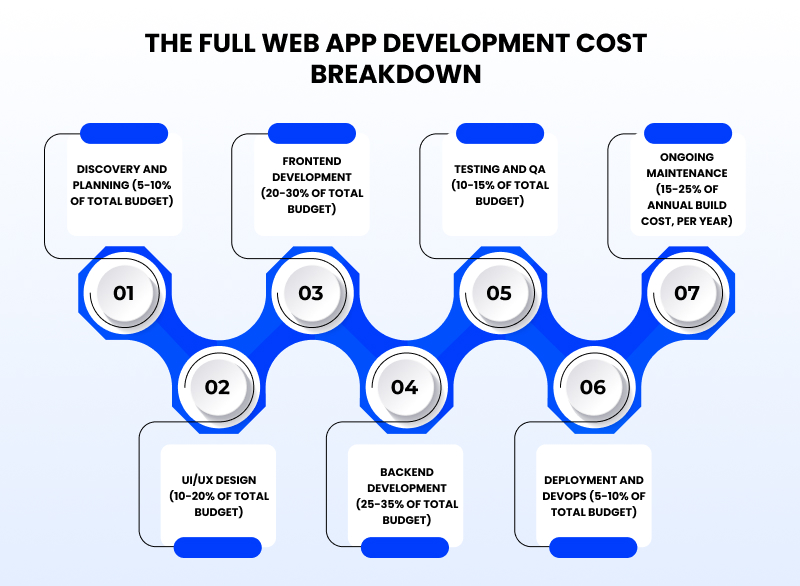
Here’s the full picture of your web app development cost breakdown:
1. Discovery and Planning (5-10% of total budget)
This is where requirements, user stories, wireframes, and architecture are defined.
Skipping this phase is the number one reason projects go over budget. A $3,000 discovery sprint can save you $30,000 in rework later.
2. UI/UX Design (10-20% of total budget)
Good design is not decoration. It’s conversion.
A well-designed app can improve user retention by up to 200%, according to Forrester Research. Poor UX, on the other hand, is the reason 88% of online users say they won’t return to a site after a bad experience, per Google.
3. Frontend Development (20-30% of total budget)
This is everything the user sees and interacts with.
Technologies like React.js, Vue.js, and Next.js dominate this space in 2026. They allow for fast, responsive interfaces that work beautifully across all screen sizes.
4. Backend Development (25-35% of total budget)
This is the brain of your application. Databases, APIs, business logic, and server-side code all live here.
Your backend determines how fast your app runs, how secure your data is, and how well the system scales as you grow.
5. Testing and QA (10-15% of total budget)
Bugs caught early cost 6x less to fix than bugs caught after launch, according to IBM’s Systems Science Institute.
Good QA includes functional testing, performance testing, security testing, and cross-browser compatibility checks.
6. Deployment and DevOps (5-10% of total budget)
Getting your app live on AWS, Google Cloud, or Azure. This also includes setting up CI/CD pipelines, monitoring tools, and auto-scaling configurations.
7. Ongoing Maintenance (15-25% of annual build cost, per year)
Every app needs updates. Security patches. Performance improvements. New feature additions. Bug fixes.
Most businesses forget this line item. Don’t be like those most businesses.
If you build a $50,000 app, budget $7,500 to $12,500 per year for maintenance. It’s not optional. It’s what keeps your app alive and competitive.
The Real ROI Question: Is the Cost of Web App Development Worth It?
Let’s talk money. Not just what you spend but what you get back. Here’s a simple way to think about it:
ROI = (Revenue Gained + Cost Saved) minus Development Cost, divided by Development Cost, multiplied by 100
For example, if your custom web app:
- Saves your team 20 hours per week in manual tasks
- At an average salary of $30 per hour
- That’s $600 per week, or $31,200 saved per year
A $40,000 web app pays for itself in about 15 months. After that, every dollar saved is pure gain.
Now add the revenue side. If your app improves conversion rates by just 2%, and your business does $2 million in annual revenue, that’s $40,000 in new revenue every year from a single improvement.
The numbers speak for themselves.
The mobile web app development cost makes even more sense when you consider that over 60% of web traffic globally now comes from mobile devices. If your experience isn’t built for mobile, you’re already losing revenue every single day.
Industries Seeing the Highest ROI From Custom Web Apps
- Healthcare: Patient portals and telemedicine platforms reduce admin costs by up to 30%
- Logistics: Route optimization and tracking apps cut delivery costs by 15 to 25%
- Retail and E-commerce: Personalized shopping apps increase average order value by 20 to 40%
- Professional Services: Client portals and automated billing reduce overhead by $50,000+ annually for mid-size firms
- Education: Learning management systems (LMS) increase student engagement by 60%, per eLearning Industry
If your industry is on this list, the question isn’t whether you can afford a custom web app. It’s whether you can afford not to have one.
What Happens When You Choose the Wrong Solution
This is the part nobody talks about. Picking the wrong development approach, or the wrong team, costs more than just money. It costs time, trust and momentum. Here’s what the data says:
- 31.1% of software projects are abandoned before completion, according to the Standish Group CHAOS Report
- 52% of projects experience scope creep that doubles the original budget
- Businesses that use outdated or non-scalable apps lose an average of $700,000 per year in lost productivity and missed opportunities, per IDC
Furthermore, poor web security costs businesses an average of $4.45 million per data breach, according to IBM’s 2024 Cost of a Data Breach Report.
The “Cheap App” Trap
A lot of businesses try to save money by going with the lowest bidder. It almost never works.
Here’s why. A low-cost team that takes 6 months longer than promised costs you more than a premium team that delivers on time. Because time is money. Delayed launches mean delayed revenue. Missed market windows. Frustrated customers.
Moreover, cheap apps are often built with technical debt, meaning shortcuts in the code that create bigger problems down the line. Fixing technical debt in an existing app can cost 2 to 3 times what it would have cost to build it correctly the first time.
Cutting corners on development is not saving money. It’s spending more money later, under worse conditions.

How to Control and Reduce Your Web App Development Cost
You don’t need to spend a fortune to build something great. Here’s how smart businesses manage their cost of web app development without sacrificing quality:
Start with an MVP
Build the smallest version that solves the core problem. Launch it. Get real user feedback. Then expand based on what people actually use.
This approach, used by companies like Airbnb and Dropbox, reduces initial risk by 60 to 70%. Airbnb’s first version was just a simple website with photos and a contact form. No booking engine. No maps. Just enough to validate demand.
Choose the Right Tech Stack
Some technologies cost more to develop in and maintain. Work with your team to pick tools that balance speed, cost, and scalability.
For most business web apps in 2026, a React frontend with a Node.js or Python backend is a solid, cost-efficient choice.
Prioritize Features Ruthlessly
Not every idea needs to be in version one.
Make a clear “must have” vs. “nice to have” list before development begins. Build the must-haves first. Everything else goes in version two.
This single habit can cut your initial development cost by 30 to 40%.
Hire a Team With Full-Stack Capabilities
A team that handles frontend, backend, and DevOps reduces communication gaps, hand-off delays, and overhead costs significantly.
Get Fixed-Price Contracts for Defined Scopes
If you know exactly what you want, a fixed-price contract protects you from budget creep. For evolving or exploratory projects, a time-and-materials model gives you the flexibility to change direction as you learn.
Invest in Documentation Early
Good documentation reduces onboarding time for new developers, speeds up future feature development, and makes your codebase easier to maintain. It’s an investment that pays back every year.
Mobile Web App Development Cost vs. Native App: What to Choose in 2026
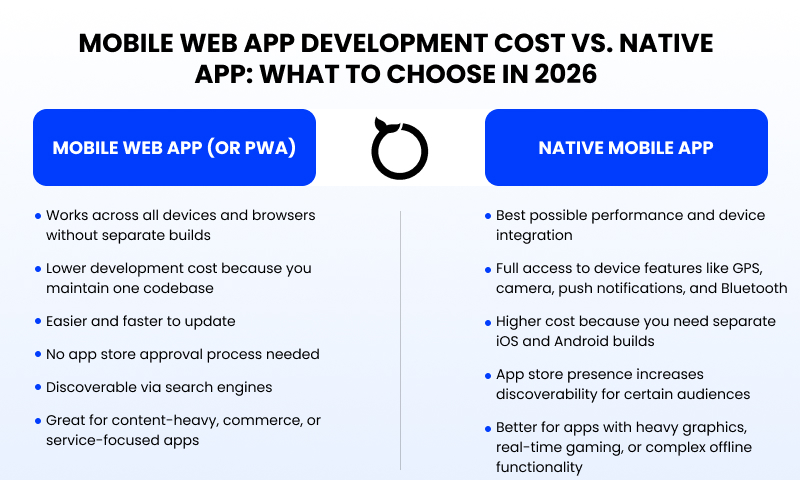
Many businesses face this exact question right now. Here’s a simple comparison to help you decide:
Mobile Web App (or PWA)
- Works across all devices and browsers without separate builds
- Lower development cost because you maintain one codebase
- Easier and faster to update
- No app store approval process needed
- Discoverable via search engines
- Great for content-heavy, commerce, or service-focused apps
Native Mobile App
- Best possible performance and device integration
- Full access to device features like GPS, camera, push notifications, and Bluetooth
- Higher cost because you need separate iOS and Android builds
- App store presence increases discoverability for certain audiences
- Better for apps with heavy graphics, real-time gaming, or complex offline functionality
In my opinion, for most small to mid-size businesses, a mobile web app or PWA is the smarter starting point. You can always build native apps once you’ve validated your product with real users and real revenue.
The mobile web app development cost being 30 to 50% lower than dual native development is a strong enough reason for most startups and growing businesses to go this route first.
Above all, the goal is to get your product in front of users quickly, learn from them, and improve. A PWA lets you do that without betting your entire budget on a single build.
Questions to Ask Before Hiring a Web App Development Team
Before you sign anything, make sure you get clear answers to these questions:
- What is your experience with apps in my specific industry?
- Can you show me case studies or live examples of similar projects?
- What does your QA and testing process look like?
- How do you handle scope changes or unexpected requirements mid-project?
- What is included in post-launch support and for how long?
- Who owns the source code and all assets after the project ends?
- What is your communication process, and how often will I receive updates?
- Do you use version control and project management tools I can access?
- What happens if we miss a deadline? What’s the escalation process?
These questions separate professional, accountable teams from those who disappear after the final invoice.
A good development partner will answer every single one of these confidently and in writing.
Local Business Reality: Web Apps Are No Longer Optional
In 2026, your customers expect digital experiences that are fast, personalized, and easy to use.
71% of consumers expect personalized interactions from the businesses they work with, according to McKinsey. And 86% of buyers say they’ll pay more for a better experience.
A generic website is not enough anymore. Whether you’re a logistics company, a healthcare provider, a retail brand, a professional services firm, or a fintech startup, a custom web application gives you:
- A direct digital channel you own, not one rented from a social media platform
- Automation that reduces operational cost and human error
- Real-time data collection that drives smarter, faster business decisions
- Scalability to handle growth without rebuilding from scratch
- A meaningful competitive edge over businesses still using off-the-shelf tools
Indeed, the businesses investing in custom software today are the ones that will dominate their markets in the next five years.
The window to build an advantage is open right now. It won’t stay open forever.
How to Estimate Your Web App Budget Before Talking to Developers
Here’s a practical framework you can use today:
Step 1: List the core features you need (login, dashboard, payments, reports, notifications, etc.)
Step 2: Categorize your app using the table above (simple tool, business app, enterprise system)
Step 3: Use the cost ranges as your baseline
Step 4: Add 20% as a buffer for unexpected changes, revisions, and QA
Step 5: Add 15 to 25% of the build cost annually for ongoing maintenance and updates
Step 6: Factor in hosting, third-party API costs, and licensing fees that may not be included in development quotes
This gives you a realistic range to work with before entering any negotiation with a development team.
Also, be honest with developers about your budget from the start. Good teams will help you prioritize features to fit your number. Great teams will tell you when your expectations don’t match your budget and suggest better alternatives.
Transparency from day one leads to better outcomes for everyone involved.
Common Mistakes That Silently Inflate Your Web App Development Cost
Even smart business owners make these mistakes. Here’s what to avoid:
Skipping the discovery phase to save time
This almost always leads to rebuilding features later. The discovery phase is where you catch misaligned assumptions before they become expensive problems.
Adding features mid-development without adjusting the timeline
Every new feature added mid-sprint ripples through the entire project. It’s called scope creep, and it’s the single biggest cause of blown budgets.
Not planning for mobile from day one
Retrofitting mobile responsiveness after the fact costs far more than designing for it upfront. Always start mobile-first.
Ignoring performance optimization
A slow app is a dead app. A one-second delay in page load time reduces conversions by 7%, according to Akamai. Performance needs to be built in, not bolted on.
Choosing a vendor based on price alone
As discussed earlier, the cheapest option is rarely the most cost-effective one. Evaluate teams on experience, communication, and portfolio, not just hourly rate.
Summary
Building a web app is one of the highest-leverage investments a business can make right now.
The web app development cost ranges from $5,000 for a simple MVP to $300,000 or more for an enterprise solution. But the ROI, when executed correctly, far exceeds the investment.
Here’s what to take away from everything you’ve read:
- Know your app type and match your budget to it realistically
- Understand the full web app development cost breakdown, not just the build cost
- Consider a progressive web app if you need mobile performance without the full price of native apps
- Calculate your ROI before you build, not after
- Start small, validate fast, and scale smart
- Avoid the cheap app trap and the scope creep trap
- Ask the right questions before you hire any development team
- Choose a partner who communicates clearly, builds for the long term, and treats your budget like their own
The businesses that win in 2026 are not the ones with the biggest budgets. They’re the ones that spend smartly, build thoughtfully, and move faster than their competition.