Before approving an iOS app budget, leadership needs to know what the estimate actually includes. The same app idea can be priced very differently depending on discovery, UI/UX, backend development, APIs, admin controls, QA, App Store support, and post-launch maintenance.
Clutch reports that the average app development project costs $90,780.11 and typically takes around 11 months, which shows why a rough number is not enough for budget planning.
This guide breaks down iOS app development cost by app complexity, MVP scope, features, hiring model, hidden costs, maintenance, and the scope of iOS app development services so you can compare quotes with fewer blind spots.
How Much Does it Cost to Develop an iOS App? (Quick Overview)
| App Type | Estimated Cost Range | Best For |
| Simple iOS app | $15,000–$50,000 | Basic apps, internal tools, simple MVPs |
| Medium-complexity iOS app | $50,000–$150,000 | Customer apps, dashboards, booking, ecommerce |
| Complex iOS app | $150,000–$300,000+ | Marketplace, fintech, healthcare, logistics, AI-enabled apps |
| Enterprise-grade iOS platform | $300,000+ | Multi-role, regulated, integrated platforms |
What Factors Affect iOS App Development Costs?
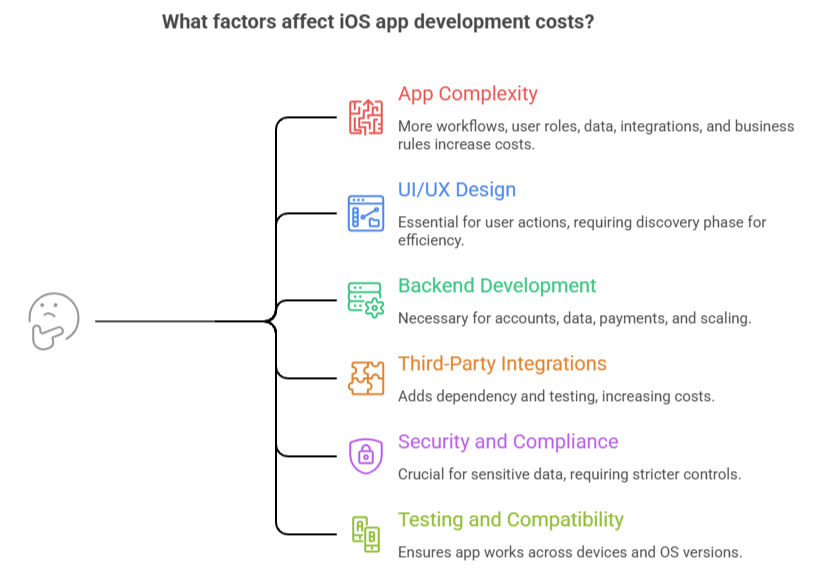
The main factors that affect iOS app development costs are app complexity, feature depth, UI/UX discovery, backend architecture, third-party integrations, security requirements, QA coverage, iOS compatibility, App Store preparation, and post-launch maintenance.
The more workflows, user roles, data, integrations, and business rules the app needs, the higher the final cost.
1. App Complexity and Feature Scope
Feature names are often misleading. “Login” can be a basic sign-in screen, or it can include social login, MFA, role permissions, password recovery, session rules, and admin visibility.
The same applies to payments, chat, bookings, subscriptions, AI features, or dashboards. Cost increases when a feature has business rules behind it.
A simple iOS app usually has:
- One user type
- Limited screens
- Minimal backend logic
- Few integrations
- Basic analytics
A higher-cost iOS app usually has:
- Multiple user roles
- Payments or subscriptions
- Real-time updates
- Admin panel
- Custom backend
- API integrations
- Security or compliance requirements
This is why iOS app development cost should be estimated by workflow depth, not only by screen count.
2. UI/UX Design and Product Discovery
Design affects cost when the app needs users to complete important actions: onboarding, checkout, booking, search, subscription, profile setup, or lead submission.
A proper discovery phase usually defines:
- User flows
- Wireframes
- Prototype
- Screen states
- Error states
- Design system
- Accessibility needs
This keeps the build focused. Without discovery, the development team ends up deciding product logic during coding, which usually increases revisions and delays.
3. Backend Development and Database Architecture
The backend is where many iOS estimates become incomplete. If the app needs accounts, saved data, payments, notifications, analytics, admin controls, permissions, or APIs, backend work must be priced clearly.
A lightweight app can use a managed backend. A serious product may need custom database architecture, API development, role-based access, reporting, audit logs, and long-term scaling support.
A quote is weak if it says “backend included” but does not explain what the backend will actually handle.
4. Third-Party Integrations
Integrations raise the iPhone app development price because they add dependency and testing. Stripe, Apple Pay, Firebase, Twilio, Google Maps, HealthKit, CRM, ERP, analytics platforms, and AI APIs all need more than a connection.
The real cost comes from handling what happens when the integration does not behave perfectly:
- Failed payments
- Expired sessions
- Webhook delays
- Wrong or missing data
- API limits
- Permission issues
- Future API changes
The more integrations an app depends on, the more QA and maintenance it needs.
5. Security, Compliance, and Data Privacy
Security cost depends on the type of data the app handles. A basic consumer app may only need secure login and encrypted API communication. A healthcare, fintech, insurance, enterprise, or marketplace app needs stricter controls.
Cost can increase for:
- Multi-factor authentication
- Role-based permissions
- Encrypted data transfer
- Secure API design
- Audit logs
- Payment security
- Data deletion rules
- HIPAA, PCI, GDPR, or CCPA-related planning
The proposal should name these items clearly. “Secure app development” is not enough.
6. Testing, iOS Compatibility, and App Store Readiness
QA is not a final polish step. It is part of the cost because iOS apps must work across devices, OS versions, permissions, network conditions, and real user flows.
According to Apple, 74% of iPhones introduced in the last four years use iOS 26, while 66% of all iPhones use iOS 26. That means a meaningful share of users still run older versions, so compatibility testing affects budget.
Testing should cover:
- Login and account flows
- Payments and subscriptions
- Push notifications
- Location permissions
- Offline or poor-network behavior
- Admin actions
- API failure cases
- Device and iOS version compatibility
Apple’s Developer Program costs $99 per year, but that fee is not the main cost. The real work is preparing the app for review: privacy details, screenshots, test accounts, metadata, build settings, and complete app flows.
How Much Does iOS App Development Cost by App Complexity
A simple iOS app usually costs $15,000–$50,000. A medium-complexity iOS app usually costs $50,000–$150,000. A complex iOS app usually costs $150,000–$300,000+. An enterprise iOS app usually starts around $300,000+.
The final iOS app development cost depends on how much backend work, admin control, integration, security, QA, App Store support, and maintenance the quote includes.
iOS App Development Cost by Complexity
| App Complexity | Estimated Cost Range | Best-Fit Examples | What Usually Drives the Cost |
| Simple iOS app | $15,000–$50,000 | Calculator-style app, simple company app, static content app, basic booking request app, internal tool | Limited screens, basic login, minimal backend, few integrations |
| Medium-complexity iOS app | $50,000–$150,000 | Ecommerce app, real estate app, fitness app, appointment booking app, delivery app, learning app | User dashboard, admin panel, payments, search, push notifications, APIs |
| Complex iOS app | $150,000–$300,000+ | Marketplace app, fintech app, healthcare app, logistics app, SaaS companion app, AI-powered app | Multiple roles, real-time features, custom backend, security, AI/ML, compliance |
| Enterprise iOS app | $300,000+ | Internal enterprise platform, field operations app, multi-location business app, ERP/CRM-connected app | Legacy integration, advanced admin control, audit logs, custom reporting, support |
How Much Does an iOS MVP Cost for a Startup?
An iOS MVP usually costs $20,000 to $120,000+, depending on how much of the product needs to work in the first release. A clickable prototype sits at the lower end. A working MVP with login, backend, admin control, analytics, and one complete transaction flow costs more because it is not just showing the idea. It is testing whether users will actually use it.
That matters because early app usage drops fast. Business of Apps reports that average iOS retention is 25.65% on Day 1 and 4.13% by Day 30. For startups, the MVP should be built to measure real behavior early, not to impress users with a bloated first version.
What Counts as an iOS MVP?
An iOS MVP is the smallest working version that proves the app’s core value. It should be usable, testable, and focused on one main workflow.
For example, a booking MVP should let users complete a booking. A marketplace MVP should prove the buyer-seller interaction. A fitness MVP should prove tracking, progress, or coaching value.
Typical iOS MVP Cost Range
| MVP Type | Estimated Cost Range | Best Example |
| Prototype-only MVP | $5,000–$15,000 | Clickable design, no working backend |
| Basic functional MVP | $20,000–$60,000 | Login, core workflow, basic admin |
| Investor-ready MVP | $60,000–$120,000+ | Polished UI, backend, analytics, integrations |
What Features Should Stay in the First Version?
The first version should include only what is needed to prove the app’s main value. For most iOS MVPs, keep:
- Login/signup
- One core user journey
- Basic admin panel
- One payment, booking, request, or transaction flow
- Essential push notifications
- Analytics events
- Feedback loop
- Basic user profile
- App Store-ready build
For example, if the app is a booking MVP, the first version should prove that users can search, select, book, receive confirmation, and let the admin manage requests. It does not need advanced loyalty, multi-language support, or deep personalization on day one.
How to Reduce MVP Cost Without Weakening the Product
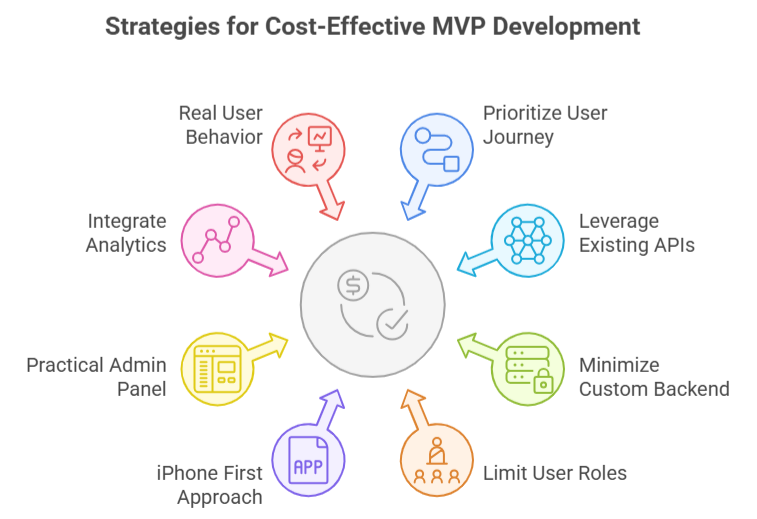
The best way to reduce iOS app development cost for an MVP is to narrow the first release, not lower the quality of the build.
Use these rules:
- Prioritize one user journey.
- Use existing APIs where possible.
- Avoid custom backend work unless it is necessary.
- Launch with fewer user roles.
- Start with the iPhone first, then expand.
- Keep the admin panel practical, not overbuilt.
- Add analytics from the first release.
- Use real user behavior to plan version two.
For startups, the goal is not to build the cheapest iOS app. The goal is to build the smallest version that can answer a business question: will users complete the main action, come back, and give you enough signal to justify the next investment?
Also read: MVP app development
How Much Does It Cost to Build an iOS App With Login, Payments, Chat, Push Notifications, and Admin Panel?
An iOS app with login, payments, chat, push notifications, and an admin panel usually falls in the $50,000–$120,000+ range if it has a clean UI, API-based backend, basic analytics, and one main user journey. This aligns with current 2026 iOS pricing references where medium-complexity iOS apps with backend, login, and payments are commonly estimated around $40,000–$120,000.
Feature-by-Feature Cost Impact
| Feature | Typical Add-On Cost | Cost Impact | Why It Affects Price |
| User login | $2,000–$8,000 | Low to medium | Email/social login, password reset, sessions, account security |
| Payments | $5,000–$20,000 | Medium to high | Gateway setup, Apple Pay/Stripe, failed payments, refunds, transaction testing |
| Chat | $8,000–$30,000 | Medium to high | Real-time messaging, media support, moderation, notifications, message storage |
| Push notifications | $2,000–$6,000 | Low to medium | Triggers, user permissions, notification logic, testing |
| Admin panel | $8,000–$35,000 | Medium to high | User management, records, reports, roles, internal controls |
| Maps/location | $5,000–$15,000 | Medium | GPS, permissions, map APIs, nearby search, geofencing |
| AI chatbot | $10,000–$40,000+ | Medium to high | Prompt logic, API setup, chat flow, data handling, testing |
Basic push notifications alone can cost around $1,500–$2,500, while custom notification logic can reach $4,000–$5,000, depending on triggers and server-side handling.
Example Cost Scenario for a Startup App
A startup iOS app with the following scope usually lands around $50,000–$120,000+:
- 12–20 screens
- User login/signup
- Basic admin panel
- Payment integration
- Push notifications
- Basic analytics
- API-based backend
- QA and App Store submission
The lower end applies when the app has one user type, simple backend logic, and standard integrations. The higher end applies when payments need refunds or subscriptions, chat is real-time, the admin panel needs reporting, or the backend has custom business rules.
What is iOS App Development Cost by Hiring Model
Freelance iOS developers usually cost $16–$35/hour. iOS app development companies commonly charge $25–$49/hour, with many reviewed projects falling between $10,000 and $49,999+. Dedicated iOS developers often cost $4,000–$12,000+ per month, depending on seniority and region. In-house iOS development has the highest fixed cost, with U.S. software developer salary alone around $133,080/year before benefits, tools, and management.
Hiring Model Cost Comparison
| Hiring Model | Typical Cost | Best For | What the Price Usually Includes | Main Cost Risk |
| Freelance iOS developer | $16–$35/hour | Small fixes, MVP support, defined features | iOS development only | You manage scope, QA, design, backend, and delivery |
| iOS app development company | $25–$49/hour or $10,000–$49,999+ per project | Full app delivery | Strategy, UI/UX, development, QA, launch support | Higher upfront cost |
| Dedicated iOS developer / staff augmentation | $4,000–$12,000+ per month | Scaling an existing product team | Full-time or part-time developer capacity | Requires internal product and tech management |
| In-house iOS team | $133,080/year salary baseline per software developer in the U.S. | Long-term product ownership | Permanent engineering capacity | Salary, benefits, tools, management, hiring time |
Upwork lists iOS developer rates at $16–$35/hour, with a $25/hour median. For in-house planning, the U.S. Bureau of Labor Statistics reports the median annual wage for software developers at $133,080.
Which Hiring Model Is Cheaper?
The cheapest model depends on the scope.
| Goal | Best Cost-Fit Model |
| Small fix or isolated feature | Freelancer |
| Full iOS app from idea to launch | iOS app development company |
| Add capacity to an existing team | Dedicated iOS developer / staff augmentation |
| Build and own the product long-term | In-house team |
A freelancer is usually cheaper for small tasks. An agency is often more practical for full product delivery. A dedicated developer is cost-effective when you already have internal direction. An in-house team is expensive, but it makes sense when the app needs continuous ownership.
How Much Does iOS App Development Cost by Region?
iOS app development in North America usually costs the most, often $100,000–$300,000+ for medium or complex apps. Western Europe and the UK are also premium markets, often around $80,000–$250,000+. Eastern Europe usually offers moderate pricing around $50,000–$180,000+. South Asia is generally more affordable, often around $25,000–$120,000+. The Middle East varies widely, usually around $60,000–$220,000+, depending on local delivery and offshore support.
For example, a business comparing offshore teams with a mobile app development company in Houston may see a major price difference. The Houston-based quote may cost more, but it can also include closer discovery, easier communication, local stakeholder alignment, and stronger project visibility.
iOS App Development Cost by Region
| Region | Typical iOS Developer / Agency Rate | Estimated Cost for a Medium iOS App | Best Fit |
| North America | $100–$250/hour | $100,000–$300,000+ | Enterprise apps, funded startups, complex products needing close stakeholder communication |
| Western Europe / UK | $80–$180/hour | $80,000–$250,000+ | Compliance-aware apps, strong delivery process, high-mid budget projects |
| Eastern Europe | $40–$100/hour | $50,000–$180,000+ | Strong engineering quality with moderate pricing |
| South Asia | $20–$60/hour | $25,000–$120,000+ | Cost-controlled MVPs, dedicated teams, offshore development |
| Middle East | $50–$150/hour | $60,000–$220,000+ | Regional apps, Arabic/English products, local market alignment |
Why Region Should Not Be the Only Cost Factor
Region explains the hourly rate, but it does not explain the full project cost. A cheaper team can become expensive if the scope is unclear, QA is thin, architecture is weak, or communication creates rework.
Before choosing by region, compare:
- What is included in the quote
- Who handles product discovery
- Whether backend and admin panel are included
- QA coverage and device testing
- App Store submission support
- Communication overlap
- Post-launch maintenance
- Experience with similar iOS apps
Hidden Costs in iOS App Development Buyers Often Miss
The quoted iOS app development cost is rarely the full budget. Some costs appear before development starts. Others show up after launch when the app needs hosting, API usage, bug fixes, App Store updates, and new feature work.
| Hidden Cost | Typical Budget Impact | When It Applies |
| Discovery and product planning | $3,000–$15,000+ | Before development starts |
| Apple Developer Program | $99/year | Required to publish apps on the App Store |
| App Store launch assets | $500–$3,000+ | Screenshots, descriptions, privacy details, review prep |
| Backend hosting and cloud services | $50–$2,000+/month | Apps with accounts, data, APIs, storage, notifications |
| Third-party APIs and SaaS tools | $20–$5,000+/month | Maps, SMS, email, analytics, AI, CRM, support tools |
| Payment processing | Percentage + fixed fee per transaction | Apps with checkout, subscriptions, bookings, marketplace payments |
| Maintenance and iOS updates | $1,000–$10,000+/month | Bug fixes, security patches, OS updates, performance work |
| Post-launch feature iteration | $5,000–$50,000+ per release cycle | After real |
1. Discovery and Product Planning
Discovery is often skipped to lower the first quote, but it usually comes back as rework. Budget $3,000–$15,000+ for requirements workshops, feature prioritization, technical feasibility, user journey mapping, and a clearer build scope.
This cost is worth separating in the quote because it prevents vague estimates like “app with login, payments, and admin panel” from turning into a moving target.
2. App Store Launch and Developer Account
Apple lists the Developer Program at $99 per membership year. That fee is small, but the launch work around it is not always included in development quotes.
Budget $500–$3,000+ for App Store assets and launch preparation, including:
- App screenshots
- App description
- Privacy details
- App review preparation
- Test account setup
- Build submission support
Apple also requires app privacy details for App Store submissions, so this should be planned before launch, not added at the last minute.
3. Backend Hosting and Cloud Services
Apps with login, saved data, admin panels, notifications, or APIs need ongoing backend costs. A small MVP may start at $50–$300/month, while a growing app can move into $500–$2,000+/month depending on traffic, storage, bandwidth, and database usage.
Firebase, for example, offers no-cost usage on the Spark plan and pay-as-you-go pricing on the Blaze plan. Its listed App Hosting pricing includes no-cost usage up to certain limits, then paid bandwidth and storage after those limits.
Common backend costs include:
- Server hosting
- Database usage
- File storage
- Authentication
- Push notification infrastructure
- Logs and monitoring
4. Third-Party API and SaaS Fees
Third-party tools can quietly increase the iPhone app development price after launch. These are not always part of the build quote because they depend on usage.
Budget for tools like:
- Maps
- SMS
- AI APIs
- Analytics
- Payment processing
- Customer support tools
- CRM integrations
For example, Twilio lists U.S. SMS long-code pricing at $0.0083 outbound and $0.0083 inbound per SMS. That looks small, but it scales with verification codes, reminders, alerts, and customer messages.
Google Maps Platform now uses pricing plans and pay-as-you-go options, with new customers getting a $300 trial credit and paid plans such as Starter at $100/month.
For AI features, OpenAI’s current API pricing lists GPT-5.5 at $5.00 per 1M input tokens and $30.00 per 1M output tokens, so chatbot or AI workflow costs depend on usage volume.
5. Payment Processing Fees
If the app accepts payments, the payment gateway cost continues after launch. Stripe lists payment pricing that starts around 2.9% + 30¢ per successful card charge in its U.S. Connect pricing reference.
Budget impact depends on transaction volume. A low-volume app may barely notice it. A marketplace, booking app, or subscription product should model payment fees before launch.
6. Maintenance and iOS Version Updates
Maintenance is not optional for iOS apps. Budget $1,000–$10,000+/month, depending on app complexity and support needs.
This usually covers:
- Bug fixes
- Security patches
- iOS version updates
- Performance improvements
- App Store policy changes
- API updates
- Minor UX fixes
A basic app may need light monthly support. A payment, healthcare, fintech, marketplace, or enterprise app needs a more serious maintenance budget.
7. Post-Launch Feature Iteration
The first release usually creates new priorities. Users may drop off during onboarding, abandon checkout, ignore notifications, or request features the original scope did not include.
Budget $5,000–$50,000+ per release cycle for post-launch improvements such as:
- Better onboarding
- New dashboard views
- Improved search
- Payment flow changes
- Reporting updates
- Admin workflow improvements
- Retention-focused features
Why Software Orca Is an Expert in iOS App Development
Software Orca brings a product-first approach to iOS app development, helping businesses move from rough ideas to stable, App Store-ready products. The team focuses on more than clean screens. Every iOS app is planned around user flows, backend requirements, integrations, performance, security, and long-term scalability.
Whether you need an MVP, customer-facing app, internal business tool, or complex iOS platform, Software Orca builds with practical delivery in mind.
From Swift and SwiftUI development to API integration, QA testing, App Store submission, and post-launch improvements, the goal is to create an iOS app that works smoothly for users and remains manageable for the business after launch.
Wrapping it Up
The real iOS app development cost depends on scope, features, backend work, integrations, QA, hiring model, and post-launch support. A simple app costs less, while apps with payments, chat, admin panels, AI, or enterprise integrations need a higher budget.
Before approving a quote, check what is included: discovery, design, development, backend, testing, App Store submission, and maintenance. Software Orca can help you define the right scope, estimate the cost clearly, and build an iOS app that fits your launch goals.
FAQs
How much does it cost to develop an iOS app?
The average iOS app development cost usually ranges from $15,000 to $300,000+. A simple iOS app may cost $15,000–$50,000, while a medium or complex app with backend, payments, integrations, admin controls, and QA can cost $50,000–$300,000+. The final price depends on scope, features, backend complexity, team model, and post-launch support.
What is the average iOS app development cost for a startup MVP?
A startup iOS MVP usually costs $20,000 to $120,000+. A clickable prototype may cost $5,000–$15,000, a basic functional MVP may cost $20,000–$60,000, and an investor-ready MVP can cost $60,000–$120,000+. The first version should include one core user journey, login, basic admin control, analytics, and the main workflow users need to complete.
How much does it cost to build an iPhone app from scratch?
The iPhone app development price for a full build usually starts around $15,000–$50,000 for a simple app and can exceed $150,000–$300,000+ for complex products. A from-scratch build may include product discovery, UI/UX design, iOS development, backend development, APIs, QA testing, App Store submission, hosting, and maintenance.
Why are iOS app development costs so different between companies?
iOS app development costs vary because companies may not include the same scope in their quotes. One vendor may only price design and frontend development, while another may include discovery, backend, admin panel, QA, integrations, App Store launch, and support. Region, team seniority, process quality, and post-launch responsibility also affect the final cost.
Is it cheaper to hire an iOS freelancer or an app development company?
A freelance iOS developer is usually cheaper for small tasks, bug fixes, or isolated features. An iOS app development company costs more but usually includes a broader delivery team, such as product strategy, UI/UX, backend development, QA, project management, App Store support, and maintenance. The cheaper option depends on whether you need coding help or full product delivery.
How much does iOS app maintenance cost after launch?
iOS app maintenance usually costs $1,000–$10,000+ per month, depending on app complexity. Maintenance can include bug fixes, iOS version updates, security patches, performance improvements, hosting support, API updates, App Store policy changes, and new feature improvements. Apps with payments, user data, integrations, or enterprise workflows usually need a higher maintenance budget.
How much does it cost to add payments, chat, or push notifications to an iOS app?
Feature add-on costs vary by complexity. User login may add $2,000–$8,000, payments may add $5,000–$20,000, chat may add $8,000–$30,000, and push notifications may add $2,000–$6,000. The cost increases when these features require refunds, subscriptions, real-time messaging, notification triggers, admin visibility, or extra QA.
Does Apple charge to publish an iOS app?
Yes. Apple’s Developer Program costs $99 per year. This fee allows businesses to publish apps on the App Store, but it is not the only launch cost. App Store preparation may also include screenshots, app descriptions, privacy labels, test accounts, review-ready builds, metadata, and submission support.
How long does it take to develop an iOS app?
A simple iOS app may take 2–4 months, a medium-complexity app may take 4–8 months, and a complex or enterprise iOS app may take 8–12+ months. Timeline affects cost because longer projects require more design, development, backend work, QA cycles, project management, and launch preparation.
How can I reduce iOS app development costs?
The best way to reduce iOS app development cost is to narrow the first release. Start with one core user journey, delay non-essential features, use proven APIs where possible, avoid unnecessary custom backend work, and document requirements before development starts. A focused MVP reduces cost without weakening the product.