Every great app you use today started as a rough idea with one big question behind it: “Will people actually pay for this?”
Uber didn’t launch with surge pricing and scheduled rides. Airbnb didn’t start with Experiences and luxury listings. They started small, tested fast, and grew based on real feedback. That’s the MVP mindset, and in 2026, it’s the smartest way to bring an app idea to life without burning your budget on features nobody asked for.
The global mobile app market is expected to generate over $756 billion by 2027. The opportunity is enormous. However, most first-time founders make the same mistake: they build too much, too fast, and too expensively before proving their idea works.
This guide will show you exactly how to avoid that trap.
In this article, you’ll learn:
- What an MVP app is and why it matters
- Real-world MVP app examples you already know
- What affects the cost of MVP app development
- How much you should actually budget in 2026
- How to choose the right development partner
What Is an MVP App? (And What It’s Not)
The Simple MVP App Meaning
MVP stands for Minimum Viable Product. In app development, an MVP app is the simplest version of your app that still delivers real value to your first users.
It’s not a broken app. It’s not a demo. It’s a working product with just enough features to solve one core problem, ship fast, and learn from real users.
Think of it this way: an MVP app is your smartest first step, not your last.
What Does MVP Mean in App Development, Exactly?
In app development, MVP means:
- Minimum: Only the features that matter most
- Viable: Good enough that real users will actually use it
- Product: A real, working app, not just a prototype
The goal of a mobile app MVP is not perfection. It’s learning. You ship, gather feedback, and improve based on what users actually do, not what you assumed they would do.
Why Build an MVP App in 2026?
The startup failure rate is still alarmingly high. About 90% of startups fail, and 42% of those fail because there was no market need for their product.
Building a full-featured app before validating your idea is one of the most expensive mistakes you can make.
Here’s why MVP app development for startups makes sense:
- Saves money: You only build what’s necessary
- Saves time: You launch in weeks, not years
- Reduces risk: You test your assumptions before going all in
- Attracts investors: Traction beats PowerPoints every time
- Generates feedback: Real users reveal what you truly need
In short, a custom MVP app development approach lets you invest with confidence instead of guessing in the dark.
Real MVP App Examples You Know and Use
Some of the world’s most successful companies started with a bare-bones MVP app. These examples make the concept easy to understand.
| App | MVP Version | What They Tested |
| Uber | Simple ride request + GPS in San Francisco | Would people pay for on-demand rides? |
| Airbnb | A basic website renting out the founders’ apartment | Would strangers pay to stay in someone’s home? |
| Dropbox | A demo video (no product yet) | Would people want cloud file storage? |
| Photo sharing with filters only | Was photo sharing socially compelling? | |
| A college-only profile and friend network | Would people connect online with real identities? |
Each of these apps grew into a billion-dollar platform. However, they all started with the simplest possible version of their idea.
What Features Should Your MVP App Have?
This is where most founders go wrong. They try to include everything in version one.
The Three Questions to Ask Before Adding Any Feature
- Does this feature solve the core problem?
- Would users stop using the app without it?
- Can we add it in version two based on feedback?
If a feature doesn’t pass all three tests, it doesn’t belong in your MVP.
Core MVP App Design Elements
A solid MVP app design typically includes:
- User onboarding: Simple signup or login (email, Google, Apple)
- Core function: The one thing your app does better than anything else
- Basic UI: Clean, functional, and intuitive
- Feedback mechanism: A way for users to report bugs or share thoughts
- Analytics: So you can track how users actually behave
That’s it. Everything else comes later.
How Much Does It Cost to Build an MVP App in 2026?
Now for the question everyone really wants answered.
The honest answer is: it depends. However, that’s not helpful on its own. Let’s break it down so you can actually plan your budget.
Factors That Affect MVP App Development Cost
1. App Complexity
The more features, the higher the cost. A simple MVP with 3-5 screens is very different from one with real-time chat, payment integration, and AI features.
2. Platform Choice
- iOS only: Typically cheaper and faster
- Android only: Similar to iOS in cost
- Both platforms: More expensive unless you use cross-platform frameworks like Flutter or React Native
3. UI/UX Design
Good MVP app design takes time. Expect to budget 15-25% of total development cost just for design.
4. Backend Complexity
Does your app need user accounts, databases, APIs, or third-party integrations? Each one adds cost and time.
5. Developer Location
This is one of the biggest cost variables in app development MVPs.
| Developer Location | Hourly Rate (2026) |
| North America | $120 – $250/hr |
| Western Europe | $80 – $180/hr |
| Eastern Europe | $40 – $100/hr |
| South Asia | $20 – $60/hr |
| Southeast Asia | $25 – $70/hr |
6. AI Features
AI MVP app development is growing fast. Adding AI-powered features like recommendations, chatbots, or image recognition can add $10,000 to $50,000+ depending on complexity.
MVP App Cost Breakdown by Type
For a deeper look at how different app types are priced, check out our complete guide on app development cost to understand full project budgeting.
| MVP App Type | Estimated Cost Range |
| Simple utility app (5-7 screens) | $8,000 – $20,000 |
| Marketplace or booking app | $20,000 – $60,000 |
| Social or community app | $25,000 – $70,000 |
| AI-powered MVP app | $30,000 – $100,000+ |
| FinTech or healthcare MVP | $40,000 – $120,000+ |
The average cost to build an MVP app in 2026 falls between $15,000 and $50,000 for most startups working with professional development teams.
How Long Does It Take to Build an MVP App?
Speed matters in 2026. Markets move fast, and so do competitors.
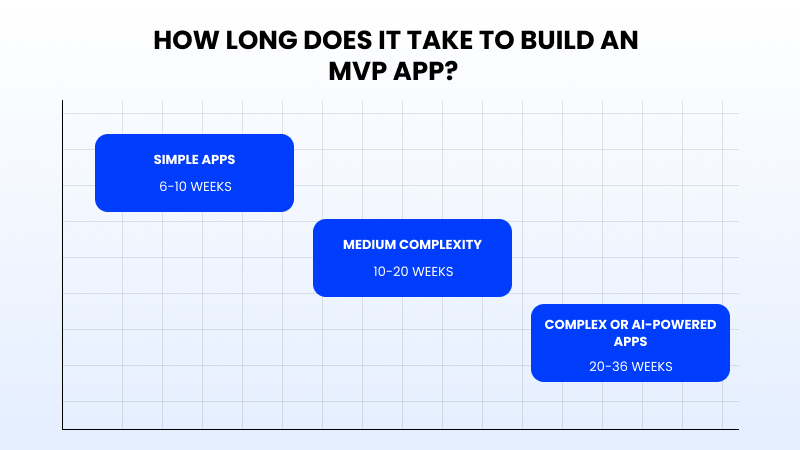
A well-scoped mobile app MVP can typically be built in:
- Simple apps: 6-10 weeks
- Medium complexity:
- Complex or AI-powered apps: 20-36 weeks
The fastest MVPs come from teams that have done it before, have a clear scope, and avoid feature creep.
The Wrong Way to Build an MVP (And Why It Costs More)
Many founders fall into traps that blow their budget and delay their launch.
Trap 1: Building too many features. Every extra feature adds weeks and thousands of dollars. Stick to your core.
Trap 2: Skipping user research. Building without knowing your users is like cooking without knowing who you’re feeding. You’ll waste ingredients.
Trap 3: Hiring the cheapest developers. Low-cost developers often deliver low-quality code that costs even more to fix later. In fact, poor code quality costs the U.S. economy $2.41 trillion annually, according to the Consortium for IT Software Quality.
Trap 4: Ignoring scalability. Your MVP should be built on a foundation that can grow. Rebuilding your backend after launch is expensive and painful.
Trap 5: No analytics from day one If you don’t track user behavior from the start, you’re flying blind when it’s time to improve.
How to Build an MVP App: A Simple Step-by-Step Process
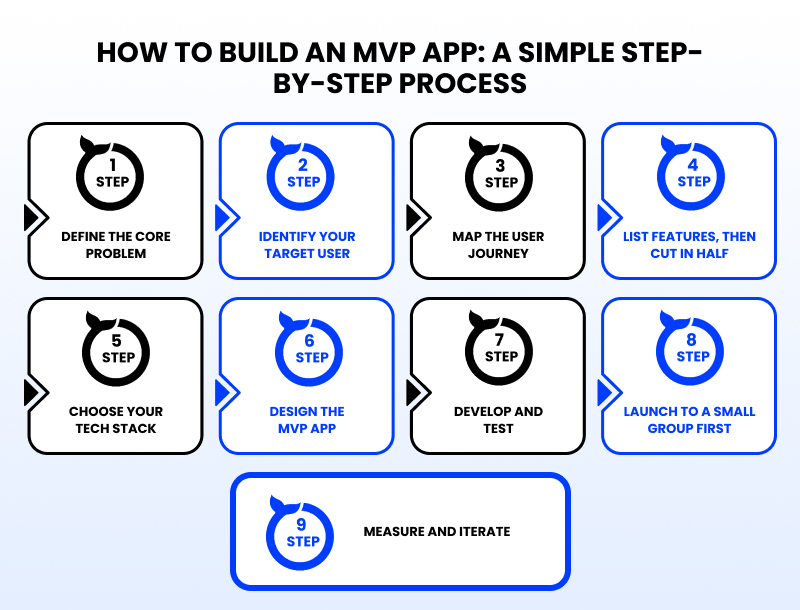
If you’re wondering how to build an MVP app without wasting time or money, follow this proven process.
Step 1: Define the Core Problem. What single problem does your app solve? Write it in one sentence.
Step 2: Identify Your Target User: Who has this problem? Be specific. “Everyone” is not a target user.
Step 3: Map the User Journey. What does your user need to do from opening the app to achieving their goal?
Step 4: List Features, Then Cut in Half. Write every feature you want. Then eliminate anything that isn’t essential to the core journey.
Step 5: Choose Your Tech Stack. Work with your development team to choose the right technologies for your platform, budget, and scalability needs.
Step 6: Design the MVP App. Build wireframes and a clickable prototype before writing a single line of code. This saves money and catches problems early.
Step 7: Develop and Test Build in sprints. Test each feature before moving to the next. Don’t wait until launch to find bugs.
Step 8: Launch to a Small Group First Soft-launch to early adopters, gather feedback, and improve before opening to the public.
Step 9: Measure and Iterate. Use real data to decide what to build next. Let users guide version two.
What to Look for in an MVP App Development Partner
Choosing who builds your MVP is as important as the idea itself. The wrong partner can drain your budget and deliver something unusable.
Look for a team that offers:
- Proven experience with MVP app development for startups
- A defined process from discovery to launch
- Post-launch support so you’re not left alone after go-live
- Transparent pricing with no surprise costs
- Client references or a portfolio you can verify
- Understanding of your industry or similar verticals
Furthermore, look for mobile app development services that include product strategy, not just coding. The best teams think like founders, not just developers.
AI and the Future of MVP App Development
In 2026, AI is no longer optional. It’s a competitive advantage.
AI MVP app development is changing what’s possible even on lean budgets. You can now build smart features like:
- Personalized recommendations based on user behavior
- AI chatbots for customer support or onboarding
- Predictive analytics to flag user drop-off before it happens
- Smart search that understands natural language
What used to cost hundreds of thousands of dollars is now accessible to early-stage startups thanks to open-source models and APIs like OpenAI, Google Gemini, and Anthropic Claude.
Is an MVP App Right for You?
In my opinion, almost every new app idea should start as an MVP. However, it’s especially important if:
- You’re a first-time founder with limited capital
- You’re entering a competitive or uncertain market
- You haven’t yet validated product-market fit
- You want to attract investors with proof, not just pitches
- You’re a business testing a new digital product line
On the other hand, if you’re in a heavily regulated industry like healthcare or finance, you may need to build more robustly from day one to meet compliance requirements.
Final Thoughts
The best app idea in the world fails if it never reaches users. And it never reaches users if you spend 18 months and $300,000 building the “perfect” version before testing it.
The MVP approach forces discipline. It makes you ask hard questions. It keeps your budget under control. And above all, it puts real feedback in your hands while your competitors are still planning.
To summarize, here’s what you now know:
- An MVP app is a lean, working product that solves one core problem
- Most MVPs cost between $15,000 and $50,000 in 2026
- Cost depends on complexity, platform, design, backend, and location
- AI features are now accessible even for early-stage startups
- The right development partner makes or breaks your launch