You search “custom software development cost” and find answers ranging from $10,000 to $500,000.
That’s not a range. That’s a guess dressed up as research.
The majority of internet pricing guides are authored by persons who have never really scoped a software project. They use data from out-of-date polls, disregard important factors, and leave you feeling even more perplexed than before.
The world of software development has drastically changed in 2026. The labor market shifted. AI tools were incorporated into the process. The number of offshore choices increased. What about the estimations you continue to read online? Still incorrect.
This article breaks down what actually drives the cost of custom software development and gives you a realistic framework to think about your own project.
Here’s what you’ll find in this post:
- Why most cost estimates online are misleading
- The real factors that determine custom software development cost
- An honest breakdown of the average cost of custom software development by project type
- How to evaluate custom software development cost per hour across different regions
- Red flags to avoid when hiring a development partner
Why Most Cost Estimates Are Completely Misleading
Let me be direct with you.
Most blog posts on this topic exist to rank on Google, not to actually help you budget a project.
They’ll say something like “custom software costs between $25,000 and $300,000” and call it a day. That’s the equivalent of saying “a car costs between $5,000 and $500,000.” Technically true. Completely useless.
In fact, a 2023 report by Stripe found that software inefficiencies and poor development decisions cost companies an estimated $85 billion annually in lost productivity. A big chunk of that comes from projects that were under-budgeted from the start.
I believe that the real problem isn’t that pricing is complicated. It’s that most guides skip the context that makes pricing make sense.
The Real Custom Software Development Cost Factors
This is where things get interesting.
The cost of custom software development doesn’t live in a spreadsheet. It lives in decisions. Most of those decisions happen before a single line of code is written.
Here are the factors that actually move the number:
1. Project Complexity
This is the biggest driver. Period.
A simple internal tool with basic CRUD functionality is a completely different animal from a multi-platform SaaS product with real-time data processing.
Think about it this way:
- Low complexity: Admin dashboards, simple booking systems, basic mobile apps
- Medium complexity: E-commerce platforms, CRM systems, multi-role portals
- High complexity: AI-integrated platforms, fintech apps, healthcare systems with compliance requirements
Each step up in complexity doesn’t just add cost linearly. It multiplies it.
2. Team Location and Structure
Custom software development cost per hour varies wildly by geography.
Here’s a realistic breakdown for 2026:
| Region | Average Hourly Rate (USD) |
| North America | $100 – $200/hr |
| Western Europe | $80 – $150/hr |
| Eastern Europe | $40 – $90/hr |
| India | $25 – $60/hr |
| Latin America | $35 – $80/hr |
| Southeast Asia | $20 – $50/hr |
However, cheaper per hour doesn’t always mean cheaper overall. Communication gaps, time zone friction, and quality issues can quietly inflate your total cost.
3. Team Composition
You’re not just hiring “a developer.”
A real software team includes:
- The Project Manager keeps timelines and stakeholders aligned
- A business analyst translates your needs into technical requirements
- A UI/UX Designer makes the product usable and intuitive
- Frontend Developer builds what users see
- Backend Developer builds the logic and data layer
- QA Engineer finds bugs before your users do
- A DevOps Engineer handles deployment, infrastructure, and security
Skipping any of these roles doesn’t save money. It just moves the cost to a later (and more painful) stage.
4. Technology Stack
Your software’s development speed and long-term maintenance costs are both impacted by the tools you choose.
For instance, using React Native for mobile development can lower costs because a single codebase can be used for both iOS and Android. Conversely, adopting native (Kotlin for Android, Swift for iOS) may boost speed for sophisticated apps but comes at a higher cost.
Your current technological decisions will have an impact on future updates, integrations, and scale-ups for years to come.
5. Discovery and Planning Phase
Most people underestimate this or skip it entirely.
A proper discovery phase (where requirements are mapped, wireframes are built, and technical architecture is designed) can cost $5,000 to $25,000. However, it can save you 3x that by preventing costly mid-project pivots.
In fact, McKinsey research found that large software projects run 45% over budget on average, mostly because requirements weren’t properly defined upfront.
Average Cost of Custom Software Development by Project Type (2026)
Let’s get specific. Here’s an honest look at what different types of software actually cost to build in 2026:
| Project Type | Estimated Cost Range |
| Simple internal tool or MVP | $10,000 – $40,000 |
| Small business web application | $30,000 – $80,000 |
| Mobile app (iOS or Android) | $40,000 – $120,000 |
| Cross-platform mobile app | $50,000 – $150,000 |
| E-commerce platform | $50,000 – $200,000 |
| SaaS product (full-featured) | $100,000 – $400,000+ |
| Enterprise software | $200,000 – $1,000,000+ |
| AI-integrated platform | $150,000 – $500,000+ |
These ranges account for a mid-size team, proper QA, and a standard 6–18 month build cycle.
They do not account for post-launch maintenance, which typically adds 15–25% of the original build cost per year.
How Much Does Custom Software Development Cost? Breaking It Down by Phase
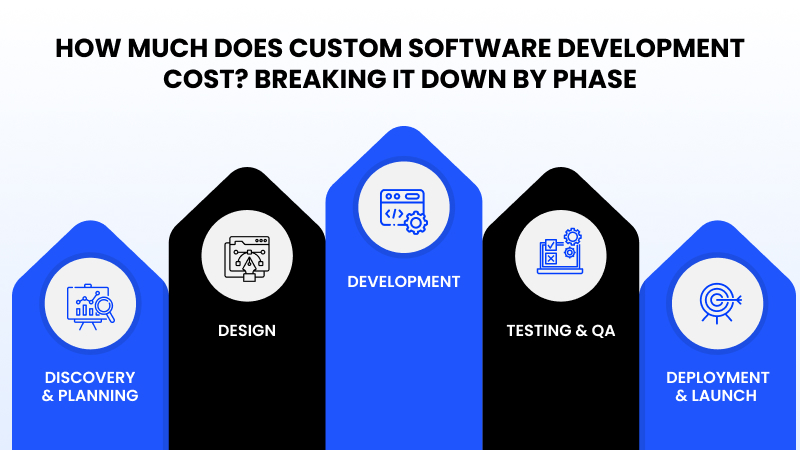
This is the question everyone asks. And the honest answer is: it depends on the phase.
Here’s how a typical project budget breaks down:
Discovery & Planning: 10–15% of total budget
This includes requirement gathering, technical architecture, UI/UX wireframing, and project scoping.
Design: 10–20% of total budget
UI design, UX flows, prototyping, and design system creation.
Development: 50–60% of total budget
This is the core build phase — frontend, backend, APIs, and integrations.
Testing & QA: 10–15% of total budget
Manual and automated testing, bug fixing, and performance testing.
Deployment & Launch: 5 –10% of total budget
Server setup, DevOps configuration, and release management.
Most people only plan for the development phase. That’s why projects go over budget.

What to Look for in a Custom Software Development Company
Not all development partners are created equal. There are many factors and services that needs to be checked before choosing development partner.
The vendor selection process is where most businesses lose before the project even starts. They either choose based on price alone or fall for polished portfolios without asking the right questions.
Here’s what to look for:
- Transparent pricing model: Pricing should be transparent for all. Observe “Do they charge fixed price, time-and-material, or retainer?” This is important as each model suits different projects
- Discovery-first approach: Any reputable team will insist on a scoping phase before quoting a final number.
- Technical documentation: Ask to see sample architecture documents or project roadmaps from past work.
- Post-launch support plan: The build is only the beginning. Ask what happens after go-live.
- Communication structure: See their way of communication. Is it through weekly updates, a dedicated project manager, or any defined escalation path?
- Client references: Not just testimonials on their website. Actual references you can call.
A custom software development company that skips any of these is a red flag.
Common Traps That Inflate Your Final Cost
Here are the mistakes that quietly double your budget:
- Skipping the discovery phase to save money early costs 3x more in rework later
- Choosing the cheapest bidder without evaluating the communication quality or process
- Scope creep: Adding features mid-project without adjusting the timeline or budget
- No QA budget: Bugs caught in production are 10x more expensive to fix than bugs caught during testing
- Ignoring scalability: Building for today’s user volume without planning for growth means a painful rebuild later
- No post-launch plan: Software needs updates, security patches, and performance tuning after launch.
Furthermore, general contracts without clear deliverables and milestones are one of the biggest financial risks in software development.
What Actually Determines Custom Software Development Cost
Here’s what moves the number:
- Complexity of features: More complex means exponentially more expensive.
- Team location: Rates vary significantly by region.
- Team size and roles: Cutting roles cuts quality, not just cost.
- Tech stack: Some choices cost more upfront but save money long-term.
- Planning quality: Better discovery means fewer surprises.
- Post-launch needs: Maintenance is a real and recurring cost.
Final Thoughts
In my opinion, the biggest mistake businesses make is treating software development like a commodity purchase.
It’s not. It’s an investment in a system that will touch your customers, your team, and your revenue, every single day.
The cost of custom software development in 2026 is ultimately shaped by your decisions: what you build, who you hire, how well you plan, and how honest you are about your requirements.
The range is genuinely wide. But now you understand “why” and that puts you in a far stronger position than before.
Above all, don’t let a general estimate scare you away from a project that could transform your business. Get real numbers from real people who understand your problem.
Frequently Asked Questions
Q1: How much does custom software development actually cost in 2026?
It depends on what you’re building. A simple tool can cost $10,000 to $40,000, while a full SaaS or enterprise system can run $200,000 to $1,000,000+. Most projects land between $30,000 and $200,000.
Q2: Why are quotes from different companies so different for the same project?
Yes, quotes are different for different projects in different companies because they’re not quoting the same thing. One vendor may be estimating a basic build, while another is already factoring in security, scalability, QA depth, DevOps, and future maintenance. Always ask what’s included before comparing numbers.
Q3: Is hiring a cheaper offshore team actually cheaper in the end?
Not always, but communication gaps, time zone friction, and quality issues can quietly inflate your total cost even if the hourly rate looks attractive. A low rate per hour means nothing if the project takes twice as long or needs expensive rework.
Q4: What hidden costs do most people forget to budget for?
Most projects land between $30,000 and $200,000, though a simple tool can start at $10,000 and a full enterprise system can exceed $1,000,000.
Q5: Is the discovery phase really worth paying for?
Yes, it’s worth every penny. A short discovery phase can save 20 to 30% in development costs because problems caught early are far cheaper to fix than problems found mid-build.