If you’ve ever stood at the corner of Uptown Dallas and watched a new tower rise seemingly overnight, you already understand the pace of North Texas commercial real estate.
Dallas added over 43 million square feet of commercial space between 2020 and 2024, according to CBRE. And yet, most of the deals closing those buildings are still being managed with email threads, PDF leases, and spreadsheets that belong in 2009.
That gap between Dallas’s ambition and its operational tools? That’s exactly where custom AI agents step in.
Here’s what you’ll learn in this article:
- Why Dallas commercial real estate deals take too long to close
- What custom AI agents for real estate actually do
- How AI slashes lease processing and deal timelines
- The real cost of not automating your real estate workflow
- How to choose the right AI development partner in Dallas
The Dallas Commercial Real Estate Boom Is Real. Your Closing Speed Isn’t.
Dallas-Fort Worth is now the number one commercial real estate market in the United States by leasing volume, according to JLL’s 2024 North America Office Report.
Companies like Tesla, Goldman Sachs, and Oracle have all planted flags in North Texas. The demand is historic.
However, demand doesn’t close deals. People do. And right now, your people are buried in manual tasks that slow everything down.
The Average Commercial Deal Timeline Is Too Long
According to Deloitte’s 2024 Commercial Real Estate Outlook, the average commercial lease takes between 6 to 12 months from first contact to signed agreement.
Think about what happens inside that window:
- Dozens of back-and-forth emails between brokers, tenants, and landlords
- Manual document reviews that take days per revision
- Compliance checks done by hand across multiple jurisdictions
- Scheduling conflicts that push due diligence timelines back by weeks
In a market moving as fast as Dallas, a slow pipeline isn’t just frustrating. It’s expensive.
What Are Custom AI Agents for Real Estate?
Before we go deeper, let’s make this concrete.
A custom AI agent is not a chatbot. It’s not a simple automation rule.
It’s an intelligent system trained to handle specific, multi-step tasks in your workflow with minimal human intervention.
In commercial real estate, that looks like this:
- An AI agent that reads an incoming lease inquiry and auto-generates a preliminary term sheet
- An agent that flags non-standard clauses in a lease document in seconds
- An agent that schedules property tours, sends reminders, and follows up with prospects automatically
- An agent that monitors North Texas zoning changes and alerts your team when a deal is affected
These aren’t futuristic concepts. They are being deployed right now through AI development services built specifically for real estate workflows.
Why “Off-the-Shelf” AI Doesn’t Cut It for Dallas Deals
Generic AI tools like basic document processors or plug-and-play CRM automations are built for the average user.
Your deals are not average.
Dallas commercial real estate involves Texas-specific lease law, unique market comps, DFW zoning regulations, and relationships with brokers who have their own workflows.
A one-size-fits-all AI tool doesn’t know any of that. A custom AI agent does, because it’s built around your data and your process.
How Custom AI Agents Actually Speed Up the Deal Pipeline
This is where theory becomes ROI.
Lease Abstraction in Minutes, Not Days
Manually abstracting a 60-page commercial lease takes a skilled paralegal 4 to 8 hours per document.
A custom AI agent trained on commercial lease structures can extract key terms, critical dates, rent escalations, and liability clauses in under 10 minutes with up to 95% accuracy, according to research from McKinsey’s real estate automation studies.
That’s not a marginal improvement. That’s a transformation.
Automated Tenant Screening and Qualification
Your leasing team shouldn’t spend three hours qualifying a prospect who doesn’t meet basic financial thresholds.
Custom AI agents built through real estate app development services can pull credit signals, business financials, and occupancy history to produce a qualification score automatically.
Your brokers only touch the leads worth their time.
Deal Monitoring Across the North Texas Market
The DFW Metroplex spans 9,000 square miles. Tracking competitor listings, available inventory, and market rate shifts manually is nearly impossible.
An AI agent can monitor MLS data, public filings, and commercial databases in real time, then surface relevant insights to your deal team before your competitors even see them.
Contract Drafting and Redlining
71% of legal professionals say contract review is the most time-consuming part of a commercial transaction. AI agents trained on your firm’s standard lease templates can draft initial contracts, flag unusual clause insertions, and produce redlined comparisons in a fraction of the time.
The Numbers That Tell the Real Story
Here’s a side-by-side comparison of a traditional commercial deal pipeline versus one powered by custom AI agents:
| Stage | Traditional Timeline | With Custom AI Agents |
| Lead qualification | 2 to 3 days | Under 1 hour |
| Lease abstraction | 4 to 8 hours/doc | 10 to 15 minutes |
| Contract drafting | 3 to 5 days | Same day |
| Compliance review | 1 to 2 weeks | 24 to 48 hours |
| Full deal cycle | 6 to 12 months | 2 to 4 months |
In a market where occupancy rates in prime Dallas submarkets like Uptown and Legacy West exceed 90%, speed is a competitive advantage. The firm that moves faster closes more deals.

What Happens When You Don’t Automate
This section matters. Because I believe the real risk isn’t in adopting AI. It’s waiting too long.
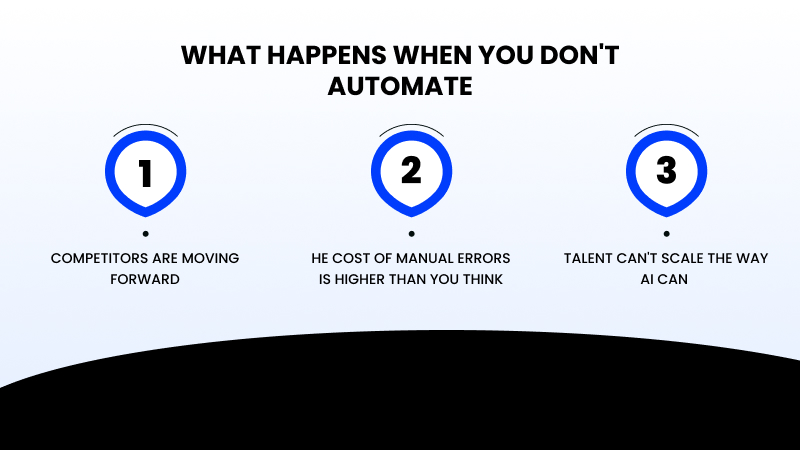
Your Competitors Are Already Moving
CBRE, Transwestern, and Cushman & Wakefield have all publicly committed to AI-driven transaction management as of their 2024 annual reports. These are firms that operate heavily in the Dallas market.
While you’re manually reviewing lease amendments, they are closing.
The Cost of Manual Errors Is Higher Than You Think
A single data entry error in a commercial lease can mean a missed rent escalation clause worth thousands of dollars annually. Multiply that across a portfolio of 50 to 100 properties, and the financial exposure grows fast.
Moreover, compliance errors in Texas commercial real estate can trigger legal liability that costs far more than any AI implementation ever would.
Talent Can’t Scale the Way AI Can
The DFW commercial real estate sector is also competing for talent with financial services, tech, and healthcare. Hiring your way out of an operational bottleneck is slow and expensive.
The average commercial real estate analyst in Dallas earns between $75,000 and $110,000 annually, according to the Bureau of Labor Statistics. AI agents work around the clock for a fraction of that cost.
What to Look for in a Dallas AI Development Partner
Not every development team understands commercial real estate. And not every real estate tech vendor can build truly custom AI.
You need both.
Here’s what to look for:
- Deep workflow knowledge: They should ask about your current deal pipeline before they write a single line of code
- Experience with real estate data: MLS integrations, lease document parsing, and property database connections are specialized skills
- Flexible development approach: Your needs will evolve; your AI system should be built to evolve with them
- Local market understanding: A team that knows the DFW market builds better tools for it
- Proven track record: Ask for case studies, not just demos
In addition, look for a partner who offers AI development services alongside mobile and web delivery. The best real estate AI tools today aren’t just desktop systems. They’re accessible to your brokers on the go through a dedicated mobile platform built by a mobile app development company Dallas teams can actually trust.
How to Get Started: A Practical Roadmap
Starting with custom AI doesn’t mean rebuilding everything at once.
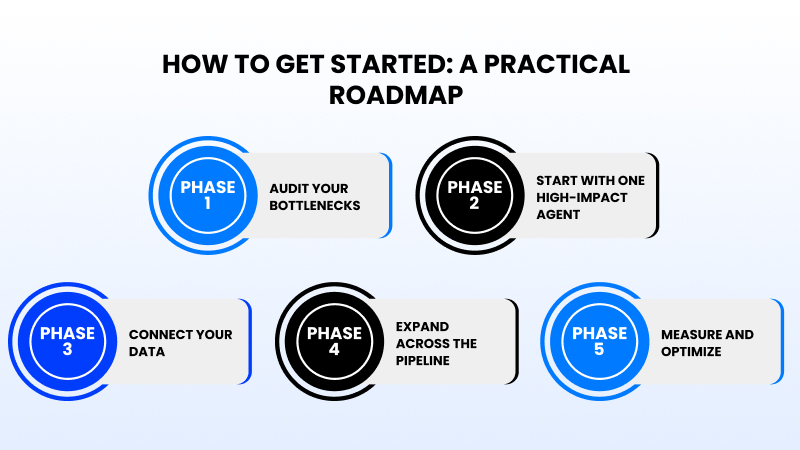
Here’s a phased approach that works for Dallas commercial real estate firms:
Phase 1: Audit Your Bottlenecks
- Identify the 3 highest-friction points in your deal pipeline
- Document the average time each step takes
- Quantify the cost of delays in each area
Phase 2: Start with One High-Impact Agent
- Lease abstraction is often the fastest win
- A single AI agent here can free up 20+ hours per week for your team
Phase 3: Connect Your Data
- Integrate your CRM, lease management system, and market data feeds
- This is where AI agents become truly intelligent instead of just fast
Phase 4: Expand Across the Pipeline
- Layer in tenant qualification, contract drafting, and deal monitoring
- Each agent learns from your data over time and gets more accurate
Phase 5: Measure and Optimize
- Track deal velocity before and after
- Use the data to continuously improve agent performance
Why Dallas Is the Right City to Lead This Shift
Dallas has always been a city that moves on opportunity before others see it.
It led the Sun Belt office boom. It attracted the largest corporate relocations in the country. It built an entire innovation corridor from Frisco to Plano to Irving.
In short, North Texas didn’t wait for permission to become a top-tier commercial real estate market. It built one.
The firms that will dominate the next decade of Dallas commercial real estate won’t just be the ones with the best listings. They’ll be the ones with the fastest, smartest deal operations.
Custom AI agents for real estate are not the future of this market. They are the present. And the gap between early adopters and late movers is already opening.
Final Thoughts
The Dallas commercial real estate market is one of the most active in the world right now.
However, activity without efficiency is just noise. Your pipeline deserves better than manual processes and slow closing timelines.
Custom AI agents built specifically for your workflow can cut your deal cycle in half, reduce errors, and free your brokers to do what they do best: build relationships and close deals.
Above all, the firms winning in DFW right now are the ones treating AI not as a tech experiment but as a core business operation.
Frequently Asked Questions
1. How much do custom AI agents cost for real estate firms?
The cost varies based on complexity and features. Most real estate AI agent projects range from $15,000 to $80,000, depending on the number of workflows automated and integrations required.
2. How long does it take to build a custom AI agent?
A focused, single-workflow AI agent typically takes 6 to 12 weeks to build and deploy. More complex systems with multiple integrations can take 3 to 6 months.
3. Do I need technical knowledge to use AI agents in my real estate business?
No. Custom AI agents are built to fit into your existing workflow. Your team uses them through simple dashboards or tools they already know, with no coding required.
4. Can AI agents handle Texas-specific lease laws and regulations?
Yes. Custom AI agents are trained on the specific legal frameworks, lease structures, and compliance requirements relevant to your market, including Texas commercial real estate law.
5. What is the difference between a custom AI agent and a generic automation tool?
Generic tools follow fixed rules and work the same for every user. A custom AI agent is built around your data, your process, and your market, making it significantly smarter and more accurate over time.