Nobody wakes up planning to build a healthcare app that gets breached. Yet in 2025, U.S. healthcare organizations reported 772 large data breaches, a record high. And the average cost? $7.42 million per incident. The stakes couldn’t be higher.
Meanwhile, the global digital health market is racing toward $347.4 billion, growing at over 20% annually. Opportunity and risk have never been more tightly linked. That’s why professional healthcare app development services can’t treat security or compliance as an afterthought.
This guide cuts through the noise to show you exactly how to build an app that captures market opportunity without compromising patient safety or regulatory standing.
What Is Healthcare App Development?
Healthcare app development is the process of designing, building, and maintaining software applications that support clinical care, patient engagement, healthcare operations, or health data exchange.
It differs from conventional mobile application development because it must account for protected health information, patient safety, clinical workflows, and regulatory requirements that don’t apply to most other software categories.
A typical healthcare application connects to at least one external system, like an electronic health record (EHR), a laboratory system, a payment processor, or a wearable device, and handles data that is legally and ethically sensitive.
Healthcare App Development vs. Medical App Development
“Healthcare app” and “medical app” are often used interchangeably, but they describe different scopes. A healthcare app is the broader category: any application that supports healthcare-related activity, including scheduling, patient communication, administrative workflows, and general wellness.
A medical app is a narrower subset built for clinical or diagnostic purposes, such as functionality that assesses, diagnoses, treats, or monitors a medical condition.
| Factor | Healthcare App | Medical App |
| Primary purpose | Support healthcare-related activity: scheduling, communication, administration, engagement | Diagnose, treat, monitor, or otherwise clinically manage a medical condition |
| Typical users | Patients, administrative staff, general consumers | Clinicians, patients under clinical supervision |
| Examples | Patient portals, appointment apps, hospital operations tools | Diagnostic imaging apps, clinical decision-support tools, condition-specific monitoring apps |
| Regulatory considerations | May involve HIPAA or GDPR depending on data handled | May additionally involve FDA/SaMD review depending on intended use |
Why Is Healthcare App Development More Complex Than Standard App Development?
Healthcare app development carries more complexity because the software touches patient safety, regulated data, and clinical operations that most consumer software never encounters.
Six factors drive that complexity: the sensitivity of health data, patient-safety implications of software errors, applicable regulation, the need to fit real clinical workflows, interoperability with existing healthcare systems, and the reliability demands of care-related software.
A scheduling bug in a retail app is an inconvenience. A scheduling bug in a healthcare app can delay treatment.
That difference in consequence is why healthcare application development requires closer collaboration between engineering, compliance, and clinical stakeholders than most other software projects.
What Types of Healthcare Apps Can You Build?
There isn’t one “healthcare app” template. The right application type depends on the problem you’re solving, who will use it, the clinical or administrative workflow it supports, the business model, and the systems it needs to integrate with.
1. Telemedicine and Virtual Care Apps
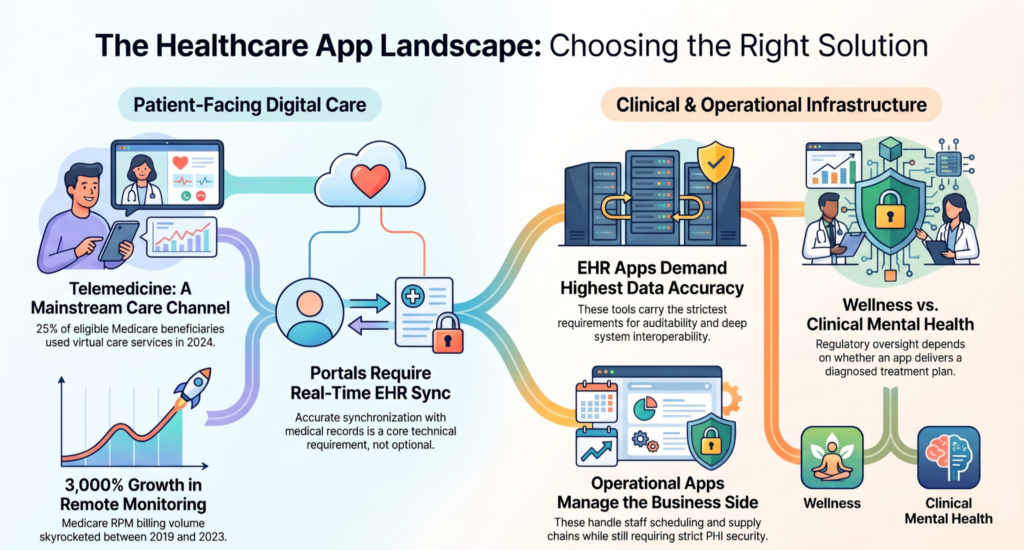
Telemedicine apps let patients consult with providers remotely through video, audio, or messaging. Core functionality typically includes virtual consultation scheduling, secure video and messaging, e-prescribing, and follow-up care coordination.
Even after the pandemic-era surge, telehealth remains a mainstream care channel: CMS reports that 25% of Medicare beneficiaries eligible for telehealth services used one in 2024, down from a peak of 48% in 2020 but still well above pre-pandemic levels.
Also read: Telemedicine app development
2. Patient Engagement and Patient Portal Apps
Patient portal apps give patients direct access to their own health information and a channel to communicate with their care team. Typical features include access to records and test results, appointment booking, secure messaging, bill payment, and care-plan tracking.
These apps are usually the patient-facing layer on top of a provider’s EHR, which makes accurate, real-time data synchronization a core technical requirement rather than an optional feature.
3. Remote Patient Monitoring Apps
Remote patient monitoring (RPM) apps collect vital signs and other health data from connected devices, like blood pressure cuffs, glucose meters, pulse oximeters, wearables, and relay it to care teams for review.
Adoption has accelerated sharply on the reimbursement side: Medicare claim volume for RPM billing codes (CPT 99453–99458) grew by more than 3,000% between 2019 and 2023, reflecting both expanded reimbursement policy and rising clinical use for chronic-disease management.
RPM apps need reliable device integration, threshold-based alerting, and a clear escalation path when readings fall outside safe ranges.
4. EHR/EMR and Clinical Apps
These applications support clinicians directly: documentation, clinical decision support, order entry, and e-prescribing.
Because they read from and write to the official medical record, they carry the highest bar for data accuracy, auditability, and integration reliability of any healthcare app category, and they most often require deep EHR interoperability work.
5. Hospital, Pharmacy, and Healthcare Operations Apps
Operational apps support the business side of care delivery: staff scheduling, inventory and supply-chain management, pharmacy dispensing workflows, billing, and administrative reporting.
They handle less clinical data than patient-facing apps but still often touch PHI indirectly through billing or scheduling records, so they aren’t exempt from security and compliance planning.
6. Mental Health, Wellness, and Preventive Care Apps
This category spans a wide range, from general wellness and habit-tracking tools to apps that support clinically supervised behavioral health treatment.
The distinction matters: a meditation or fitness-tracking app with no clinical claims is treated very differently, from a regulatory standpoint, than an app that delivers or supports a diagnosed treatment plan.
| App Type | Primary Users | Core Purpose | Typical Integrations |
| Telemedicine | Patients, providers | Virtual consultations and follow-up care | Video/messaging APIs, EHR, e-prescribing |
| Patient portal | Patients | Records access, scheduling, communication | EHR/EMR, billing systems |
| Remote patient monitoring | Patients, care teams | Continuous vital-sign tracking and alerts | Connected devices, EHR, alerting systems |
| EHR/EMR and clinical apps | Clinicians | Documentation, orders, decision support | EHR core systems, pharmacy, lab systems |
| Hospital/pharmacy operations | Staff, administrators | Scheduling, inventory, billing | ERP, pharmacy systems, payment processors |
| Mental health and wellness | Patients, consumers | Preventive care, behavioral health support | Wearables, scheduling, sometimes EHR |
How Should You Plan a Healthcare App Before Development?
Planning establishes the problem you’re solving, who you’re solving it for, the workflows involved, the minimum viable feature set, applicable compliance requirements, and the integrations needed, all before a single line of code is written.
Skipping this stage is the single most common reason healthcare app projects run over budget or fail clinical adoption.
1. Define the Healthcare Problem and Target Outcome
Start by writing a specific problem statement: what breaks down today, for which users, and what measurable outcome the app should produce.
“Improve patient engagement” is not specific enough to design around. “Reduce missed follow-up appointments for post-discharge cardiac patients” is. Review existing alternatives, including manual workarounds, to understand why they fall short before committing to a technical solution.
2. Identify Users, Stakeholders, and Healthcare Workflows
Healthcare apps typically serve multiple user types with different needs: patients, physicians, nurses and care teams, administrative staff, and sometimes pharmacists or lab technicians.
Map how each group currently completes the relevant task before designing new screens. Workflow mapping should come before interface design because clinical workflows are often constrained by regulation, staffing, and downstream systems in ways that aren’t visible from a purely UX perspective.
3. Define the MVP Scope
Separate features into three groups: what the first release must include to be useful and safe, what can wait for a later phase, and what shouldn’t be built at all because it doesn’t serve the core problem.
A disciplined MVP scope keeps the initial build focused, testable, and easier to secure than a feature-heavy first release.
4. Identify Compliance and Data Requirements Early
Before development starts, determine what data the app will collect, what data it will access from other systems, where that data will be stored, which third-party processors will touch it, and which regulations apply as a result.
This step directly shapes architecture decisions like encryption approach, access control design, and hosting environment, so addressing it late in the process usually means expensive rework.
5. Define Integration Requirements
Identify every system the app needs to connect to: EHR/EMR platforms, FHIR-based data exchange, HL7 messaging, pharmacy and laboratory systems, payment processors, and wearable or medical devices.
Each integration has its own authentication model, data format, and reliability characteristics, and integration work is consistently one of the largest cost and timeline drivers in healthcare application development.
How Do You Develop a Healthcare App?
Healthcare app development follows the same broad lifecycle as other software, like discovery, design, development, testing, deployment, and maintenance, but security, compliance, architecture, and interoperability decisions have to be built in from the beginning rather than added later.
Retrofitting compliance or security controls after launch is far more expensive than designing for them upfront.
Here’s how it actually works, step by step.
1. Discovery and Requirements
This is where you turn your big idea into a real plan. You need to answer some hard questions: What exactly will this app do? How many users will it support? How fast does it need to run? Who are the actual people using it, such as patients, doctors, nurses, admin staff?
But here’s where healthcare gets tricky. You also need to figure out which outside vendors will touch patient data and sign formal agreements (called BAAs) with each one. These agreements determine which cloud providers and third-party tools you can even consider. Skip this step, and you might find yourself locked out of the services you actually need.
2. UX/UI Design
Designing for healthcare is not like designing for Instagram. Your users range from tech-savvy doctors to 75-year-old patients who still struggle with email. And the stakes? A confusing interface can lead to a medication error or a missed allergy warning.
So you design with care. Screen readers and high contrast are must-haves, not nice-to-haves. Critical information, like allergies, abnormal readings, medication changes, stays visible, never buried in menus. You build safeguards against high-risk inputs like dosage amounts. And you create separate interfaces for different roles because a doctor’s dashboard looks nothing like a patient’s view.
3. Architecture and Technology Selection
This is where you make decisions that will haunt you, or save you, for years. Pick the wrong stack now, and you’ll be fighting integration battles forever.
Start with what you actually need to do. Are you connecting to wearable devices? Then your mobile architecture needs to support that. Are you talking to hospital EHRs? Then your backend better support FHIR and HL7. Authentication needs to handle multiple user roles with different permissions. Your database must support audit logging because regulators will want to know who accessed what and when.
This is where experienced custom software development company in Dallas and other tech-forward cities makes a real difference. Local teams often bring deep expertise in healthcare-specific stacks and compliance-ready architectures.
And don’t forget scalability. A remote patient monitoring app doesn’t handle traffic like a typical business app. It gets sudden bursts of data from dozens or hundreds of connected devices all at once. Plan for that spike or watch your system crash at the worst possible moment.
4. Healthcare Application Development
This is where code actually gets written, but healthcare apps demand more than just clean code. You need multi-factor authentication right out of the box. You need role-based access control so nurses don’t see doctor-only panels and patients don’t see admin functions. Every piece of data must be encrypted, such as both while moving across networks and while sitting in storage.
Every API request touching health data must be validated and sanitized. No exceptions. Build these controls into your core architecture, don’t tack them on later. That’s what separates serious healthcare software from amateur projects that get breached within months.
5. Healthcare System Integration
If you’ve built apps before, you know integration is always the painful part. In healthcare, it’s the nightmare part.
Most apps need to connect to electronic health records, labs, pharmacies, wearables, and payment systems. Each has its own data format, authentication model, and quirks. For modern EHRs, use FHIR. It’s the API-based standard that actually works well. But don’t throw away HL7 entirely; many hospitals still rely on it for lab results and patient admissions. Many organizations run both, so you need to support both.
If your app needs to live inside an EHR’s interface, look at SMART on FHIR. It standardizes how your app launches and authenticates within the hospital’s existing system.
Get this right, and you’re a hero. Get it wrong, and your app never gets past the pilot.
6. Testing and Quality Assurance
Testing a healthcare app isn’t checking off a checklist. It’s running functional tests, security tests, and performance tests under peak load. It’s testing every single integration with every connected system. It’s accessibility testing, compliance validation, and device testing across every platform your users actually use.
Security testing deserves special attention.
In 2025, hacking caused over 80% of large healthcare data breaches. That means penetration testing isn’t a compliance checkbox. Vulnerability scanning should be routine, not annual. If you’re not testing for vulnerabilities, someone else will find them first.
7. Deployment, Monitoring, and Maintenance
Here’s the truth nobody tells you: launch is just the beginning. Your app needs continuous monitoring for performance issues and security threats. You need an incident-response plan ready to execute the moment something goes wrong.
Regular updates to operating systems and security patches are non-negotiable. Regulations change, and your app must adapt.
And then there’s iteration. Real usage data will reveal what’s working and what’s not. Use it to guide improvements. Plan for this phase from day one because the initial build is usually just a fraction of the total cost over the app’s lifetime.
What Features Should a Healthcare App Include?
There’s no universal healthcare app feature list. The right feature set depends on the application type and which user roles it serves. A telemedicine app and a hospital inventory tool share almost no functional overlap despite both being “healthcare apps.” What follows are the feature categories most healthcare applications draw from, organized by user type.
Patient-Facing Features
Patient-facing functionality typically includes account registration and identity verification, secure authentication, a patient profile with relevant health information, appointment scheduling, secure messaging with care teams, notifications and reminders, access to health records and test results, and payment processing where billing is part of the app’s scope.
Provider Features
Provider-facing tools generally include a provider profile and credentialing information, patient list and case management, appointment and schedule management, clinical note documentation, secure communication with patients and colleagues, e-prescribing where applicable, and monitoring dashboards for connected-device data.
Administrative Features
Administrative functionality supports the operational side of care delivery: role-based dashboards tailored to different staff functions, staff scheduling and management, billing and claims workflows, reporting for operational and compliance purposes, and audit trails that log who accessed what data and when, a requirement that applies regardless of whether the app is formally HIPAA-regulated, since audit logging is a security best practice in its own right.
Advanced Healthcare App Features
More advanced healthcare apps may include video consultation infrastructure, wearable and medical-device integration, remote monitoring with automated alerting, AI-assisted functionality such as triage support or documentation assistance, usage and outcomes analytics, and accessibility or multilingual support for diverse patient populations.
These features add real value when they’re tied to a specific user need identified during planning, not when they’re added because a competitor’s app has them.
What Security, Compliance, and Interoperability Requirements Apply to Healthcare Apps?
Which requirements apply to a given healthcare app depends on its functionality, the health data it handles, its users, its jurisdiction, its intended use, and the systems it integrates with. There is no single compliance checklist that applies uniformly to every healthcare app.
Security and compliance decisions need to be made during planning and architecture, while interoperability determines how the app exchanges data with the rest of the healthcare ecosystem.
| Standard/Regulation | Primary Purpose | When It Matters |
| HIPAA | U.S. legal framework protecting PHI handled by covered entities and business associates | When the app handles PHI on behalf of a healthcare provider, plan, or clearinghouse |
| GDPR | EU regulation protecting personal and health data of EU individuals | When the app has users, patients, or data subjects located in the EU |
| FHIR | Modern API-based standard for structured health data exchange | When integrating with contemporary EHR systems or building interoperable apps |
| HL7 | Family of legacy healthcare messaging standards | When integrating with hospital systems still using HL7 messaging (labs, ADT events) |
| FDA/SaMD | U.S. medical device regulation for qualifying software | When the app’s intended use is to diagnose, treat, or mitigate a medical condition |
Security stakes in healthcare remain high by any measure: the average cost of a healthcare data breach reached $7.42 million in the 2025 IBM Cost of a Data Breach Report, with breaches in the sector taking an average of 279 days to identify and contain.
Both figures are higher than nearly every other industry IBM tracks. That cost and timeline gap is a direct argument for building security controls in from the start rather than adding them after an incident.
How Much Does Healthcare App Development Cost?
Healthcare app development typically costs between $50,000 for a narrowly scoped MVP and $500,000 or more for an enterprise-grade platform with deep integrations, though the right figure for any specific project depends heavily on complexity, platform coverage, integrations, security and compliance requirements, AI functionality, and ongoing maintenance.
Treat the ranges below as planning estimates. Actual cost depends on the specific scope, team rates, and region.
| App Complexity | Estimated Timeline | Estimated Cost (USD) | Typical Scope |
| MVP | 3–5 months | $50,000–$120,000 | Single platform, core features, minimal integrations, basic compliance controls |
| Mid-level | 5–9 months | $120,000–$300,000 | Multi-platform, moderate integrations (e.g., one EHR connection), full security/compliance controls |
| Enterprise | 9+ months | $300,000–$700,000+ | Multiple platforms, deep EHR/FHIR/HL7 integration, advanced features (AI, RPM), extensive testing and compliance validation |
What Factors Increase Healthcare App Development Cost?
Cost climbs with the number of platforms supported (iOS, Android, web), the breadth of the feature set, the number and complexity of integrations with EHR, FHIR, or HL7 systems, third-party API dependencies, the depth of security and compliance work required, AI or machine-learning functionality, integration with regulated medical devices, the scope of testing needed, and infrastructure choices that support scale and redundancy.
What Are the Ongoing Costs After Launch?
Ongoing expenses include cloud infrastructure and hosting, continuous monitoring and security operations, routine maintenance and bug fixes, compliance updates as regulations or standards change, user support, keeping pace with new OS and device versions, and continued feature development based on usage data.
Organizations budgeting for healthcare app development should plan for annual maintenance costs in the range of 15–25% of the original build cost, a common industry benchmark, while confirming the actual figure against their specific app’s complexity and support needs.
What Are the Biggest Challenges in Healthcare App Development?
The biggest challenges in healthcare app development usually center on regulation, interoperability, security, legacy systems, clinical adoption, and reliability at scale, not on coding difficulty alone. Each challenge has a practical mitigation, outlined below.
1. Regulatory and Compliance Complexity
Requirements vary by jurisdiction, data type, and intended use, and they can change during a project’s lifecycle.
Impact: Teams that treat compliance as a late-stage checklist often discover gaps that require rearchitecting core systems.
Solution: Identify applicable regulations during planning, involve compliance expertise from the start, and build audit-ready documentation as you go rather than reconstructing it before launch.
2. EHR and Legacy-System Integration
Many healthcare organizations run older systems with limited or inconsistent API support.
Impact: Integration work frequently takes longer and costs more than initial estimates.
Solution: Audit the target systems’ actual integration capabilities early, budget explicit contingency time for integration work, and prioritize the highest-value integrations for the MVP rather than attempting full connectivity on day one.
3. Data Security and Privacy
Healthcare data is a high-value target, and a single vulnerability can expose large volumes of sensitive information.
Impact: Breaches carry direct financial cost, regulatory exposure, and loss of patient trust.
Solution: Build layered security controls into the architecture from the start, conduct regular penetration testing, and maintain a tested incident-response plan rather than relying on a single control like encryption.
4. User and Clinical Adoption
A technically sound app that doesn’t fit real clinical workflows often goes unused.
Impact: Low adoption undermines the return on the entire development investment.
Solution: Map actual workflows before designing interfaces, involve clinicians and patients in usability testing, and prioritize reducing clicks and friction in high-frequency tasks over adding new features.
5. Scalability and Reliability
Healthcare apps often need to handle unpredictable load, like a surge of telehealth visits, a burst of device data from RPM patients, without downtime.
Impact: Outages in care-related software can directly affect patient care, not just user experience.
Solution: Design for horizontal scalability from the architecture stage, load-test against realistic peak scenarios, and build monitoring and alerting that catches degradation before it becomes an outage.
How Software Orca Built A Successful Healthcare App?
The best mobile app development company in Dallas, Software Orca, developed “Medicore” to solve the frustrations clinicians face with cumbersome legacy systems. Designed for physicians and nurses, it streamlines patient relationship management, prescription handling, dosage tracking, and digital records access.
The six-month project prioritized real-world workflows over rigid methodology. The team interviewed medical staff extensively and designed a UI that stays clear even in high-stress hospital environments.
Technical challenges included compressing medical imagery without losing detail, maintaining GPS accuracy inside complex hospital buildings, and organizing medication categories for quick retrieval.
The result? Medicore transformed daily operations. It improved prescription reliability, accelerated patient data access, and reduced administrative burden. Users praised its ease of use and immediate impact on clinical efficiency.
FAQs
How much does healthcare app development cost?
Costs typically range from about $50,000 for a narrowly scoped MVP to $500,000 or more for an enterprise platform with deep integrations. The exact figure depends on complexity, integrations, compliance requirements, and team rates.
How long does it take to develop a healthcare app?
Timelines generally range from three to five months for an MVP to nine months or longer for an enterprise-grade application with extensive integrations, security work, and compliance validation.
How do you build a medical app?
Building a medical app follows the same lifecycle as healthcare app development, with additional emphasis on clinical accuracy, evaluating FDA/SaMD applicability early, and more rigorous validation and testing given the higher patient-safety stakes.
What is the difference between a healthcare app and a medical app?
A healthcare app is a broad category covering any healthcare-related software. A medical app is a narrower subset focused on diagnosing, treating, or monitoring a medical condition, which carries a higher likelihood of regulatory oversight.
Does a healthcare app need to be HIPAA compliant?
Only if it handles protected health information on behalf of a covered entity or functions as a business associate. Applicability depends on the data handled and the app’s role, not on the fact that it’s healthcare-related.
How do healthcare apps integrate with EHR systems?
Most modern integrations use FHIR-based APIs, sometimes combined with SMART on FHIR for authentication and in-EHR app launch. Older systems may still require HL7 messaging for certain data types like lab results.
What technology is commonly used for healthcare app development?
Technology choices vary by project, but common elements include native or cross-platform mobile frameworks, API-based backends supporting FHIR/HL7, cloud infrastructure with compliance certifications, and role-based authentication systems — selected based on the app’s specific integration and compliance needs.
Conclusion
Healthcare app development is a discipline that blends software engineering with regulatory, security, and clinical-workflow expertise. Planning determines what gets built and why; security and compliance have to be designed in, not bolted on; interoperability is an architectural concern, not an afterthought; and cost depends far more on integration and compliance scope than on the app’s visual complexity.
The healthcare app development projects that succeed are the ones built around real clinical and administrative workflows, not generic feature templates.
If you’re planning app development for healthcare and want an experienced team to help scope, architect, or build it, that’s a conversation worth having before development starts, not after.