There is a moment every founder knows.
You have the idea. You can see the app clearly in your head. Users are loving it. Revenue is flowing. Then someone asks: “So how long will it take to build?”
And the room goes quiet.
Over 257 billion apps were downloaded globally in 2023. Behind every one of those downloads was a team that had to answer that exact question. Some got it right. Many didn’t.
In my opinion, this is one of the most misunderstood parts of building a tech product. People expect a simple answer like “three months.” However, the real answer depends on the choices you make before a single line of code is written.
This article will help you understand:
- What actually drives app development timelines
- How long it take to develop an app by type and complexity
- The hidden stages most people forget to plan for
- What mistakes slow teams down the most
- How to get a realistic estimate for your specific idea
Why “How Long Does It Take to Develop an App?” Has No One-Size Answer
Think about this: a flashlight app and a fintech platform are both “apps.”
One takes a weekend. The other takes a year.
The timeline depends on three big factors:
- How complex your features are
- How experienced is your development team
- How clear are your requirements before coding starts
In fact, the Project Management Institute found that organizations with poor requirements gathering waste 12 cents of every dollar spent on development. That adds up fast.
So when people ask how long it takes to make an app, the honest answer starts with a question: what kind of app?
App Development Timelines by Complexity (2026 Estimates)
Here is a clear breakdown to help you plan:
| App Type | Examples | Estimated Timeline |
| Simple App | Calculator, flashlight, basic to-do list | 1 to 3 months |
| Medium Complexity | Food delivery, booking app, e-commerce | 3 to 6 months |
| Complex App | Social platform, fintech, healthcare | 6 to 12 months |
| Enterprise App | ERP, multi-platform SaaS tools | 12 to 18+ months |
These are realistic ranges, not promises.
Furthermore, keep in mind that these timelines assume a skilled team, clear scope, and no major pivots. Real-world projects often run 20 to 30% longer due to feedback cycles and testing.
The Real Stages of App Development (And How Long Each Takes)
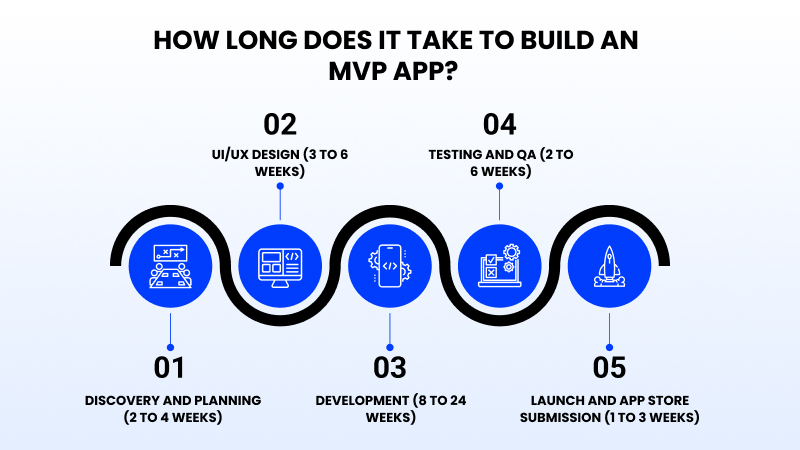
Most people think app development means writing code. It does not.
Coding is only one part of a much bigger process. Here is what a full timeline actually looks like:
Stage 1: Discovery and Planning (2 to 4 Weeks)
This is where ideas become structured plans.
Your team maps out:
- User personas and journeys
- Core features vs. nice-to-have features
- Tech stack decisions
- Project timeline and budget estimates
Skipping this stage is the single biggest reason projects fail or go over budget. Many teams want to jump straight into design. That is a mistake.
Stage 2: UI/UX Design (3 to 6 Weeks)
Design is not decoration. It is the blueprint.
Good design work includes:
- Wireframes (basic layout sketches)
- Prototypes (clickable, testable mockups)
- User testing on the prototype before coding begins
Companies that invest in UX see a return of up to $100 for every $1 spent, according to Forrester Research. That is not a small number.
Moreover, testing your design before development saves you from rebuilding features that users simply do not want.
Stage 3: Development (8 to 24 Weeks)
Now the coding begins.
This stage is usually broken into sprints. Each sprint is typically two weeks long and delivers a working chunk of the app.
Development includes:
- Frontend (what users see and interact with)
- Backend (servers, databases, logic)
- API integrations (payment gateways, maps, third-party tools)
For a medium-complexity app, expect around 3 to 5 months here alone.
How long does it take to code an app? This stage is the bulk of the answer. It varies based on how many features you have and how many developers are working in parallel.
Stage 4: Testing and QA (2 to 6 Weeks)
Here is where a lot of teams cut corners. But you should not.
QA testing includes:
- Functional testing (does it do what it should?)
- Performance testing (does it handle traffic spikes?)
- Security testing (are user data and payments protected?)
- Device and OS compatibility testing
The IBM Systems Sciences Institute found that fixing a bug after launch costs 6 times more than fixing it during development. In short, testing saves you money.
Stage 5: Launch and App Store Submission (1 to 3 Weeks)
You are not living the moment you finish coding.
Apple’s App Store review process typically takes 1 to 7 days. Google Play is usually faster, but still requires review time.
During this phase, your team also handles:
- Final performance checks
- App store listing optimization
- Initial bug fixes post-submission
Stage 6: Post-Launch Maintenance (Ongoing)
The app is live. The work is not over.
Most successful apps release updates every 2 to 4 weeks to fix bugs, add features, and respond to user feedback.
Budget around 15 to 20% of your original development cost per year for maintenance. This is a realistic number that most first-time founders underestimate.
What Slows Down App Development the Most?
In my experience, most timeline blowouts come from predictable problems.
Here are the most common culprits:
- Scope creep: Adding features mid-project without adjusting the timeline
- Poor communication: Developers and stakeholders use different languages for the same things
- Unclear requirements: Building the wrong thing and having to redo it
- Underestimating QA: Rushing testing and paying for it after launch
- Wrong team: Hiring developers without relevant experience in your app category
Above all, unclear requirements are the biggest killer. A 2021 report by McKinsey found that 45% of large software projects go over budget, and poor planning is the leading cause.
How Long to Make an App: Quick Scenarios
Let us make this very concrete for you.
Scenario A: MVP Fitness App Core features: workout tracker, user profiles, basic analytics Timeline: 3 to 4 months Team: 2 developers, 1 designer, 1 project manager
Scenario B: On-Demand Service Marketplace Core features: user and provider profiles, booking, payments, real-time tracking Timeline: 6 to 9 months Team: 4 to 5 developers, 1 to 2 designers, 1 QA specialist
Scenario C: Healthcare Telemedicine Platform Core features: video consultations, EHR integration, prescription management, HIPAA compliance Timeline: 10 to 14 months Team: 6 to 8 developers, compliance consultants, QA team
As a result, you can see how the scope of features directly drives how long to develop an app.
The Risk of Choosing the Wrong Development Partner
This is where things get expensive.
Some teams promise short timelines to win the contract. They know what you want to hear. Six weeks later, you are facing missed deadlines, poor code quality, and a product that barely works.
Consider what is at stake:
- The average cost to fix a failed app launch: $50,000 to $250,000+
- Percentage of apps abandoned after one use: 25%, according to Statista
- Time lost to rebuilding from scratch: 3 to 9 months on top of what you already spent
Furthermore, poor-quality code is not just a delay. It is a security risk. Data breaches cost companies an average of $4.45 million per incident in 2023, according to IBM’s Cost of a Data Breach Report.
The wrong development partner does not just waste your time. It puts your users and your business at risk.
5 Tips to Keep Your App Development on Track
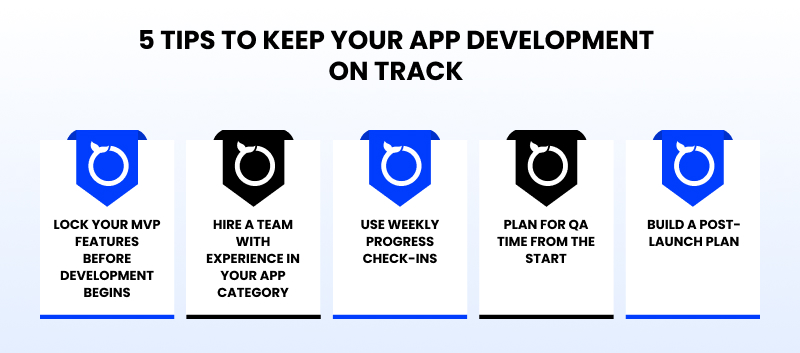
Before you start, put these into practice:
- Lock your MVP features before development begins. Decide what is in and what is out. Write it down.
- Hire a team with experience in your app category. A fintech app and a retail app have very different technical demands.
- Use weekly progress check-ins. Short, regular updates catch problems early.
- Plan for QA time from the start. Do not treat it as optional or a last-minute step.
- Build a post-launch plan. Know how you will handle bugs, updates, and user feedback before you go live.
These are not just best practices. They are the difference between a launch and a restart.
So, How Long Does It Take to Develop an App in 2026?
To summarize, here is what you have learned today:
- Simple apps: 1 to 3 months
- Medium complexity apps: 3 to 6 months
- Complex apps: 6 to 12 months
- Enterprise apps: 12 to 18+ months
How long does it take to develop an app? The most honest answer is: as long as it takes to do it right.
Cutting corners on planning, design, or QA does not make your app launch faster in practice. It makes it launch broken. And a broken launch costs far more time and money than getting it right the first time.
You have a real idea. You deserve a real timeline.
Frequently Asked Questions
How long does it take to develop an app in 2026?
It depends on complexity. Simple apps take 1 to 3 months. Medium apps take 3 to 6 months. Complex apps can take 6 to 12 months or more.
How long does it take to code an app?
Coding alone takes 8 to 24 weeks. However, coding is just one part of the full process, which also includes planning, design, testing, and launch.
What is the fastest way to build an app?
Start with a clear plan, lock your core features early, and avoid adding new features mid-project. A focused MVP always ships faster than a bloated one.
Why do app development timelines go over schedule?
The most common reasons are unclear requirements, scope creep, and rushed testing. Poor planning at the start almost always causes delays at the end.
How much does it cost to maintain an app after launch?
Most teams budget 15 to 20% of the original development cost per year for updates, bug fixes, and new features.