Software development outsourcing is the practice of contracting an external organization or team to design, build, and maintain software applications on behalf of your business. It has become a strategic imperative for companies of all sizes, enabling access to global talent, faster time-to-market, and optimized development costs.
This article covers the core outsourcing models, real cost structures, key risks, and a practical framework for selecting the right partner, so you can make an informed decision that actually delivers results.
What Is Software Development Outsourcing?
Software development outsourcing is the engagement of an external team or organization to handle some or all of your software development work. It differs from hiring freelancers (who work independently on discrete tasks) and staff augmentation (where external developers join your existing team under your management).
The core distinction lies in who owns the delivery, the management structure, and the duration of engagement.
Full outsourcing shifts the delivery responsibility to the vendor. They manage the team, they own the delivery, and they’re accountable for the outcomes. This works well when you don’t have internal management bandwidth or when the project is non-core to your business.
Hiring Model Comparison Table
| Dimension | In-House | Freelancers | Staff Augmentation | Full Outsourcing |
| Ownership | You own everything | You own output | You manage; they execute | Vendor owns delivery |
| Management | Your team leads | Minimal oversight | You manage daily | Vendor manages |
| Duration | Permanent | Task/Project-based | Flexible (weeks–months) | Project or long-term |
| Control | Full | Low | High | Moderate |
| Cost Structure | Fixed (salaries + benefits) | Hourly / Project | Hourly / Monthly | Fixed or Monthly |
| Scalability | Slow | Fast | Fast | Fast |
| Knowledge Retention | High | Low | Medium | Medium |
Why Do Companies Outsource Software Development?
Companies outsource software development primarily to access specialized talent they cannot find locally, accelerate product delivery, and reduce development costs. But the motivations have evolved significantly over the past decade.
Today, the most successful outsourcing relationships are driven by talent scarcity. Walk into any mid-sized company in the US or Western Europe, and you’ll hear the complaint: “We can’t find good engineers.” The competition for talent is fierce, salaries have skyrocketed, and even when you do hire, it takes months to ramp someone up to full productivity.
Outsourcing solves this problem directly. Instead of fighting for the same limited pool of local talent, you tap into global talent markets. You can find senior developers with exactly the skills you need, whether that’s AI/ML, blockchain, cloud architecture, or mobile app development, in regions where those skills are more abundant and more affordable.
The cost advantage is shrinking. According to Gartner, by 2028, 75% of enterprise software engineers will use AI code assistants, with teams that apply AI throughout the SDLC achieving 25-30% productivity improvements.
Business Challenge → Outsourcing Solution Table
| Business Challenge | Outsourcing Solution |
| Can’t find local talent with specific skills (e.g., AI/ML, blockchain) | Access global talent pools with specialized expertise |
| Development takes too long; competitors are moving faster | Accelerate delivery with larger, dedicated teams |
| Budget constraints limit headcount | Reduce development costs by 30–60% through offshore/nearshore rates |
| Need to test a new product idea without full commitment | Project-based outsourcing with defined scope and fixed budget |
| Internal team is overloaded with maintenance work | Offload maintenance to free up internal teams for innovation |
| Entering a new market or industry vertical | Partner with vendors who have domain expertise and regulatory knowledge |
Case Study: Tech Transit
Tech Transit, a Dallas-based logistics company, had been running on the same dispatch system for over a decade. It worked, but it was slow, difficult to update, and lacked the real-time tracking capabilities that competitors were starting to offer. The company knew they needed to modernize, but they had two problems.
First, they didn’t have the internal engineering capacity. Their IT team was small and focused on keeping the existing systems running. Second, they couldn’t justify the cost of hiring a full in-house engineering team, especially since they weren’t a software company and didn’t want to become one.
So they acquired an app and software development services in Dallas to build a cloud-native platform with real-time tracking and predictive ETAs. The vendor assembled a team of six developers, two QA engineers, and a project manager who worked exclusively on Tech Transit’s product.
The result? The project went from concept to deployment in five months, less than half the estimated time for an in-house build. Tech Transit achieved a 40% reduction in development costs while gaining access to specialized expertise in cloud architecture and machine learning that didn’t exist in their local talent pool.
The outsourcing model allowed them to scale the team up during active development and ramp down post-launch, avoiding permanent overhead.
Software Development Outsourcing Models
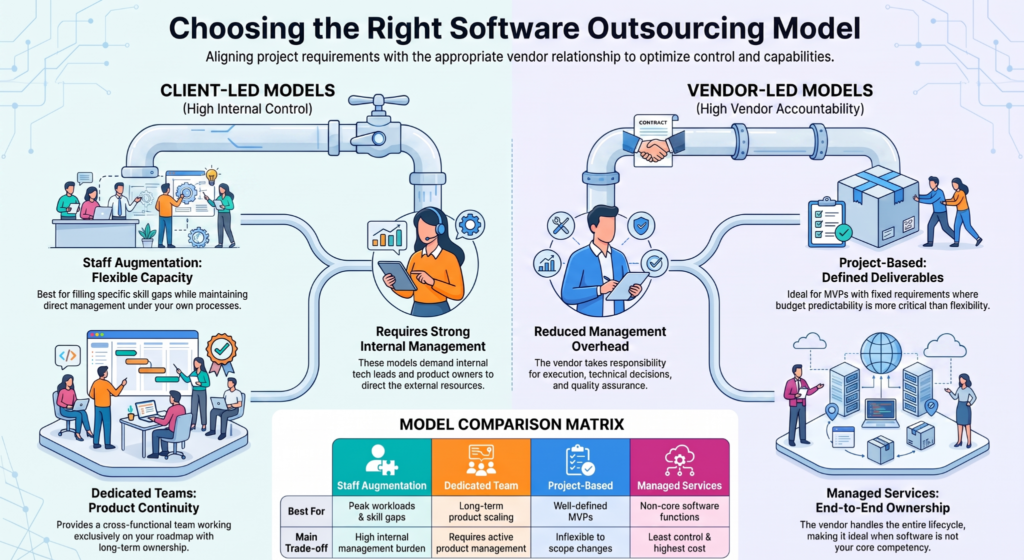
There are four primary software development outsourcing models: project-based outsourcing, dedicated development teams, staff augmentation, and managed services. The right model depends on your project scope, timeline, internal capabilities, and how much control you want to retain.
Project-Based Outsourcing
This is what most people think of when they hear “outsourcing.” You define the scope, requirements, and timeline; the vendor delivers the finished product for a fixed price or on a time-and-materials basis.
That’s where project-based outsourcing shines. You get a predictable budget, defined deliverables, and minimal management overhead. The vendor takes your requirements and runs with them.
This model is inflexible. If you discover halfway through that users actually need something different, or if market conditions shift, you’re locked into the original scope. Changes are expensive and disruptive. The vendor has already planned their resources around your project, and any deviation means renegotiation.
- Best for: Well-defined projects with clear requirements, MVPs, and applications where scope is unlikely to change significantly.
- Pros: Predictable budget, defined deliverables, minimal management overhead.
- Cons: Inflexible, scope changes are expensive and disruptive. Vendor controls the execution.
Dedicated Development Team
The vendor assembles a cross-functional team, like developers, QA, project manager, sometimes a designer, that works exclusively on your product. You own the product roadmap; the vendor manages the team.
Unlike project-based outsourcing, where the team disperses after delivery, a dedicated team stays with you. They can handle maintenance, build new features, and iterate based on user feedback. You get the benefits of a permanent team with the flexibility to scale up or down as needed.
- Best for: Long-term product development, startups building their core product, and companies scaling engineering capacity without hiring locally.
- Pros: Deep product ownership, continuity, full focus on your product, scalable.
- Cons: Higher commitment than project-based, requires active product management from your side.
Staff Augmentation
Staff augmentation is the most flexible model. You hire individual developers, QA engineers, or other specialists from a vendor to join your existing team. You manage them directly; they work under your processes, tools, and culture.
This is the right choice when you already have a strong internal team but need extra capacity or specific skills that you can’t find locally.
But this model requires strong internal management. You need product owners who can direct the work, tech leads who can review code, and project managers who can coordinate across teams. If your internal management is already stretched, staff augmentation will add to the burden, not relieve it.
- Best for: Filling specific skill gaps, handling peak workloads, and short-term projects where you already have strong internal management.
- Pros: Maximum control, seamless integration with your team, flexible scaling.
- Cons: Requires internal management bandwidth, less vendor accountability, knowledge doesn’t stay if contractors leave.
Managed Software Development Services
This is the most comprehensive model. The vendor takes end-to-end responsibility for the entire software development lifecycle, from requirements gathering and design to development, testing, deployment, and ongoing maintenance.
You tell them what you want, they handle everything else. They manage the team, they make technical decisions, they ensure quality, and they’re accountable for the outcome.
This model makes sense when software development is not your core competency. You’re a healthcare company building a patient portal. You’re a bank modernizing your core systems. You’re a manufacturer implementing IoT solutions. You need the software, but you don’t have the expertise to build it yourself.
- Best for: Companies that want to outsource the entire development function, non-core software projects, and organizations lacking internal technical leadership.
- Pros: Minimal client management overhead, full accountability, predictable outcomes.
- Cons: Least control, highest dependency on vendor, most expensive model.
Which Outsourcing Model Is Right for Your Business?
| Factor | Project-Based | Dedicated Team | Staff Augmentation | Managed Services |
| Client Control | Low | Medium | High | Low |
| Management Effort | Low | Medium | High | Minimal |
| Flexibility | Low | High | High | Low |
| Cost Predictability | High | Medium | Medium | High |
| Vendor Accountability | High | High | Low | Highest |
| Best For | Fixed-scope projects | Long-term product development | Filling skill gaps | End-to-end software development |
Outsourcing Model Decision Matrix
| Your Situation | Recommended Model |
| Clear requirements, fixed budget, short timeline | Project-Based |
| Building a long-term product and need team continuity | Dedicated Team |
| Have strong internal management and need specific skills | Staff Augmentation |
| No internal technical leadership and want a hands-off approach | Managed Services |
| MVP or proof of concept with evolving requirements | Dedicated Team |
| Temporary workload spike (e.g., migration or product launch) | Staff Augmentation |
| Legacy system modernization with a defined scope | Project-Based |

Offshore Vs Nearshore Vs Onshore Software Development
Offshore, nearshore, and onshore describe where your outsourcing partner is located relative to your company. Offshore means a different continent (e.g., US to India), nearshore means a neighboring region with similar time zones (e.g., US to Latin America), and onshore means the same country.
Each has distinct trade-offs in cost, communication, and collaboration. Before you know it, the project is 40% over budget and four months late.
The hourly rate was attractive, but the total cost of coordination, rework, and delays completely erased the savings.
| Factor | Offshore | Nearshore | Onshore |
| Hourly rate (vs US) | 25–40% of US | 45–55% of US | 100% |
| Time zone overlap | 0–3 hours | 7–9 hours | Full |
| Ramp to productivity | 4.6 months | 1.8 months | Immediate |
| Budget overrun rate | 70% exceed budget | Lower | Lower |
| Client satisfaction | 70% | 85% | Highest |
| Communication friction | High | Low | Minimal |
An analysis of 12,000 offshore IT workers found that 68% experienced chronic sleep disruption within six months of aligning with US schedules, resulting in a 14% decline in code quality. Humans aren’t designed to work nights consistently, and the impact on code quality is measurable.
Software Development Outsourcing Costs
Software development outsourcing costs range from $25/hour in Asia to $150+/hour in North America, with total project costs varying from $60,000 for a basic MVP to over $500,000 for complex enterprise systems. However, the hourly rate is only the starting point, and hidden costs often add 20–40% to the total bill.
Typical Project Costs
| Project Type | Typical Cost Range | Timeline |
| Basic MVP / Simple Web App | $60,000–$100,000 | 3–6 months |
| Moderate CRM / E-commerce System | $100,000–$250,000 | 6–10 months |
| Complex Enterprise Platform | $250,000–$500,000+ | 10–18 months |
| Mobile App (iOS/Android) | $80,000–$200,000 | 4–10 months |
| Legacy System Modernization | $150,000–$500,000+ | 8–18 months |
Average Hourly Rates by Region
| Region | Hourly Rate (USD) | Notes |
| North America | $90–$150+ | Premium quality, full cultural alignment |
| Western Europe | $60–$120 | High quality, EU labor market costs |
| Eastern Europe | $28–$80 | Best cost-quality balance; mature ecosystem |
| Latin America | $33–$60 | Strong US timezone overlap |
| Asia (India, Philippines, Vietnam) | $23–$45 | Lowest rates; larger timezone gap |
| Africa | $25–$40+ | Emerging market with a growing talent pool |
Global spending on IT services reached an estimated 1.72 trillion U.S. dollars in 2025, with projections indicating further growth to approximately 1.87 trillion U.S. dollars by 2026. This isn’t a niche. It’s a massive and growing industry.
Factors That Affect Cost
1. Senior vs junior developers; inclusion of designers, QA, project managers
2. Specialized skills (AI/ML, blockchain, AR/VR) command premiums
3. Integration requirements, regulatory compliance, security needs
4. Vendor location. The single biggest cost driver
5. Engagement model. Dedicated teams often cost less per hour than project-based fixed bids
6. Vendor reputation. Established vendors with proven track records charge more
Hidden Costs Businesses Often Ignore
| Hidden Cost | Typical Impact | How to Avoid |
| Management overhead | 15–30% of project cost | Ensure the vendor has a strong project manager and limit your oversight to product decisions. |
| Rework from miscommunication | 15–30% of total development effort | Invest in clear requirements, regular demos, and frequent feedback loops. |
| Coordination and communication | Can erode up to 25% of initial cost savings | Choose a nearshore partner or ensure sufficient timezone overlap. |
| QA and testing | Adds 15–25% to development costs | Include QA in the initial project scope rather than treating it as optional. |
| Knowledge transfer | 1–3 months of reduced productivity | Document processes thoroughly and plan for a structured transition. |
| Vendor switching costs | 3–6 months of disruption | Select partners carefully and include clear exit provisions in the contract. |
This is the part that catches most executives off guard. The contract says $80,000, but you end up paying $120,000. Where did the extra $40,000 go?
Case Study: KeyNova
KeyNova, a Houston-based energy tech company, needed to build a complex data analytics platform for oil and gas operations. The project required expertise in big data processing, machine learning, and real-time monitoring, like skills that were scarce and expensive in the local Houston market.
KeyNova explored options and contacted an app and software development company in Houston. However, the project’s complexity, including integrating with legacy SCADA systems, handling petabyte-scale data, and meeting strict security requirements, meant the team needed senior talent, which commanded a premium even in nearshore markets.
The final project landed at over 14 months, representing a 35% savings over other options.
KeyNova’s CTO noted that the cost savings were meaningful, but the real value was getting access to specialized data engineering talent we got from Software Orca.
Benefits And Risks Of Software Development Outsourcing
Software development outsourcing offers significant benefits, like cost savings, talent access, and faster delivery, but carries real risks around quality, communication, security, and loss of control. Understanding both sides is essential for making an informed decision.
Benefits Table
| Benefit | Explanation |
| Cost savings | Reduce development costs by 30–60% compared to in-house in high-cost markets. |
| Access to global talent | Tap into skill sets that are scarce or unavailable locally. |
| Faster time-to-market | Scale teams quickly without hiring delays. |
| Flexibility | Scale teams up or down as project requirements change. |
| Focus on core business | Offload non-core development work to external experts. |
| Reduced hiring risk | Avoid the cost and long-term commitment of permanent hires for uncertain projects. |
| 24/7 development | Leverage distributed teams to enable around-the-clock development. |
Risks Table
| Risk | Likelihood | Impact | Mitigation |
| Communication breakdown | High | High | Regular meetings, clear documentation, and nearshore teams for better time-zone overlap |
| Quality issues | Medium | High | Conduct code reviews, implement automated testing, and include QA in the project scope |
| Security/IP breach | Medium | Critical | Sign NDAs, include IP ownership clauses, perform vendor due diligence, and use code escrow where appropriate |
| Loss of control | Medium | Medium | Choose the right outsourcing model and retain product ownership internally |
| Cultural misalignment | Medium | Medium | Evaluate cultural fit during vendor selection and consider nearshore or onshore partners |
| Vendor lock-in | Low | High | Use standard technologies, maintain comprehensive documentation, and define an exit strategy |
| Hidden costs | High | Medium | Allocate an additional 20–40% contingency budget and evaluate the total cost of ownership (TCO) |
The Stack Overflow Developer Survey shows that 32% of developers worldwide now work fully remote, with 45% in the US working remotely full-time.
Risk Assessment Matrix
| Risk Level | Description | Action Required |
| Critical | Security breach, IP theft, vendor bankruptcy | Legal protection, escrow, and multiple vendors |
| High | Significant delays and quality failures | Strong SLAs, regular milestones, and robust QA processes |
| Medium | Communication friction and cultural issues | Maintain overlap hours, provide cultural training, and ensure project management oversight |
| Low | Minor scope creep and process misalignment | Implement a change control process and schedule regular sync meetings |
How To Choose The Right Software Development Outsourcing Partner
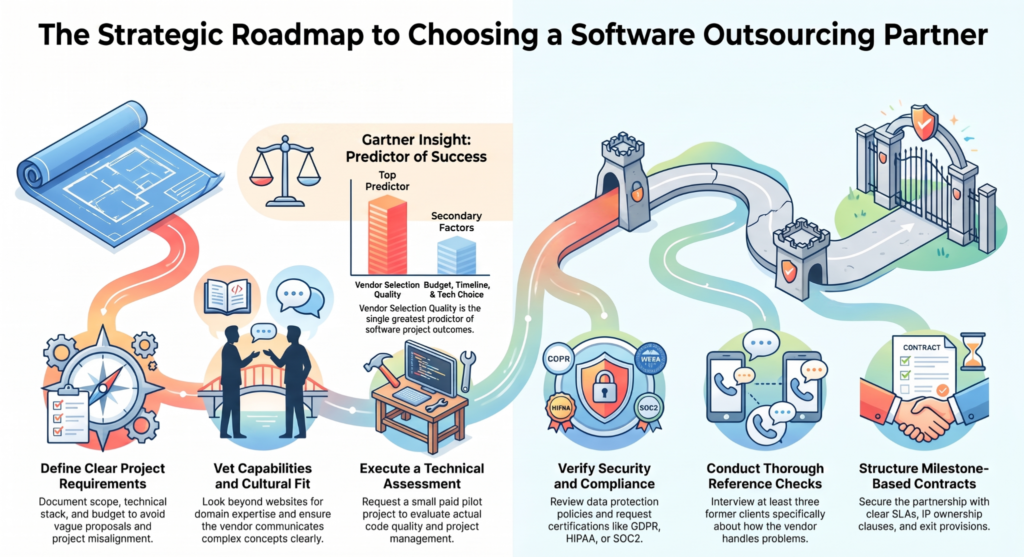
Choosing the right outsourcing partner requires a systematic evaluation process that goes beyond checking references and comparing rates. According to Gartner research, vendor selection quality is one of the top predictors of software project outcomes, more predictive than budget size, timeline, or technology choice.
Step 1
Define your requirements clearly. Before you talk to any vendor, document your project scope, technical stack, timeline, budget range, and must-have vs nice-to-have features. Vague requirements lead to vague proposals, and vague proposals lead to failed projects.
Step 2
Shortlist 3–5 vendors with relevant experience. Look for domain expertise, technical capabilities, and a track record with companies of similar size and complexity. Don’t just look at their website, ask for case studies and client references in your industry.
Step 3
Evaluate technical capability. Ask vendors to walk through their development process, testing approach, and quality assurance practices. Request a technical assessment or a small paid pilot project to evaluate code quality, communication, and project management.
Step 4
Assess cultural and communication fit. How well do they communicate? Do they ask good questions? Can they explain complex technical concepts clearly? Cultural alignment is often the difference between success and failure.
Step 5
Review their security and compliance posture. Ask about data protection, IP policies, access controls, and compliance with relevant regulations (GDPR, HIPAA, SOC2, etc.). Request to see their security certifications.
Step 6
Check references thoroughly. Talk to at least three current or former clients. Ask about communication, quality, timeliness, and how the vendor handled problems. Don’t just take the vendor’s word, verify. Start with a small project. Before committing to a large engagement, start with a smaller project or a pilot phase. This allows you to evaluate the partnership with minimal risk.
Step 7
Structure the contract carefully. Include clear SLAs, milestone-based payments, IP ownership clauses, confidentiality agreements, and exit provisions. Don’t assume standard contracts cover everything, negotiate what matters.
The best outsourcing partners adopt practices, like continuous delivery, automated testing, and robust monitoring. Ask potential partners about their deployment frequency, lead time, and change failure rate.
Vendor Evaluation Scorecard
| Criteria | Weight | Vendor A | Vendor B | Vendor C |
| Technical expertise | 20% | |||
| Domain/industry experience | 15% | |||
| Communication & cultural fit | 15% | |||
| Quality assurance practices | 10% | |||
| Security & compliance | 10% | |||
| Client references | 10% | |||
| Cost transparency | 10% | |||
| Scalability & flexibility | 5% | |||
| Contract terms (IP, exit) | 5% | |||
| Total Score | 100% |
Score each vendor 1–5 per criterion, multiply by weight, sum for total.
Outsourcing Readiness Assessment
Before you start looking for a partner, assess your own readiness:
| Question | Yes | No |
| Do you have clear, documented requirements? | ☐ | ☐ |
| Do you have internal technical leadership to manage the relationship? | ☐ | ☐ |
| Have you defined success metrics for the project? | ☐ | ☐ |
| Do you understand your budget and timeline constraints? | ☐ | ☐ |
| Have you considered IP and security implications? | ☐ | ☐ |
| Do you have a project manager or product owner available? | ☐ | ☐ |
| Are you prepared to invest time in knowledge transfer? | ☐ | ☐ |
If you answered “No” to 3+ questions: You’re not ready. Invest in preparation before engaging a partner.
Questions to Ask Before Signing
- What’s your development process? How do you handle code reviews, testing, and deployment?
- Who will be on my team? Can I interview them? What’s your retention rate?
- How often will we meet? What’s your response time for urgent issues?
- What’s your QA process? How do you measure and ensure code quality?
- What security certifications do you have? How do you protect client data?
- Who owns the code? What happens if we part ways?
- Can I speak to three current clients with similar projects?
- Is this fixed or time-and-materials? What’s not included?
- How do you handle scope changes? What’s the process?
- What’s the notice period? How do you transition knowledge and code?
Case Study: MediCore
MediCore, an Austin-based healthcare technology startup, was building a HIPAA-compliant patient engagement platform. The stakes were high: security breaches meant regulatory fines, and poor user experience meant low adoption.
Software Orca, expands its software development services in Austin that had built three prior HIPAA-compliant systems. The platform launched on time, passed its HIPAA audit on the first attempt, and achieved 95% patient satisfaction in early user testing.
7 Common Mistakes To Avoid When Outsourcing Software Development
The most common mistakes in software development outsourcing are: unclear requirements, choosing the cheapest vendor, poor communication, neglecting IP protection, skipping reference checks, underestimating management overhead, and treating outsourcing as a one-time transaction rather than a partnership.
A systematic literature review identified significant impeding factors that hinder successful software outsourcing projects, with relational and communication barriers consistently ranking among the most critical.
1. Vague or incomplete requirements
This is the single biggest cause of outsourcing failure. You can’t build what you haven’t defined. Vague requirements lead to scope creep, rework, and missed expectations. The vendor can’t read your mind, and they’ll interpret your vague requirements in ways you didn’t intend.
2. Choosing the cheapest vendor
The lowest hourly rate rarely results in the lowest total cost. Hidden costs, rework, and delays erase initial savings.
3. Poor communication and no overlap hours
When teams don’t overlap, blockers linger for days. This is the number one cause of outsourcing failure. A two-minute conversation becomes a 24-hour email thread. A blocker that would take five minutes to resolve in the office takes two days when the teams are on opposite sides of the world.
4. Neglecting IP protection
Without clear IP clauses, you risk losing ownership of your code and competitive advantage. If your vendor goes bankrupt, who owns the code? If they’re acquired by a competitor, what happens to your intellectual property?
5. Skipping reference checks
Vendors always show their best work. References show how they handle problems. A vendor with glowing case studies might still be a nightmare to work with. Talk to current and former clients. Ask about communication, quality, timeliness, and how the vendor handled problems.
6. Underestimating management overhead
Outsourcing doesn’t mean “set it and forget it.” You still need to manage the relationship, review deliverables, and make decisions. This is one of the most overlooked aspects of outsourcing.
7. No exit strategy
What happens if the partnership doesn’t work? Without transition plans and knowledge documentation, you’re locked in. Companies sign contracts with no plan for how to transition the work, or the knowledge. If they need to switch partners. 42% of outsourcing relationships fail because of communication problems, not technical problems. The technology works; the people don’t.
Conclusion
Software development outsourcing is a powerful strategic tool, but only when approached with clarity, discipline, and the right partner. The companies that succeed treat outsourcing not as a cost-saving tactic but as a strategic capability: they define clear requirements, choose partners based on total cost (not hourly rate), prioritize communication and timezone alignment, protect their IP, and actively manage the relationship.
FAQs
Is outsourcing software development cheaper than hiring in-house?
Usually, yes, especially for offshore and nearshore engagements, where regional hourly rates can run 30–70% lower than onshore hiring. However, true savings depend on scope stability and vendor quality, such as poor requirements or a mismatched vendor can erase the cost advantage through rework.
What is the difference between offshore and nearshore outsourcing?
Offshore outsourcing works with teams on a different continent, offering the largest cost savings but minimal time-zone overlap. Nearshore outsourcing works with teams in nearby regions with overlapping working hours, offering a more moderate cost saving but far easier real-time collaboration.
How do I protect my intellectual property when outsourcing?
Start with a clear contract specifying that all IP created belongs to you, not the vendor, and include confidentiality and data-handling clauses specific to your industry. Reputable vendors will readily agree to these terms; hesitation on IP ownership is a warning sign.
How long does an outsourced software project typically take?
Timelines vary widely by scope: a simple MVP often takes two to four months, while a complex, integration-heavy platform can take eight months to over a year. The single biggest driver of timeline overruns is unstable or incomplete requirements, not vendor speed.
What is staff augmentation, and how is it different from outsourcing?
Staff augmentation places vendor developers directly under your management and processes to fill a specific gap, while traditional outsourcing has the vendor manage their own process and deliverables against agreed milestones. Staff augmentation suits teams that already have a strong internal process; outsourcing suits teams that want the vendor to own delivery.
How do I evaluate an outsourcing vendor before signing a contract?
Focus on relevant portfolio experience, direct reference checks, documented QA and security practices, and clear contract terms around IP and exit/offboarding. A short paid trial engagement, when feasible, reveals more about fit than any proposal document.
What industries benefit most from software development outsourcing?
Startups needing fast MVP delivery without a large upfront engineering hire, and established businesses facing a specific talent gap (AI/ML, legacy modernization, compliance-heavy platforms) benefit most consistently. Regulated industries like healthcare and finance can still outsource effectively, but should weight vendor compliance experience heavily in selection.
What is the best country for software development outsourcing?
There is no single “best” country. It depends on your needs. Eastern Europe offers excellent quality at $28–80/hour. Latin America provides strong timezone alignment for US companies at $33–60/hour. Asia offers the lowest rates ($23–45/hour) but with larger timezone gaps. The best choice balances cost, quality, communication, and timezone.
Should I outsource software development?
Outsource if you need specialized skills you can’t find locally, want to accelerate development, or need flexible scaling without permanent hiring. Don’t outsource if software is your core competitive advantage, you lack internal technical leadership to manage the relationship, or you can’t clearly define your requirements.