Software development methodologies are structured frameworks that guide how teams plan, build, test, and deliver software. They also provide the structured delivery foundation behind successful custom software development services, helping organizations improve speed, quality, cost control, and risk management.
Choosing the right one affects delivery speed, cost, quality, and risk.
This guide explains the main types of software development methodologies, how they differ from models and approaches, and how CTOs and engineering leaders can select the right one for a given project.
Software Development Methodologies at a Glance
| If your project needs… | Recommended Methodology/Model | Best For |
| Frequent requirement changes and continuous feedback | Agile (Scrum or Kanban) | SaaS, startups, MVPs |
| Fixed scope, budget, and documentation | Waterfall | Government, enterprise, regulated projects |
| Continuous releases through automation | DevOps | Cloud platforms, SaaS, enterprise applications |
| High-risk or technically complex projects | Spiral | R&D, innovative products, large-scale systems |
| Strict verification and regulatory compliance | V-Model | Healthcare, medical devices, aerospace |
| Enterprise governance with iterative delivery | Hybrid | Banking, healthcare, large enterprises |
| Ongoing maintenance and changing priorities | Kanban | IT operations, support teams, internal applications |
What Is a Software Development Methodology and Why Is It Important?
A software development methodology is a defined framework that guides how a team plans, builds, tests, deploys, and maintains software. It sets the processes, roles, and workflows a team follows from the first requirement to the final release.
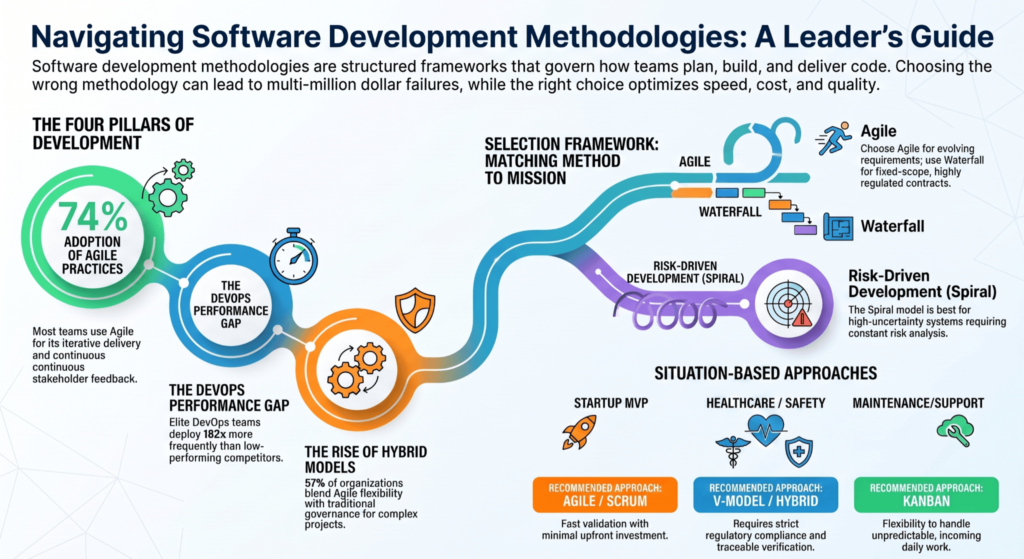
A clear methodology reduces this risk in several ways:
- Better project planning. Teams estimate timelines and resources against a known process instead of guessing.Many organizations begin with a structured discovery phase similar to MVP development consulting before selecting the right methodology.
- Improved collaboration. Defined roles and ceremonies give developers, testers, and stakeholders a shared rhythm.
- Risk reduction. Regular checkpoints catch scope and quality issues before they become expensive.
- Quality control. Built-in testing and review stages catch defects earlier in the cycle.
- Faster delivery. Predictable workflows cut down on the back-and-forth that slows releases.
Organizations that skip this step often pay for it later. Medical device maker Zimmer Biomet sued its implementation partner Deloitte for 172 million dollars after a new enterprise resource planning system finally went live in July 2024, following five delayed go-live dates spread across more than a year. They were barely able to ship products, issue invoices, or generate basic sales reports.
That example shows why methodology choice, including how rigorously a team validates readiness before a fixed go-live date, is a business decision, not just a technical preference.
Software Development Methodology vs Software Development Model vs Approach: What Is the Difference?
A software development approach is a philosophy, a methodology is how a team organizes work under that philosophy, and a model is the lifecycle structure the project follows. These three terms are related but describe different layers of decision-making.
Confusion happens because the terms get used interchangeably in job postings, vendor pitches, and casual conversation. In practice, each term answers a different question.
| Concept | Focus | Examples |
| Approach | The overall philosophy behind how software gets built | Agile, Lean |
| Methodology | How a team organizes day-to-day work | Scrum, Kanban, DevOps, Extreme Programming |
| Development Model | The structure of the project lifecycle | Waterfall, Spiral, Incremental, V-Model |
A single company can combine all three layers in one project. For example, a fintech company may operate under an Agile approach, run day-to-day work through a Scrum methodology, and structure release cycles using an Incremental development model. None of these choices conflict. They sit at different levels of the same delivery process.
The confusion between these terms usually comes from how vendors and training programs market certifications. A “Scrum Master” course teaches a methodology. A “SAFe” or “Waterfall project management” course teaches a model or a scaling framework.
Neither one is a complete answer on its own, which is why engineering leaders or software developers need to evaluate approach, methodology, and model as separate but connected decisions.
What Are the Main Types of Software Development Methodologies?
The main types of software development methodologies fall into four categories: Agile methodologies, traditional methodologies, DevOps methodologies, and hybrid methodologies. Each category solves a different combination of speed, structure, and risk.
- Agile methodologies (Scrum, Kanban, Extreme Programming) favor iterative delivery and continuous feedback.
- Traditional methodologies (Waterfall, V-Model, Spiral) favor sequential planning and heavy documentation.
- DevOps methodologies focus on automation and collaboration between development and operations teams.
- Hybrid methodologies combine Agile flexibility with the governance traditional models provide.
The right category depends on requirement stability, project risk, delivery speed expectations, compliance obligations, and how mature the team is with self-organizing work. A regulated healthcare project and a consumer mobile app rarely need the same methodology, even if both teams write code in the same language.
Methodology adoption has become close to universal across the software industry. According to the State of Agile Report, 74% of respondents said they use Agile practices somewhere in their software development lifecycle.
That figure signals how far Agile adoption has spread beyond its original home in small software teams, though many of these same organizations still rely on traditional or hybrid models for parts of their portfolio.
Agile Software Development Methodologies
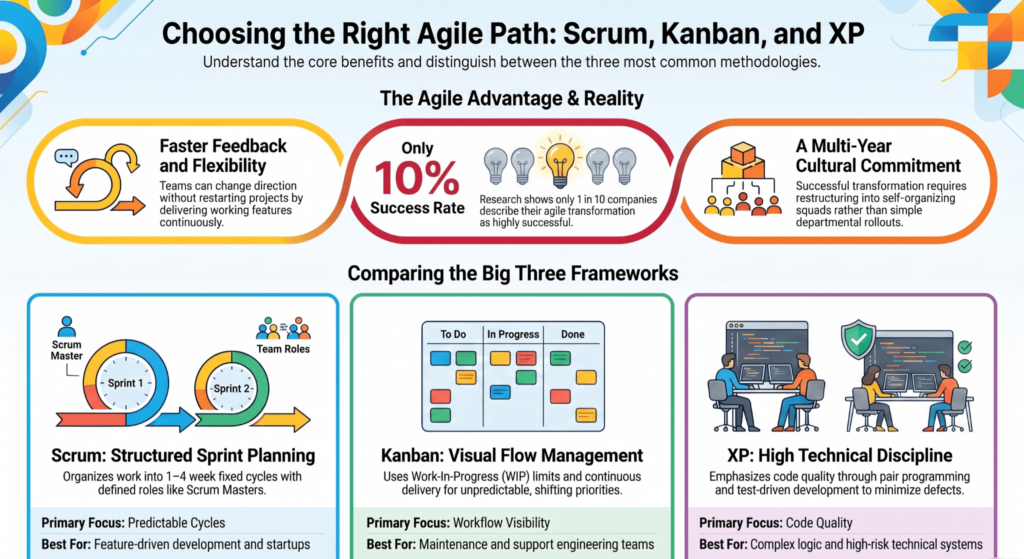
Agile software development methodologies organize work into short, iterative cycles with continuous feedback from users and stakeholders, instead of one long sequential plan. Agile is a family of methodologies, not a single framework, and Scrum, Kanban, and Extreme Programming are three of its most common implementations.
Modern Agile teams also use AI in software development to automate coding assistance, documentation, testing, and sprint planning while maintaining continuous delivery practices.
Benefits of Agile methodologies:
- Faster feedback loops between developers and users.
- Ability to change direction without restarting the project.
- Continuous delivery of working features instead of one final release.
- Higher team engagement through shared ownership of priorities.
Limitations of Agile methodologies:
- Harder to predict fixed scope, cost, and delivery date up front.
- Requires an available, decisive product owner.
- Can lose structure if teams skip planning and review ceremonies.
- Difficult to scale across many teams without added coordination.
Agile works better when requirements change frequently and teams need continuous feedback to validate direction. It works less well for fixed-scope, fixed-budget contracts where the client needs a guaranteed delivery date before work begins.
Agile transformation results vary widely by organization. Restructuring a company into self-organizing squads and tribes, moving away from traditional functional departments in marketing, IT, and product management, is a multi-year commitment rather than a single rollout.
McKinsey research involving more than 2,000 organizations found that only about 10% of companies that recently completed an agile transformation described it as highly successful, which is a useful reminder that adopting Agile methods requires sustained management commitment, not just a new team structure.
1. Scrum Methodology
Scrum is an Agile framework that organizes work into fixed-length sprints, typically one to four weeks, with defined roles, ceremonies, and artifacts to manage the backlog and track progress.
Scrum structures work around a few core elements:
- Sprint planning, where the team commits to a set of backlog items for the sprint.
- Product backlog, a prioritized list of features, fixes, and technical work.
- Scrum roles, including the product owner, scrum master, and development team.
- Sprint reviews and retrospectives, where the team demonstrates completed work and reflects on process improvements.
Strengths of Scrum:
- Predictable delivery cycles that stakeholders can plan around.
- Better product alignment through frequent review with the product owner.
Limitations of Scrum:
- Requires strong, available product ownership to keep the backlog healthy.
- Can become process-heavy if teams add ceremonies without removing anything.
A startup marketplace app uses Scrum to release features, measure feedback, and adjust priorities.
2. Kanban Methodology
Kanban is a visual workflow methodology that manages work through a board of columns representing process stages, with work-in-progress limits controlling how much a team takes on at once.
Kanban does not organize work into fixed sprints. Instead, it focuses on:
- Workflow visualization, showing every task’s current stage on a shared board.
- Continuous delivery, releasing work as soon as it is ready rather than batching it into cycles.
- Work-in-progress limits, capping how many tasks can sit in a stage at one time to prevent overload.
Strengths of Kanban:
- Flexible prioritization, since new work can enter the board without waiting for a sprint boundary.
- Clear workflow visibility for teams and stakeholders.
Limitations of Kanban:
- Less structured long-term planning compared with sprint-based methodologies.
Kanban fits maintenance teams, support engineering groups, and internal application teams where priorities shift daily and work arrives unpredictably rather than in planned batches.
The Kanban Report found that 87% of respondents said the Kanban method gave them a more effective way to manage work compared with whatever approach they used previously, which supports why operations-heavy teams often prefer it over sprint-based Agile frameworks.
A banking software team uses Kanban to manage changing priorities.
3. Extreme Programming (XP)
Extreme Programming (XP) is an Agile methodology built around technical discipline, using practices like test-driven development, pair programming, and continuous integration to keep code quality high under frequent change.
Test-driven development means writing an automated test before writing the code that satisfies it. Pair programming puts two developers at one workstation, one writing code and one reviewing in real time. Continuous integration merges code into a shared branch multiple times a day, with automated tests catching integration problems immediately.
XP works best on projects where code quality and technical risk matter more than ceremony, such as systems with complex business logic, long-lived codebases, or teams that need to move fast without accumulating defects.
Traditional Software Development Methodologies
Traditional software development methodologies follow a structured, sequential process built on detailed upfront planning, formal documentation, and controlled execution stages. Waterfall, V-Model, and Spiral are the three most widely used traditional models.
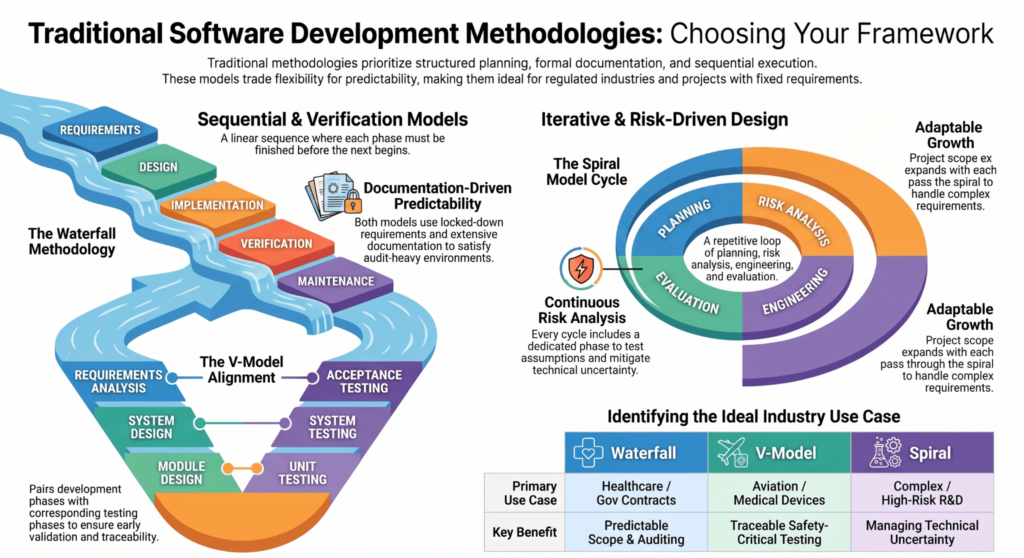
These methodologies work by locking down requirements early, then moving through distinct phases in order, with each phase producing documentation that feeds the next. This structure trades flexibility for predictability, which matters in regulated or contractually fixed environments.
1. Waterfall Methodology
Waterfall is a sequential software development methodology where each phase, requirements, design, development, testing, and deployment, must be completed before the next phase begins.
The process moves in a fixed order:
Requirements → Design → Development → Testing → Deployment
Strengths of Waterfall:
- Predictable scope, since requirements are locked before development starts
- Strong documentation at every phase, useful for audits and handoffs
Limitations of Waterfall:
- Expensive to accommodate requirement changes once development has started
Waterfall fits healthcare software requiring regulatory validation, government contracts, and other fixed-scope projects where the deliverable is defined in detail before a single line of code gets written.
2. V-Model Methodology
The V-Model extends Waterfall by pairing each development phase with a corresponding testing phase, so verification and validation activities are planned alongside design and coding rather than left until the end.
Each stage on the design side of the “V” has a matching stage on the testing side. Requirements analysis pairs with acceptance testing. System design pairs with system testing. Module design pairs with unit testing. This structure works well for safety-critical systems, such as medical device firmware or aviation software, where every requirement needs a traceable, verifiable test.
3. Spiral Methodology
The Spiral model is a risk-driven software development model that repeats a cycle of planning, risk analysis, engineering, and evaluation, expanding the scope with each pass through the cycle.
Every loop through the spiral includes a dedicated risk analysis phase, which sets it apart from Waterfall’s single pass through requirements and design. This makes Spiral a strong fit for complex projects with significant technical or market uncertainty, where teams need to test assumptions before committing to a full build.
DevOps Development Methodology
DevOps is a software delivery methodology that combines development and operations practices into one continuous workflow, using automation to move code from commit to production faster and more reliably.
DevOps depends on a set of connected practices working together:
- CI/CD (continuous integration and continuous delivery), automating the build, test, and release pipeline.
- Automated testing, catching defects before code reaches production.
- Infrastructure automation, provisioning environments through code instead of manual setup.
- Monitoring, giving teams real-time visibility into system health after deployment.
DORA’s State of DevOps report found that elite-performing teams, about 19% of respondents, deploy on demand, keep lead time for changes under one day, hold a change failure rate near 5%, and recover from failed deployments in under an hour. It also found elite teams deploy roughly 182 times more often than low performers, with 127 times faster lead times and more than 2,000 times faster recovery from failed deployments.
That gap illustrates why DevOps maturity, not just tool adoption, separates high-performing engineering organizations from the rest.
A SaaS company releasing frequent updates through automated pipelines is a common example of this discipline in practice: small, reversible changes and monitoring built into every release, rather than automation added on top of an already risky process.
Hybrid Software Development Methodologies
Hybrid software development methodologies combine Agile’s iterative flexibility with the governance, documentation, and phase gates of traditional models. Enterprises use hybrid approaches when neither pure Agile nor pure Waterfall fully fits their constraints.
Enterprises turn to hybrid methodologies for a few recurring reasons:
- Compliance requirements that demand documented sign-offs at specific milestones.
- Governance structures that require budget and scope approval before each phase.
- Large distributed teams that need more coordination than a single Scrum team provides.
A fintech platform is a common example of this pattern. Regulatory requirements demand audit trails, data handling documentation, and formal sign-offs, while product teams still want to ship features iteratively and respond to market feedback.
Hybrid delivery lets a fintech engineering group run iterative development sprints while maintaining the compliance documentation regulators expect at each release gate.
PMI research found 57% increase in the use of Hybrid approaches, which confirms that most real organizations blend approaches rather than choosing one methodology for every project.
What Are the Main Software Development Models?
Software development models define the structure of the project lifecycle, including planning, requirements gathering, design, development, testing, deployment, and maintenance. The main models are Waterfall, Iterative, Incremental, Spiral, and V-Model, and each one arranges these lifecycle stages differently.
Every model works through the same core SDLC stages, but the sequence, repetition, and flexibility of those stages differ significantly.
| Model | Process Structure | Advantages | Limitations | Best-Fit Scenario |
| Waterfall | Sequential, one pass through each phase | Predictable, well-documented | Costly to change scope mid-project | Fixed-scope, regulated projects |
| Iterative | Repeated cycles refining the same core system | Early working versions, easier to adjust | Can lose sight of full scope without discipline | Products where the core concept is known but details evolve |
| Incremental | System built and delivered in functional pieces | Usable software delivered earlier | Requires careful architecture to avoid rework | Projects that can be broken into independent modules |
| Spiral | Repeated risk-assessment cycles, expanding scope each loop | Strong risk management for complex projects | More overhead than simpler models | High-uncertainty, high-complexity systems |
| V-Model | Each development phase paired with a testing phase | Strong traceability and verification | Rigid, hard to change once testing plans are set | Safety-critical and compliance-heavy systems |
Software development models answer “in what order and structure does the work happen,” while methodologies answer “how does the team organize the day-to-day work within that structure.” A project can use an Incremental model while running Scrum ceremonies inside each increment, for example.
Agile vs Waterfall: What Is the Difference and Which One Should You Choose?
Agile delivers software in short iterative cycles with ongoing feedback, while Waterfall delivers software through a single sequential pass with requirements locked before development starts. The right choice depends on how stable your requirements are and how much documentation your project requires.
| Factor | Agile | Waterfall |
| Requirement stability | Expects change throughout the project | Assumes requirements are fixed upfront |
| Delivery style | Continuous, incremental releases | One final release at the end of the cycle |
| Documentation | Lightweight, focused on working software | Extensive, produced at every phase |
| Client involvement | Ongoing, through every iteration | Concentrated at the start and end |
| Best for | Products with evolving scope | Contracts with fixed scope and budget |
Choose Agile when requirements change frequently, when feedback from real users needs to shape the next iteration, and when the business values faster, smaller releases over one large launch.
Choose Waterfall when requirements are fixed and unlikely to shift, when documentation is critical for audits or handoffs, and when compliance obligations dominate the project’s constraints.
How Do You Choose the Right Software Development Methodology?
Choosing the right software development methodology depends on requirement stability, project risk, product stage, and operational needs. No single factor decides the choice on its own, so leaders need to weigh them together.
Requirement stability is the first signal. Fixed requirements point toward Waterfall. Requirements that change as the market or user feedback evolves point toward Agile.
Project risk matters next. High uncertainty, whether technical, market, or regulatory, points toward the Spiral model, which builds in dedicated risk analysis at every cycle.
Product stage shapes the decision further:
- MVP stage favors Agile or Scrum, since the goal is fast validation with real users.
- Growth stage favors Agile combined with DevOps, since the priority shifts to shipping reliably at higher volume.
- Enterprise stage often favors a hybrid model, balancing iteration with governance.
Operational needs round out the framework. Teams that need frequent releases benefit from DevOps practices. Teams focused on ongoing maintenance and unpredictable support requests often do better with Kanban.
Cost, timeline, team maturity, compliance obligations, and overall business goals should all factor into the final decision. A methodology that works well for a five-person startup team rarely scales cleanly to a 200-person engineering organization without adjustment.
These same factors also influence overall custom software development cost, making methodology selection an important budgeting decision.
Software Development Methodology Selection Framework
No single software development methodology fits every project. The right choice depends on matching the project’s situation, not its industry label, to the methodology best suited for that situation.
| Project Situation | Recommended Approach | Reason |
| Startup MVP | Agile / Scrum | Fast validation with minimal upfront investment |
| SaaS product | Agile + DevOps | Continuous delivery and frequent iteration |
| Healthcare software | Hybrid / V-Model | Regulatory compliance and verification requirements |
| Enterprise system | Hybrid | Governance and coordination across large teams |
| Maintenance and support | Kanban | Flexibility for unpredictable incoming work |
| High-risk or novel systems | Spiral | Structured risk management at every stage |
This table works as a starting point, not a final answer. A healthcare startup building an MVP, for example, may still lean Agile early on and shift toward a hybrid model once the product approaches regulatory submission.
Common Mistakes When Selecting a Software Development Methodology
The most common mistake organizations make is choosing Agile because it is popular, not because it fits the project’s actual requirements and constraints. Methodology choice should follow the project’s risk profile and business goals, not industry trends.
Other frequent mistakes include:
- Adding unnecessary processes. Teams bolt extra ceremonies, approvals, or documentation onto a methodology without removing anything, which slows delivery instead of improving it.
- Ignoring team capability. A methodology that assumes self-organizing, experienced teams will struggle with a group that is new to the practice.
- Optimizing speed over maintainability. Moving fast without investing in code quality or architecture creates technical debt that slows every future release.
Businesses also make costly mistakes by choosing off-the-shelf software when evolving workflows actually require a custom-built solution. Technical debt from a poorly matched methodology tends to show up in predictable ways:
- Higher maintenance costs as the codebase becomes harder to change safely
- Slower future releases as teams spend more time working around existing problems
- A growing refactoring burden that eventually requires a dedicated cleanup effort
Wrapping it Up
Software development methodologies solve different problems depending on a project’s requirements, risk, and business goals. Agile methodologies work well when requirements change and feedback drives direction. Traditional models fit fixed-scope, compliance-heavy projects. DevOps supports fast, reliable release cycles. Hybrid approaches balance flexibility with governance for larger organizations.
No single methodology fits every project. The right choice depends on requirement stability, project risk, compliance obligations, team maturity, and the business outcomes the project needs to deliver.
FAQs
What are the five software development methodologies?
The five most commonly cited methodologies are Scrum, Kanban, Extreme Programming (XP), Waterfall, and DevOps. Each organizes team workflow differently, from short iterative sprints to continuous automated delivery pipelines.
What are the 7 models of SDLC?
The seven commonly referenced SDLC models are Waterfall, Iterative, Incremental, Spiral, V-Model, Agile, and Big Bang. Each defines a different structure for moving through planning, design, development, testing, and deployment.
What are the 4 types of agile methodology for software development?
The four widely used Agile methodologies are Scrum, Kanban, Extreme Programming (XP), and Lean. All four follow Agile principles but differ in structure, ceremonies, and how strictly they control work in progress.
What is a methodology in software development?
A methodology is a defined framework for how a team plans, builds, tests, and delivers software, including its roles, workflows, and collaboration practices. It provides consistency across a project’s lifecycle.
What’s Agile vs Scrum?
Agile is a broad philosophy for iterative software delivery. Scrum is one specific framework that implements Agile principles through sprints, defined roles, and regular reviews. Scrum is Agile, but Agile is not only Scrum.
What are application development methodologies?
Application development methodologies are the same core software development methodologies, Agile, Waterfall, DevOps, and hybrid, applied specifically to building end-user applications such as web, mobile, or desktop software.
What are system development methodologies?
System development methodologies refer to structured approaches for building larger, often enterprise-scale systems, and typically draw on the same models, Waterfall, Spiral, Incremental, and Agile, depending on the system’s complexity and regulatory context.