Mobile app development outsourcing means hiring an external company or independent team to design, build, test, or maintain a mobile app. The work happens outside your internal staff. Businesses use it to reach specialized skills faster than they could hire for. It also lets them add or remove development capacity as a project changes shape.
This article covers three things you need before signing a contract. What outsourcing actually delivers. How the engagement process should run, from scoping to handoff. And how outsourcing costs actually get calculated, not just what they roughly range from.
Mobile App Development Outsourcing (Quick Summary)
- Cost: $25–$220+/hour depending on region; $30,000–$200,000+ per project.
- Models: Fixed-price, T&M, dedicated team, or staff augmentation. Each shifts cost predictability and client control.
- Geography: Onshore (costly, easy), nearshore (balanced), offshore (cheaper, more process).
- Process: Define scope → decide what to outsource → shortlist partners → verify the actual team → agree on commercial and ownership terms → establish delivery controls → launch and handoff.
- Risk: Mostly governance failure, not location. Mitigate with clear contracts, code reviews, and client-controlled repositories.
What Is Mobile App Development Outsourcing?
Mobile app development outsourcing is the practice of contracting an external company or independent professionals to build a mobile app. It covers part of the work or all of it. It’s a form of application development outsourcing applied specifically to iOS and Android products.
Outsourcing can cover a single phase, such as UI design, backend integration, or QA. It can also cover an entire product build, from concept to app store release. Or it can mean something narrower: adding external developers into a company’s existing team and processes, rather than handing over a self-contained project to an outside vendor.
These are different arrangements with different management implications. The distinction matters because it determines who owns the delivery risk.
Companies outsource mobile app development mainly because building the right in-house team is slow and expensive. Engineering, QA, DevOps, and platform-specific specialists all need to be hired, trained, and retained. That process rarely matches the pace most product timelines demand.
What are the Benefits of Mobile App Development Outsourcing?
Mobile app development outsourcing gives companies access to specialized talent and adjustable team capacity. It removes the fixed cost and lead time of building an internal engineering department. The core benefit is optionality: teams can be formed, scaled, or wound down in weeks, not months.
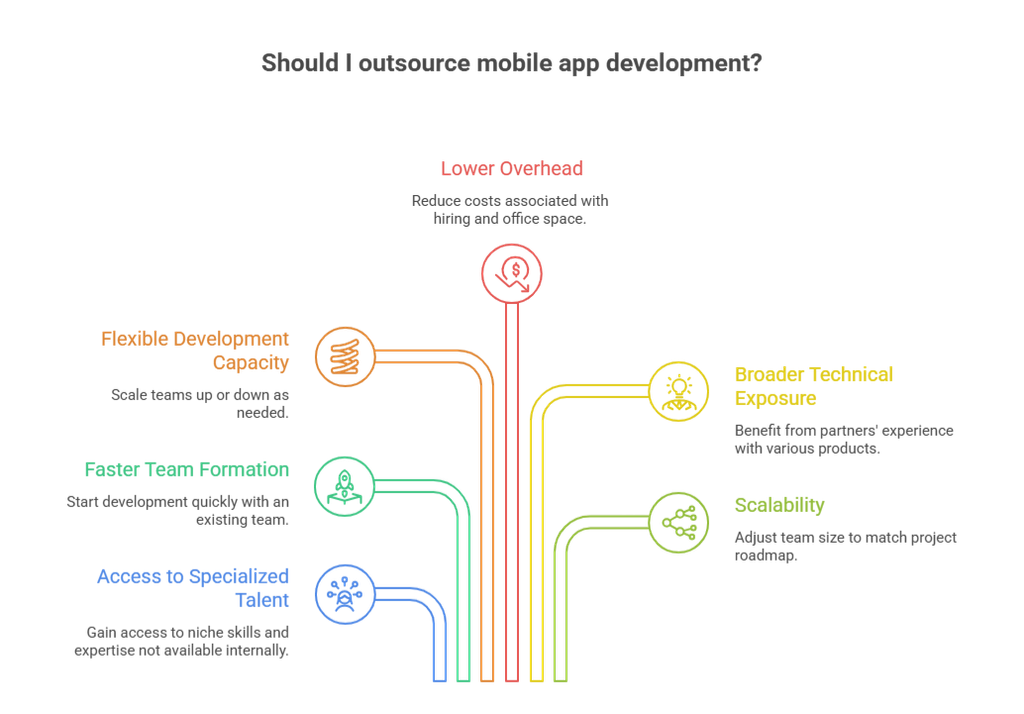
The most consistent advantages fall into a few categories:
1. Access to specialized talent
Native iOS/Android engineers, platform-specific QA specialists, and niche skills such as AR/VR, payments infrastructure, or healthcare app development are easier to source externally than to hire for a single product.
2. Faster team formation
An outsourcing partner with existing staff can typically start work in weeks. A direct-hire cycle for a comparable in-house team usually takes months.
3. Flexible development capacity
Teams can expand for a launch push, then contract once the product reaches steady-state maintenance.
4. Lower hiring and operating overhead
Recruiting, benefits, office space, and tooling costs shift to the vendor. Total overhead can drop, though not always total project cost.
5. Broader technical exposure
Partners who have shipped many mobile products bring pattern recognition. They already know what breaks at scale, what App Store review tends to flag, and what integration patterns work for logistics app development.
6. Ability to scale up or down
Engagement size can track the product roadmap instead of a fixed org chart.
Outsourcing does not automatically make a project cheaper or better. The outcome depends on how the engagement is structured, the seniority of the assigned team, how clearly the scope is defined, and how actively the client manages delivery.
Deloitte’s Global Business Services Survey polled over 2,000 organizations. It found that roughly half of businesses using outsourced or shared-service delivery models achieved more than 20% cost savings.
The report credits that outcome to strong governance, not to outsourcing on its own. A well-run outsourced team with a vague scope will still underperform a smaller in-house team with a clear brief.
Mobile App Development Outsourcing Models
There are three primary ways to structure app outsourcing engagements for a mobile product: project-based outsourcing, a dedicated development team, and staff augmentation. Project-based outsourcing splits further into fixed price and time and materials.
Each option shifts cost predictability, client control, and flexibility in a different direction.
1. Project-Based Outsourcing
Project-based outsourcing uses one of two pricing structures. Fixed price sets a total cost for a defined scope, agreed upfront. It works well when requirements are stable and well-documented, such as a defined MVP feature set.
The vendor prices in a fixed set of deliverables, and the client gets budget certainty. It works poorly when scope is likely to change, since every material change requires a formal, often slow, change order.
2. Time and Materials (T&M)
Bills for actual hours worked against an estimated range, rather than a fixed total. It suits projects where requirements will evolve, which describes most real products. Scope can shift without renegotiating the contract each time.
The trade-off is that the client carries more budget risk and needs to actively manage the backlog to control spend.
3. Dedicated Development Team
A dedicated team is a group of external developers who work almost exclusively on one client’s product on an ongoing basis. The client sets product direction; the vendor handles employment and day-to-day management.
This model suits companies with a long-term roadmap rather than a single deliverable. Continuous iteration and ongoing maintenance benefit from a team that keeps full context on the codebase over time.
Client involvement tends to run higher than in fixed-price engagements, since the team effectively functions as an extension of the internal product organization.
4. Staff Augmentation
Staff augmentation places individual external developers inside a client’s existing team and processes. The client retains full technical and managerial control. The vendor mainly supplies vetted personnel and handles employment logistics.
This model fits companies that already have engineering leadership and delivery processes in place, and simply need more hands. It’s a common route when a company wants to outsource Android development specifically. An iOS-heavy team needing Android expertise or telemedicine app development capability can add it this way, without restructuring how the team already works.
| Model | Best suited for | Cost predictability | Client control |
| Fixed price | Defined scope | High | Medium |
| Time and materials | Changing scope | Lower | High |
| Dedicated team | Long-term roadmap | Medium | High |
| Staff augmentation | Existing engineering team | Medium | Very high |
For an MVP with a tightly defined feature set and a fixed budget, fixed-price project outsourcing is usually the better starting point. For a product expected to evolve past launch, a dedicated team or T&M arrangement avoids the friction of renegotiating scope every sprint.
Onshore, Nearshore, or Offshore: Where Should You Outsource Mobile App Development?
Onshore outsourcing means contracting a company in the same country. Nearshore means a nearby country in a similar or overlapping time zone. Offshore means a distant country, often with a large time-zone gap but typically lower rates.
None of the three is universally better. The right choice depends on budget, required communication overlap, and how mature the client’s own delivery processes already are.
1. Onshore
Onshore development offers the easiest real-time communication and the fewest cultural or regulatory frictions, at the highest relative cost. It suits projects with heavy compliance requirements or close day-to-day collaboration needs.
For a Texas-based company, hiring a mobile app development company in Dallas keeps the team in the same time zone and legal framework while avoiding the need for interstate travel.
2. Nearshore
Nearshore development trades some cost savings for time-zone overlap, often with closer cultural alignment than offshore options. It’s a common middle-ground choice for teams that want cost efficiency without a large communication lag, a company in Dubai might use app development services in Austin, or look further south to Mexico for nearshore rates.
3. Offshore
Offshore development typically offers the lowest hourly rates and access to the largest global talent pools. The trade-off is reduced real-time overlap, which puts more weight on documentation and process discipline.
The talent pool argument isn’t abstract. GitHub’s Octoverse report found that India added over 5.2 million developers to the platform in last year alone, about 14% of all new accounts.
GitHub projects that India will reach 57.5 million developers by 2030. No single onshore or nearshore market currently matches that scale of engineering supply growth.
| Factor | Onshore | Nearshore | Offshore |
| Cost | Higher | Moderate | Often lower |
| Time-zone overlap | High | Usually high | Varies |
| Communication | Easier | Usually easier | Requires stronger processes |
| Talent pool | Regional | Regional | Global |
Geographic strategy isn’t fixed either. Half of the organizations running outsourced or shared-service operations are actively planning to expand their delivery footprint into new locations. Today’s cost and talent map should be revisited periodically, not treated as permanent.
Location and engagement models are independent decisions, and conflating them is a common planning mistake. A company can pair offshore location with fixed-price outsourcing for a well-defined MVP.
It can pair nearshore locations with a dedicated team for an evolving product. Or it can pair onshore location with staff augmentation to plug a specific skills gap inside an existing team. The engagement model governs pricing and control.
Geography governs cost, overlap, and talent depth. A poorly scoped project will struggle regardless of where the team sits.
How to Outsource Mobile App Development
Outsourcing mobile app development follows a specific sequence. Define the scope, decide what to hand off, and shortlist partners on real technical criteria.
Then agree on commercial and ownership terms, put delivery controls in place, and manage the handoff deliberately. Skipping steps, especially technical verification and ownership terms, is where most outsourcing problems start.
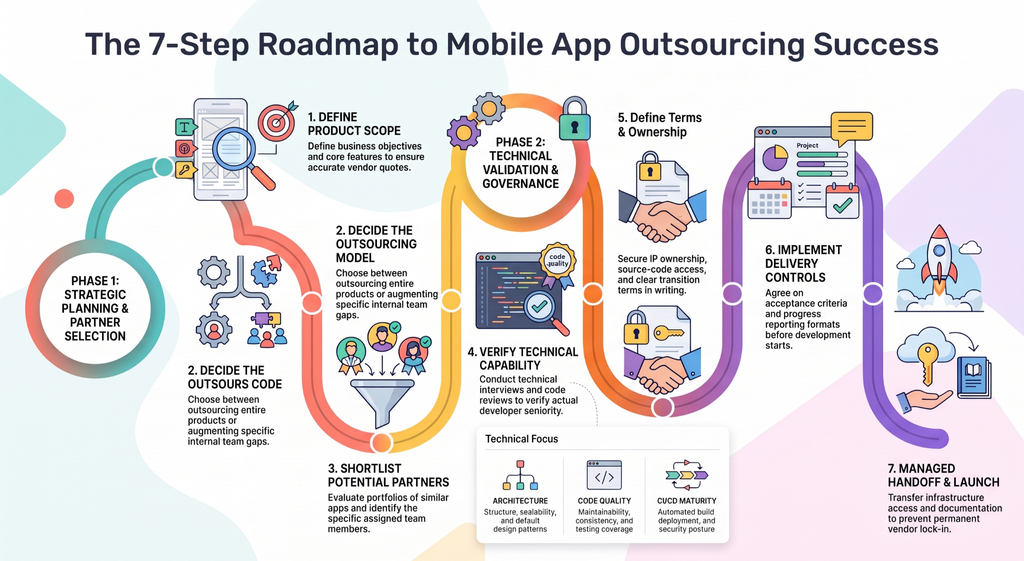
1. Define the Product Scope
Before contacting any vendor, define the business objective and the target users. Define the target platforms, the core feature set, and required integrations too. Decide whether the initial build is an MVP or a fuller product.
The scope document doesn’t need to be exhaustive. It needs to be specific enough that two different vendors would estimate similar effort from reading it. Vague scope is the single most common cause of quote variance and later disputes.
2. Decide What to Outsource
Decide whether to outsource the entire product, a specific development stage such as design, backend, or QA, a specialized capability the internal team lacks, or simply additional developer capacity.
This decision should follow from what the internal team already does well. A company with strong iOS app development expertise but no Android experience might consider android app development outsourcing, either as a discrete project or as staff augmentation to build in-house Android capability over time.
3. Shortlist Potential Partners
Evaluate candidates on relevant experience, technical capability, team structure and stability, delivery approach, and communication practices. A portfolio of similar apps is a stronger signal than a generic capabilities list.
Ask directly who will work on the project, not just who the sales team represents.
4. Verify the Team and Technical Capability
This step is where outsourcing decisions are most often rushed. Before signing, verify who will actually work on the project and at what seniority level. Check their relevant platform experience, the vendor’s default architecture approach, code quality standards, testing practices, security posture, and CI/CD maturity.
A short technical interview with the assigned lead developer surfaces more useful signal than any sales presentation. So does a review of a redacted code sample from a comparable past project.
| Check | What to examine |
| Architecture | Structure and scalability |
| Code | Maintainability and consistency |
| Testing | Automated and manual coverage |
| Dependencies | Third-party libraries and risks |
| Documentation | Technical and operational knowledge |
| CI/CD | Build and deployment process |
Testing coverage deserves particular scrutiny. According to Capgemini, based on a global survey of 2,000 executives, nearly half still lack AI/ML expertise. That gap shows up just as often inside outsourced engagements as internal ones. Ask a vendor how test findings actually change what ships. That’s a more useful diagnostic than a checklist of tools.
5. Agree on Commercial and Ownership Terms
Before development starts, the contract should cover pricing structure, scope boundaries, milestone definitions, and the process for handling change requests. It should also cover intellectual property ownership, source-code access during and after the engagement, who owns the code repository, confidentiality obligations, and exit or transition terms.
IP and code ownership should never be left implicit. Many outsourcing contracts default to work-for-hire ownership for the client, but this varies by jurisdiction and must be stated, not assumed.
6. Establish Delivery Controls
Delivery controls separate a project that stays on track from one that drifts. At minimum, agree on acceptance criteria for each milestone, a defined development cadence, a code review process, an explicit QA process, regular progress reporting in a format the client can actually evaluate, and a clear escalation path.
Set these controls before development starts, not once problems appear.
7. Launch and Handoff
Handoff covers deployment to app stores, complete technical and operational documentation, and transfer of infrastructure access such as cloud accounts, API keys, and credentials. If the team is disengaging, it should also include structured knowledge transfer sessions and a clear agreement on post-launch maintenance and support.
A project that ends without documented handoff often leaves the client dependent on the original vendor. That’s a practical form of vendor lock-in that has nothing to do with contract terms.

How Much Does Mobile App Development Outsourcing Cost?
Mobile app development outsourcing rates commonly range from about $25–$220+ per hour depending on region, seniority, and provider type. A typical project can range from roughly $30,000 for a relatively simple app, such as a basic wellness app or a similar to Yoga-Go app cost, to $200,000+ for a complex product with advanced backend systems, real-time features, or AI.
Mobile App Outsourcing Rates by Region
| Region | Typical hourly range |
| North America | $100–$220+ |
| Western Europe | $80–$180 |
| Eastern Europe | $30–$100 |
| Latin America | $40–$80 |
| South Asia | $15–$70 |
| Southeast Asia | $20–$40 |
Rates vary by developer seniority, agency vs. freelancer, technology, and engagement structure. These are not the guaranteed project prices.
What Determines the Mobile App Outsourcing Total Cost?
- App complexity and feature count
- iOS, Android, or both
- Backend and API requirements
- Third-party integrations
- Team size and seniority
- Development location
- QA, DevOps, and project management requirements
- Fixed-price, T&M, dedicated team, or staff augmentation model
How Is the Mobile App Development Outsourcing Cost Calculated?
Estimated cost = estimated hours × blended hourly rate + additional project costs
For example, 1,200 hours × $50/hour = $60,000 in development effort before separately priced infrastructure, third-party services, or other exclusions.
Two vendors can therefore quote very different totals for the same app because their estimated hours, team composition, technical approach, QA coverage, and inclusions differ.
What Should You Check Before Accepting a Quote?
Confirm whether the proposal includes UI/UX, development, QA, DevOps, project management, integrations, deployment, security testing, bug fixes, and post-launch support. Compare the assumptions behind each estimate rather than choosing the lowest hourly rate.
That’s the precise version. It answers “How much?” immediately, gives the reader usable numbers, then explains the calculation without turning the cost section into another 600-word chapter.
Risks of Mobile App Development Outsourcing
The main risks in mobile app development outsourcing are scope creep, inconsistent code quality, communication breakdowns, cost overruns, vendor lock-in, loss of institutional knowledge, and inadequate QA. Each has a specific, known mitigation.
| Risk | Mitigation |
| Scope creep | Clear scope + change control |
| Poor code quality | Technical review + code reviews |
| Communication gaps | Defined communication cadence |
| Cost overruns | Transparent estimates and assumptions |
| Vendor lock-in | Client-controlled code and documentation |
| Knowledge loss | Continuous knowledge transfer |
| Weak QA | Testing throughout development |
Security risk deserves specific attention because it compounds the others. IBM’s Cost of a Data Breach Report found that third-party vendor and supply chain compromise was the second most common breach vector. It appeared in roughly 15% of breaches studied and cost an average of $4.91 million. These breaches also took longer to detect and contain than any other category, at nearly nine months on average.
An outsourced development relationship that shares credentials, repository access, or production data without clear controls inherits this exposure directly.
Outsourcing risk is primarily a governance and execution problem, not a geography problem. A poorly managed onshore engagement carries most of the same risks as a poorly managed offshore one. The mitigations above apply regardless of where the team sits.
Software Orca: A Mobile App Outsourcing Partner Worth Evaluating
Software Orca works as a mobile app and software development outsourcing partner across the fixed price, dedicated teams, and staff augmentation.
The team focuses on native and cross-platform builds for iOS and Android, with technical evaluation, delivery governance, and code ownership handled the way this article recommends: clearly, in writing, before development starts.
If you’re shortlisting outsourcing partners using the criteria above, apply the same technical due diligence checklist to Software Orca that you would to any vendor. Ask who will work on your project. Review a code sample. Confirm ownership terms before signing.
Conclusion
Choosing where to outsource matters less than most guides suggest. What determines outcomes is selecting the right engagement model for the project’s scope volatility, defining that scope precisely before contacting any vendor, and verifying the assigned team’s actual technical capability rather than the vendor’s marketing.
Secure clear code and IP ownership in writing. Maintain active delivery governance throughout the build. Get those pieces right, and geography becomes a cost and talent-pool decision, not a risk decision.
Related Guides
Custom App Development Cost in Dallas — A financial and strategic breakdown of local developer hourly rates, project complexity tiers, and budgeting formulas in the Dallas market.
Logistics App Development — How to design, code, and deploy custom fleet management systems, live driver tracking tools, and dispatch engines.
Healthcare App Development — A guide to engineering secure medical applications, detailing HIPAA compliance standards, patient portals, and EHR integrations.
Telemedicine App Development — How to build virtual care platforms featuring encrypted WebRTC video streaming, e-prescriptions, and HIPAA-compliant scheduling workflows.
Yoga-Go App Cost — A financial and technical overview of what it costs to build a subscription-based fitness app with custom workout engines and video streaming.
What Is AR Zone App — An explainer on Samsung’s camera-based augmented reality toolkit, covering features like AR Emoji, AR Doodles, and on-device AR processing.
FAQs
How long does it take to outsource a mobile app development project?
Timelines depend on scope, but a defined MVP typically takes 3 to 5 months from kickoff to launch with an outsourced team. Partner selection and technical vetting can add another 2 to 4 weeks before development starts. Complex apps with custom backends take longer.
What is the difference between outsourcing and offshoring?
Outsourcing means hiring an external company or team, regardless of location. Offshoring specifically means moving work to a distant country, often for lower cost. Outsourcing can be onshore, nearshore, or offshore. Offshoring is one geographic form outsourcing can take, not a separate model.
Should I hire a freelance developer or an outsourcing company for my app?
Freelancers can work well for small, well-defined tasks with low coordination needs. An outsourcing company suits projects needing multiple skill sets, delivery accountability, and continuity if one person leaves. Most full mobile app builds outgrow a single freelancer quickly.
How involved do I need to be during an outsourced development project?
More involvement generally produces better outcomes, especially early on. At minimum, expect to review milestones, approve scope changes, and join regular progress calls. Dedicated team engagements typically need more client input than fixed-price projects with a locked scope.
Will an outsourcing company sign an NDA before I share my app idea?
Most established outsourcing companies will sign a mutual NDA before discussing project details. It’s standard practice and reasonable to request before any technical conversation. If a vendor resists signing one, treat that as a warning sign.