Choosing a software development company comes down to one thing: verifying that a vendor’s claims survive scrutiny before you pay for them. A confident pitch, a long client list, and a modern-looking website all tell you a company is good at marketing itself.
None of them tell you whether its engineers can build your product, estimate it honestly, or still answer your calls eight months after launch.
That gap between “sounds credible” and “is credible” is where most bad hires happen. A vendor can look excellent on a sales call and still be the wrong technical partner, and by the time that becomes obvious, you’ve usually already spent the budget.
This guide is built as a due-diligence sequence, 15 questions that each remove one layer of that uncertainty, so you’re evaluating evidence instead of confidence by the time you sign anything.
How to Choose a Software Development Company
To choose a software development company, define your requirements, shortlist vendors with relevant experience, verify the actual delivery team, evaluate the technical approach, compare engagement models and proposals, check references, and confirm ownership and security terms before signing anything.
Every step in that sequence exists to convert a claim into evidence.
A vendor can tell you it has “10+ years of experience” or “expert developers.” Those statements cost nothing to say. What separates a company you should hire from one you shouldn’t is whether its claims survive scrutiny: can it name the specific systems it built, explain the architecture decisions it made, and produce a client who will confirm the story?
Some buyers arrive at this stage still undecided on a more basic question, custom vs off-the-shelf software, and it’s worth resolving that first: if an existing platform already covers 80% of your requirements at a fraction of the cost, a custom build may be the wrong starting point regardless of which vendor you pick.
According to PM World Journal, large software projects have consistently found that only around a third succeed on time, on budget, and with the agreed scope, while roughly one in five are cancelled outright, a pattern that has barely moved in over a decade of tracking.
That’s not a reason to be paranoid. It’s the reason this process exists.
What Should You Look for in a Software Development Company?
Look for verifiable evidence across eight areas: relevant technical experience, the actual people who will do the work, a defensible architecture approach, a real development and QA process, security practices, transparent pricing, clear IP and infrastructure ownership, and client references who confirm the vendor’s version of events.
Each of these criteria only matters if you can attach evidence to it.
“Relevant experience” means naming the systems built and the problems solved, not the number of years in business.
“The actual team” means the resumes of the people assigned to your contract, not the team photo on the website.
“Transparent pricing” means a proposal that shows what’s included and excluded, not just a total.
Vague claims are the default output of a sales process; specific, checkable answers are what a technically capable vendor produces without being asked twice.
15 Questions to Ask a Software Development Company Before Hiring
These 15 questions are built on each other, moving from “has this company ever solved a problem like mine” through the people, the architecture, the process, the commercial terms, and finally the judgment of the people you’d be trusting with the build.
A vendor can survive question 1 and fail question 2. A vendor that survives all fifteen has given you something a portfolio never can: evidence.
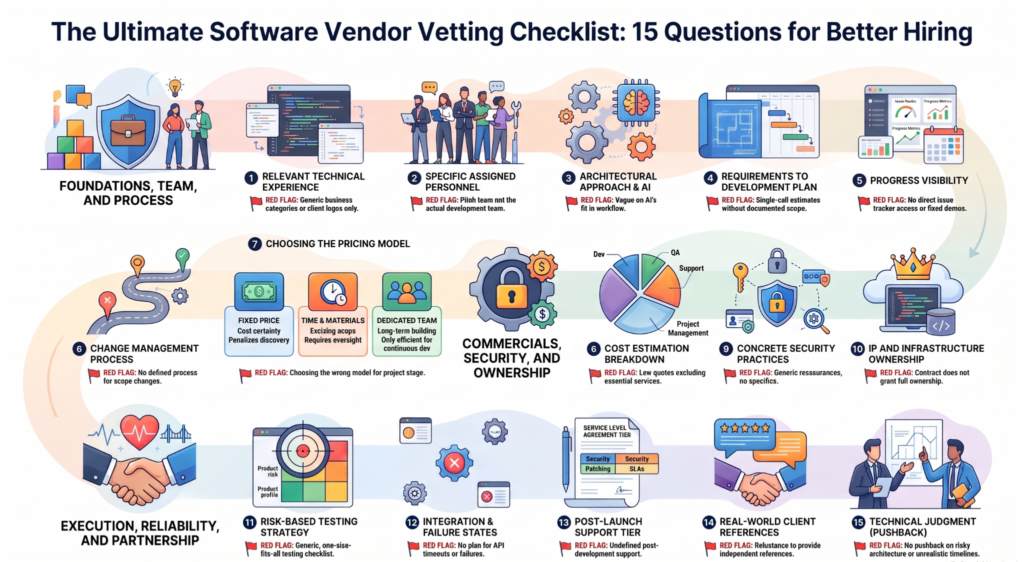
1. Have You Built Something Similar to What We’re Planning?
Relevant experience matters more than portfolio size, and “relevant” needs to be broken down. A vendor might have built dozens of e-commerce sites but never handled real-time inventory sync with a legacy warehouse system, which is the part of your project that actually carries risk.
Ask what the vendor built (not just what the client’s business does), what the assigned team specifically contributed, which technical problems came up mid-project, what architecture they used, and what measurable outcome resulted.
Red flag: The company shows client logos and screenshots but its representatives can’t describe a single technical problem their engineers actually solved on those projects.
2. Who Will Actually Build Our Product?
The team that runs the sales call is frequently not the team that writes the code. Ask for the names, roles, and relevant project history of the technical lead, architect, developers, QA engineer, and DevOps engineer who will be assigned to your contract, and ask whether any of the work will go to subcontractors.
You want this in writing before signing, because “we have senior architects” is meaningless if your project gets staffed by whoever is available that month.
Senior people appear throughout the pitch process, then the actual kickoff call introduces a different, less experienced team.
Red flag: Senior people appear throughout the pitch process, then a different, less experienced team shows up at kickoff.
3. How Would You Approach Our Architecture and Technology Stack?
Ask which parts of the proposed architecture could become bottlenecks as traffic, data volume, or integration load increases, and listen for whether the answer is specific to your product or generic.
The latest AI in software development stats has made expectations concrete. According to Stack Overflow 84% of developers already use or plan to use AI tools in their day-to-day work, and 76.6% of engineering organizations report using AI somewhere in their development workflow.
A vendor who can’t describe specifically where AI fits into its own process, and where it deliberately doesn’t (code review, security-sensitive logic, anything requiring business-context judgment), is behind that baseline, not ahead of it.
When Tech Transit, a logistics company that had been searching for a software development company in Dallas to fix a growing customer-experience problem, brought this project to Software Orca, the technical constraints weren’t optional extras, they were the project.
Tech Transit’s delivery-tracking experience relied on cryptic status codes that customers couldn’t interpret, which was driving up support tickets and repeat calls asking “where’s my package.”
Over roughly three months, the team rebuilt the experience in React Native and Node.js with a custom database architecture, integrated it against Tech Transit’s existing legacy logistics systems, and added real-time map tracking, plain-English status updates, contextual push notifications, and an AI chatbot that walked customers through claim submissions step by step.
None of that was achievable by picking a trendy stack. It required an architecture that could sit on top of systems the company already depended on, translate their output into something a customer could actually read, and still ship on a tight timeline.
That’s the kind of constraint-driven reasoning worth listening for when a vendor describes its own approach.
Red flag: The vendor answers with a list of technologies instead of a list of decisions, or claims AI “handles” a part of the build without explaining what a human still reviews.
4. How Do You Turn Requirements Into a Development Plan?
Ask what software development methodologies the team actually runs day to day (Scrum, Kanban, something hybrid) and how that shows up in practice, not just as a slide in the sales deck.
Ask what assumptions and scope boundaries are documented before estimation starts. A vendor that can quote you a number after a 20-minute call skipped this step, and the number is a guess dressed up as an estimate.
Red flag: A vendor quotes you a number after a single 20-minute call. That’s not an estimate, it’s a guess with a decimal point.
5. How Will We Know Whether the Project Is Actually Progressing?
Ask about release cadence, whether you’ll see working demos on a fixed schedule, how the backlog is tracked, and whether you get direct visibility into the issue tracker. Push back on statements like “we’re 80% done” unless the vendor can define what that percentage is measured against. Percent-complete without a defined denominator is not a status update, it’s a placeholder.
Red flag: Progress updates are consistently vague, verbal, and unaccompanied by anything you can actually look at.
6. What Happens When Requirements Change?
A credible vendor explains, before you sign, how a mid-project change affects scope, cost, architecture, timeline, and whatever else was already built around the assumption you’re now changing.
This isn’t about whether change is allowed. It always is. It’s about whether the vendor has a defined process for pricing and sequencing that change instead of absorbing it silently (which usually means it resurfaces later as slipped deadlines) or treating every change as an excuse to renegotiate the entire contract.
Red flag: The vendor either refuses to entertain any scope change once signed, or agrees to everything with no discussion of cost or timeline impact.
7. How Do We Choose Between Fixed Price, Time & Materials, and Dedicated Team?
None of these is universally better. Fixed Price gives cost certainty but penalizes discovery mid-project, since any change becomes a formal (and often expensive) amendment. Time & Materials accommodates evolving scope but requires more active client oversight to control cost.
A Dedicated Team behaves less like a vendor engagement and more like hiring an extension of your own team, which only makes sense if you plan to keep building past the first release.
Ask the vendor which model they’d recommend for your specific project stage and why, and be skeptical of a company that pushes one model regardless of what you describe.
Red flag: The vendor recommends Fixed Price for a project you’ve already described as exploratory, or Dedicated Team for a narrowly scoped one-off build. Either suggests the model is chosen for the vendor’s convenience, not your project.
8. How Do You Estimate the Cost, and What’s Included?
Custom software development cost varies enormously based on scope, integration complexity, security requirements, and team seniority, which is exactly why two proposals with different totals aren’t necessarily telling you which vendor is more expensive.
A lower quote for the same documented scope, deliverables, and team seniority is genuinely cheaper. A lower quote that excludes QA, support, or half the integrations you asked about is a different, smaller project wearing a lower price tag.
This applies whether the proposal comes from an established firm offering custom software development services in Houston or a team based somewhere else entirely; the geography tells you less than the line items do.
Red flag: A quote arrives within 24 hours of a short intro call, or a total is presented with no breakdown by deliverable.
9. What Security Practices Will Protect Our Application and Data?
Ask concretely about authentication and authorization design, encryption in transit and at rest, how secrets and credentials are managed, how dependencies get checked for known vulnerabilities, who has access to production systems, and whether the team runs any vulnerability testing before release.
A vague answer like “we take security seriously” isn’t an answer. A specific one names tools, processes, and who owns each step.
Red flag: Every security question gets the same generic reassurance, with no mention of a specific practice, tool, or person responsible.
10. Who Owns the Source Code, Intellectual Property, Accounts, and Infrastructure?
The contract should state, explicitly, that you own the source code, repositories, documentation, cloud accounts, credentials, and design assets produced during the engagement, with access transferred to you rather than left in the vendor’s name.
This has to be settled before development starts, not negotiated after launch when the vendor is the only party holding the keys. A company that builds your product inside its own AWS account, under its own admin credentials, with no plan to transfer ownership, has created a dependency that functions as leverage in every future conversation about price or scope.
That’s vendor lock-in, and it’s avoidable with one clause in the contract.
Red flag: The vendor is vague or evasive about who holds admin access to production infrastructure once the project ships.
11. How Do You Test the Software Before Release?
Testing should match your product’s actual risk profile and architecture, not a generic checklist applied identically to every project.
A simple internal tool may not need the same testing investment as a payment flow. Ask which categories apply to your specific project: unit tests, integration tests, automated regression tests, performance testing under expected load, security testing, and a defined acceptance process before you sign off on a release.
A vendor claiming every category applies to every project either hasn’t thought about your specific risk profile or is padding the proposal.
Red flag: The vendor claims every testing category applies equally to every project, which usually means it hasn’t thought through your specific risk profile.
12. How Will You Handle Integrations and Third-Party Dependencies?
A credible vendor thinks through API authentication, rate limits, retry logic, failure states, data synchronization, how they’ll handle a third-party API changing its version, and ongoing monitoring, not just whether the integration technically works during a demo.
“The API works” is a demo-day observation. “The API works, and here’s what happens when it times out, rate-limits us, or ships a breaking change six months from now” is a production-readiness statement.
The gap between those two answers is usually where post-launch incidents come from.
Red flag: The vendor describes an integration only in terms of the happy path, with no answer for what happens when the third-party service fails or changes.
13. What Happens After Launch?
Post-launch responsibilities (bug fixes, monitoring, security patching, infrastructure management, incident response) should be defined in the contract before development ends, not negotiated after the team has already moved on to its next client.
Success should also be measured by what happens after launch, not just whether the features shipped. On the Tech Transit project of Software Orca, the redesigned tracking experience and AI-assisted claims flow produced a 60% reduction in support tickets within the first month, along with a significant increase in customer satisfaction.
That’s a project-specific result, not an industry benchmark, and it’s worth stating plainly: the number that matters isn’t “did we ship the features,” it’s “did the thing we shipped change the underlying problem.”
Red flag: The proposal has no defined post-launch support tier, or support is described only as “available if needed” with no SLA.
14. Can I Speak With Clients Who Built Projects Similar to Ours?
Recent, relevant references are stronger evidence than generic testimonials pulled from a website.
- When you get a reference call, ask specific questions:
- Did the vendor deliver what was promised?
- Were the original estimates realistic, or did the project run long?
- How did they handle problems when something went wrong?
- Who actually did the work?
- How was communication throughout the engagement?
- Would you hire this company again for a similar project?
A reference who answers in specifics is confirming a real relationship. A reference who only offers enthusiasm without detail may not have worked closely enough with the team to know.
Red flag: The vendor can only offer written testimonials or references it screens and schedules itself, with no way to reach a client independently.
15. What Would Make You Tell Us NOT to Build This Way?
A strong technical partner pushes back on requirements, architecture, timelines, or technology choices when doing so protects the product, even when that risks losing the sale.
This is the question that separates a technical partner from an order-taking vendor. A company that agrees with every requirement you bring to the table isn’t necessarily being agreeable, it may simply not be exercising judgment.
Ask it directly, in the sales process, before you’ve signed anything: “What about this plan concerns you?” The answer, or the absence of one, tells you more about the company’s technical judgment than anything in its portfolio.
Red flag: The vendor has no pushback, no concerns, and no questions about your plan at any point in the sales process.
How Do You Evaluate and Compare Software Development Companies?
Compare vendors against identical, weighted criteria and actual evidence, not against how confident each one sounded in its pitch.
| Evaluation Area | Suggested Weight |
| Relevant technical experience | 20% |
| Technical approach and architecture | 15% |
| Actual delivery team | 15% |
| Development and QA process | 10% |
| Security and risk management | 10% |
| Communication and transparency | 10% |
| Pricing and commercial fit | 10% |
| Client references | 5% |
| Post-launch support | 5% |
This is a practical evaluation framework, so adjust the weights based on what matters most for your project (a compliance-heavy product should weight security higher; a fast-moving MVP might weight communication and delivery model higher).
Score each vendor against the actual evidence gathered from questions 1 through 15, not against your impression of the sales call.
The broader software development outsourcing market, estimated at roughly $618 billion globally in 2026 according to Mordor Intelligence, means you have real choice among vendors across geographies and price points.
That choice is only useful if you’re scoring it consistently.
How Do You Vet a Software Company’s Technical Experience and Client References?
Verify experience by cross-checking four things against each other: the comparable projects the vendor describes, the specific people who worked on them, the technical challenges they solved, and whether a reference from that project confirms the same story independently.
The synthesis matters more than any single check. A vendor might have a real client reference but the reference worked with a different team than the one being proposed for your project. Or the case study is real but the “architecture decisions” described are actually decisions the client’s internal team made, with the vendor just executing.
Ask the reference the same technical questions you asked the vendor, then compare the answers. Consistency across independent sources is the strongest signal you’ll get before signing a contract.
What Are the Red Flags When Hiring a Software Development Company?
The strongest warning signs are unrealistic timelines with no technical justification, suspiciously low estimates, an unknown or unconfirmed delivery team, little or no discovery before a number gets quoted, portfolio claims that can’t be verified, an inability to explain architecture decisions, vague security answers, unclear source-code ownership, everything described as “easy,” and a vendor who agrees with every requirement without pushback.
A single red flag doesn’t automatically disqualify a company; every vendor has an off day on a call.
A pattern of two or three of these, especially unverifiable claims combined with commercial vagueness, is a reason to slow down and dig deeper before signing anything.
How Should You Compare Software Development Quotes?
Normalize competing proposals to the same scope before comparing price. Line up each vendor’s deliverables, stated assumptions, exclusions, proposed team composition, timeline, QA coverage, infrastructure costs, integration work, and post-launch support side by side.
Two quotes that look $30,000 apart might represent identical scope with different team seniority, or they might represent completely different projects because one vendor quietly excluded QA and infrastructure. You can’t tell which without the line-item breakdown, so ask every finalist for one in the same format.
Wrapping it Up
The strongest candidate isn’t automatically the cheapest, the biggest, the fastest to respond, or the one with the longest technology list. It’s the vendor whose specific claims held up when you checked them against actual evidence: the people, the architecture reasoning, the references, the ownership terms.
Before hiring a software development company, ask how it knows it can build it, who will actually build it, how the work gets verified along the way, what happens when an early assumption turns out to be wrong, who owns the resulting software, and what evidence proves this company has solved a comparable problem before.
Those answers, not the pitch deck, are what you’re actually hiring.
FAQs
How long does a typical custom software project take, from first call to launch?
Most mid-sized custom builds run three to nine months from signed contract to launch, with discovery and requirements work at the front adding several more weeks before development starts. Timelines stretch fastest when integrations with legacy systems are involved, since those often surface unknowns that weren’t visible during the sales process.
Should I hire a local company, an offshore company, or a nearshore team?
Location affects hourly rate and time-zone overlap more than it affects quality; strong and weak engineering teams exist in every region. The more useful question is whether the specific team assigned to your project has done comparable work, communicates on your schedule, and can be reached directly, regardless of where they’re based.
Is it better to hire a software development company or a freelancer?
A freelancer can be the right call for a narrow, well-defined task with low integration risk. A company is generally the better fit once the project needs multiple disciplines at once (architecture, QA, DevOps, project management) or needs to survive one person being unavailable. If a single freelancer is proposing to single-handedly cover all of those roles, ask how continuity works if they’re out for two weeks.
How many companies should I actually get proposals from?
Three to five is usually enough to see real variation in approach and pricing without drowning in comparison work. Fewer than three makes it hard to tell whether a quote is reasonable; more than five mostly adds sales calls without adding new information.
Should I sign an NDA before sharing project details?
For most early conversations, a standard mutual NDA is reasonable and most established companies will sign one without pushback. Treat unusual resistance to a straightforward NDA as a minor flag worth asking about directly, since it’s a low-cost request for a vendor confident in its own practices.
What should be in the contract that isn’t already covered above?
Beyond scope, price, and ownership, look for a defined change-request process, named points of contact on both sides, an acceptance process for each milestone, a warranty period for post-launch bug fixes, and an exit clause describing what happens to code, credentials, and documentation if either party ends the engagement early.